







Question: Exercise 3. [25 Marks] Consider a 64-bit computer with a simplified memory hierarchy. This hierarchy contains a single cache and an unbounded backing memory. The
![Exercise 3. [25 Marks] Consider a 64-bit computer with a simplified](https://dsd5zvtm8ll6.cloudfront.net/si.experts.images/questions/2024/09/66f3e7c0ad134_60866f3e7c01e002.jpg)
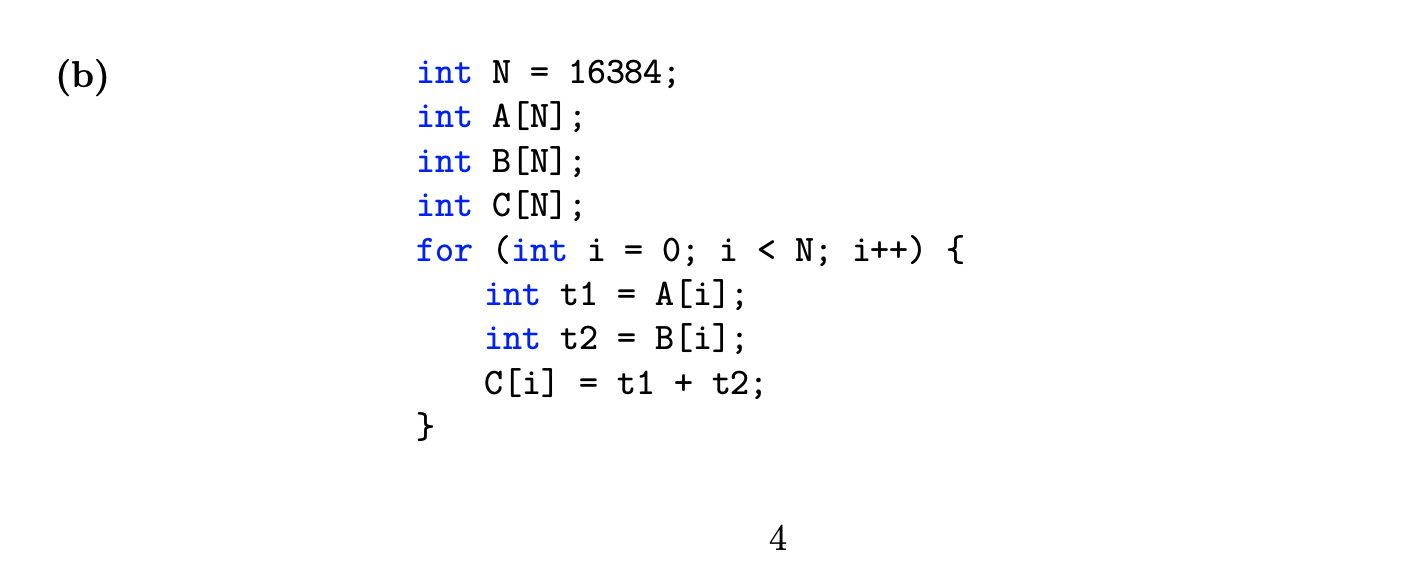
Exercise 3. [25 Marks] Consider a 64-bit computer with a simplified memory hierarchy. This hierarchy contains a single cache and an unbounded backing memory. The cache has the following characteristics: 2-way associative, Least-Recently-Used replacement policy. Write-through, Write allocate. Cache blocks are 4 words each. . The cache has 64 sets. . . Consider the following code fragments written in the C programming language to be executed on the described computer. Assume that: the cache is initially empty; only the arrays are stored in cache/memory; the arrays are cache-aligned (the beginning of an array aligns with the beginning of a cache block); arrays are contiguious in memory (e.g. B[0] immediately follows A [N-1]); every memory access results in either a cache hit or cache miss. an int is 64 bits. . . . For each code fragment, determine the following (show your workings and explain why!): (i) The number of cache misses. (ii) The cache miss rate. (iii) The type of cache miss (cold, capacity, conflict) that occurs most frequently. = (b) int N 16384; int A[N]; int B[N]; int C[N]; for (int i 0; i
Step by Step Solution
There are 3 Steps involved in it

Get step-by-step solutions from verified subject matter experts
 Study Help