







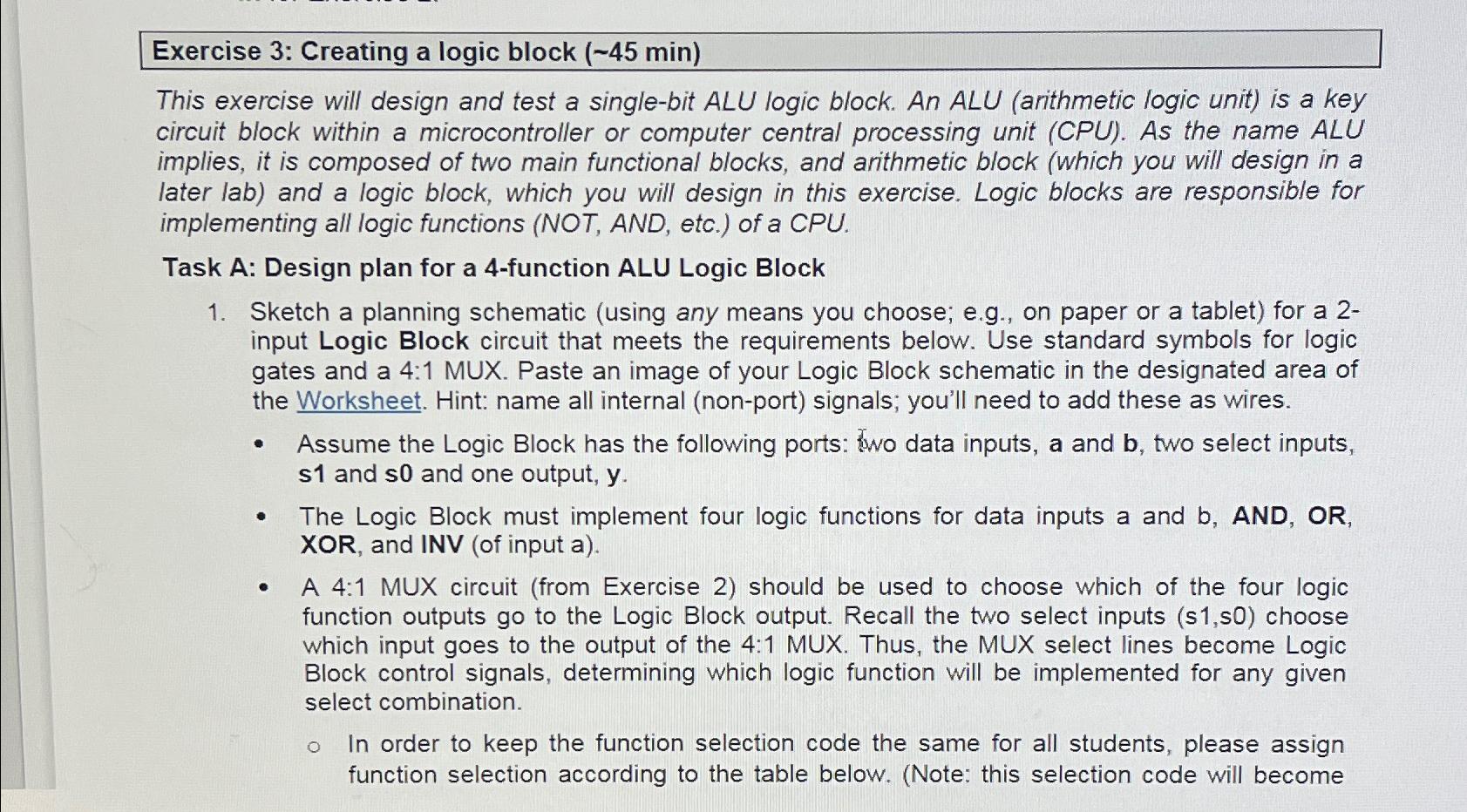
Question: Exercise 3 : Creating a logic block ( 4 5 min This exercise will design and test a single - bit ALU logic block. An
Exercise : Creating a logic block min
This exercise will design and test a singlebit ALU logic block. An ALU arithmetic logic unit is a key circuit block within a microcontroller or computer central processing unit CPU As the name ALU implies, it is composed of two main functional blocks, and arithmetic block which you will design in a later lab and a logic block, which you will design in this exercise. Logic blocks are responsible for implementing all logic functions NOT AND, etc. of a CPU.
Task A: Design plan for a function ALU Logic Block
Sketch a planning schematic using any means you choose; eg on paper or a tablet for a input Logic Block circuit that meets the requirements below. Use standard symbols for logic gates and a : MUX. Paste an image of your Logic Block schematic in the designated area of the Worksheet. Hint: name all internal nonport signals; you'll need to add these as wires.
Assume the Logic Block has the following ports: Iwo data inputs, a and two select inputs, s and and one output,
The Logic Block must implement four logic functions for data inputs a and b AND, OR XOR, and INV of input a
A : MUX circuit from Exercise should be used to choose which of the four logic function outputs go to the Logic Block output. Recall the two select inputs choose which input goes to the output of the : Thus, the MUX select lines become Logic Block control signals, determining which logic function will be implemented for any given select combination.
In order to keep the function selection code the same for all students, please assign function selection according to the table below. Note: this selection code will become
Step by Step Solution
There are 3 Steps involved in it
1 Expert Approved Answer
Step: 1 Unlock

Question Has Been Solved by an Expert!
Get step-by-step solutions from verified subject matter experts
Step: 2 Unlock
Step: 3 Unlock
 Study Help