Question: EXERCISE 3.2 Top Team Role Play LO 3.4 In groups of 3, choose an organizational change with which you are familiar, perhaps in your current
EXERCISE 3.2 Top Team Role Play
LO 3.4
In groups of 3, choose an organizational change with which you are familiar, perhaps in your current employment or in an organization about which you have recently been reading. If neither of those options works, then for the purposes of this exercise, invent an organization and a change initiative.
Now revisit table 3.1, Images of Change and Understanding the Pressures. Each person in your group must choose one of those images of managing change and will play that role.
Your group is now in a senior management board meeting. You are discussing an agenda item at the request of the chairperson of your board, who wants to know why the organization is going through the change that you have identified.
Debate how you will respond to the chairpersons request, with members of your group (board) playing their role based on the change management image that they have selected.
When you have decided how you are going to respond to the chairs request, consider the following questions:
Did one of your images better explain the rationale for change than the others, and why?
On reflection, what criteria did you use for making this judgment with regard to the comparative advantage of a particular image?
Is there an image with which you personally have a particular affinity or preference? Why? What would it take for you to change that preference?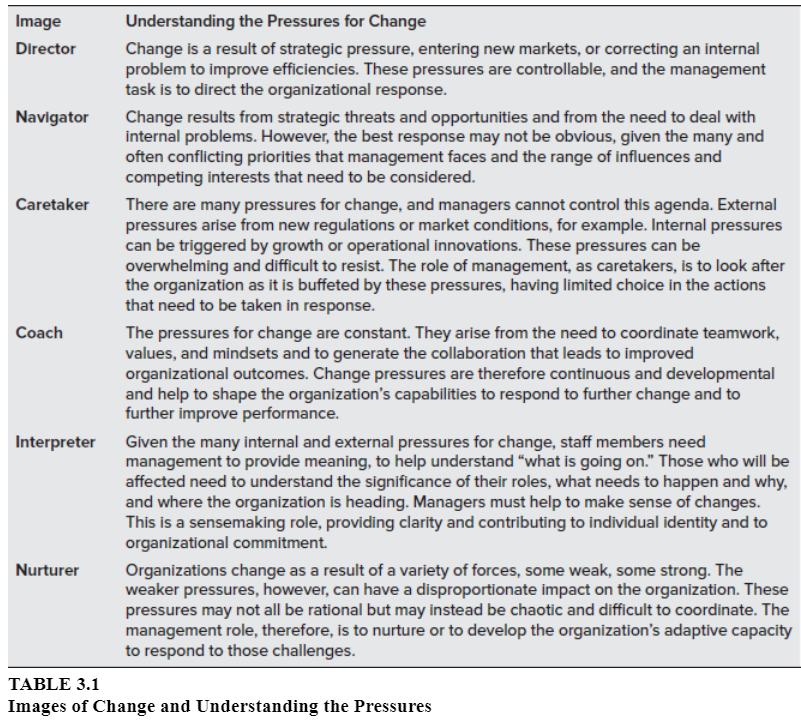
Image Understanding the Pressures for Change Director Change is a result of strategic pressure, entering new markets, or correcting an internal problem to improve efficiencies. These pressures are controllable, and the management task is to direct the organizational response. Navigator Change results from strategic threats and opportunities and from the need to deal with internal problems. However, the best response may not be obvious, given the many and often conflicting priorities that management faces and the range of influences and competing interests that need to be considered. Caretaker There are many pressures for change, and managers cannot control this agenda. External pressures arise from new regulations or market conditions, for example. Internal pressures can be triggered by growth or operational innovations. These pressures can be overwhelming and difficult to resist. The role of management, as caretakers, is to look after the organization as it is buffeted by these pressures, having limited choice in the actions that need to be taken in response. Coach The pressures for change are constant. They arise from the need to coordinate teamwork, values, and mindsets and to generate the collaboration that leads to improved organizational outcomes. Change pressures are therefore continuous and developmental and help to shape the organization's capabilities to respond to further change and to further improve performance. Interpreter Given the many internal and external pressures for change, staff members need management to provide meaning, to help understand "what is going on." Those who will be affected need to understand the significance of their roles, what needs to happen and why, and where the organization is heading. Managers must help to make sense of changes. This is a sensemaking role, providing clarity and contributing to individual identity and to organizational commitment. Nurturer Organizations change as a result of a variety of forces, some weak, some strong. The weaker pressures, however, can have a disproportionate impact on the organization. These pressures may not all be rational but may instead be chaotic and difficult to coordinate. The management role, therefore, is to nurture or to develop the organization's adaptive capacity to respond to those challenges. TABLE 3.1 Images of Change and Understanding the Pressures









 Study Help