







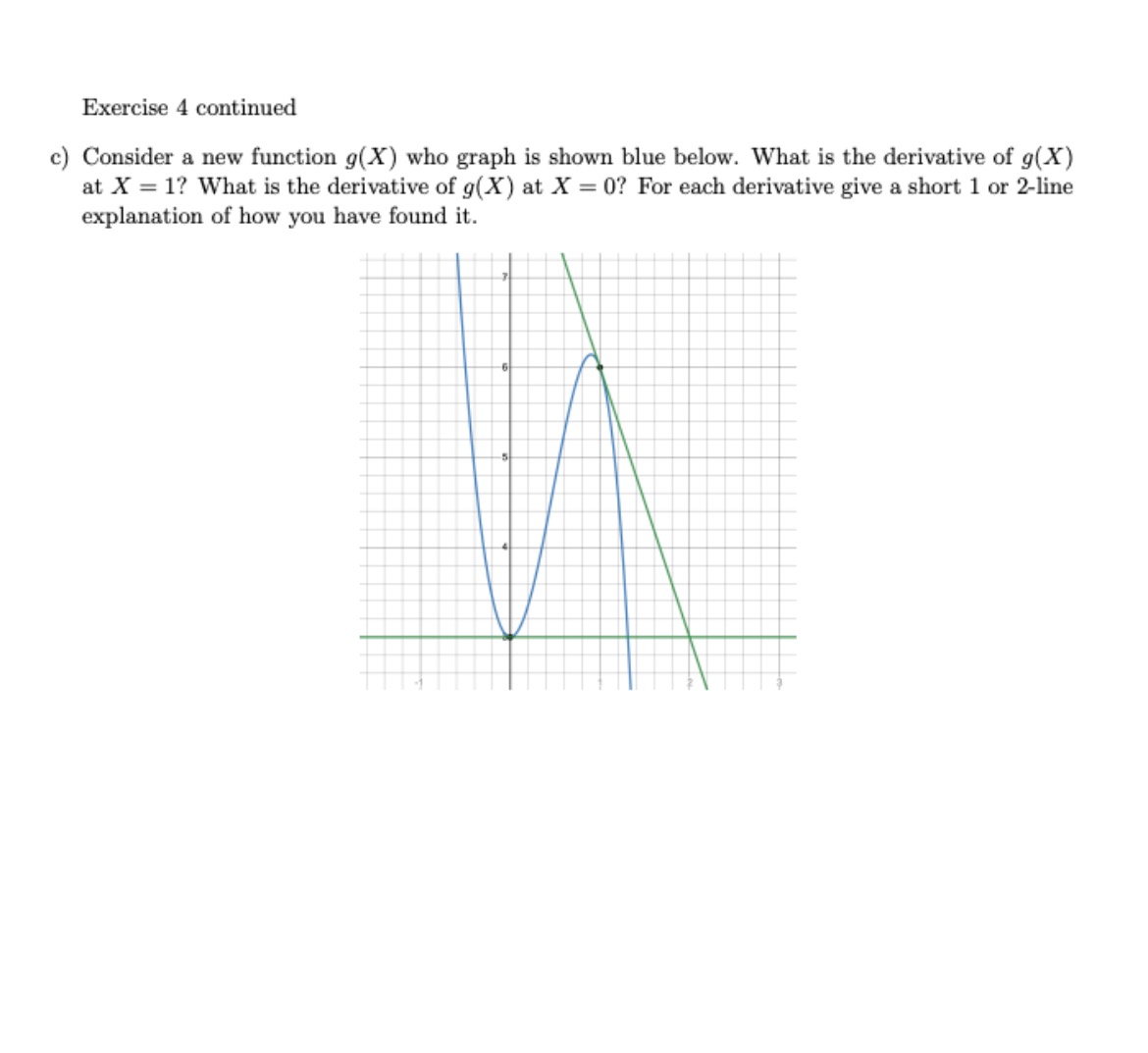
Question: Exercise 4 continued e) Consider a new function 9(X) who graph is shown blue below. What is the derivative of 9(X) at X = 1?
![For each derivative give a short 1 or 2-]ine explanation of how](https://s3.amazonaws.com/si.experts.images/answers/2024/06/66781dc00b08d_96766781dbfe02db.jpg)
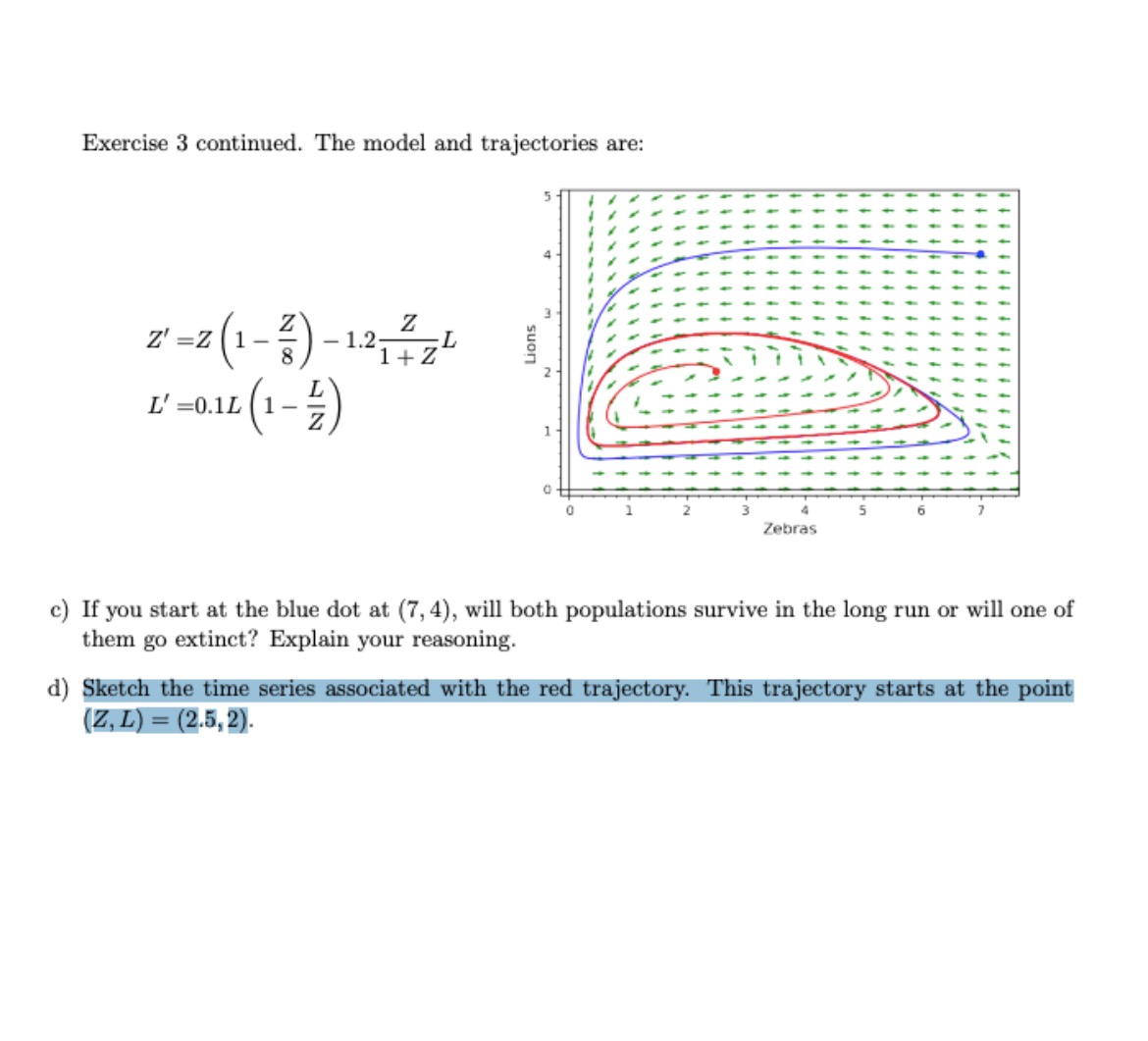
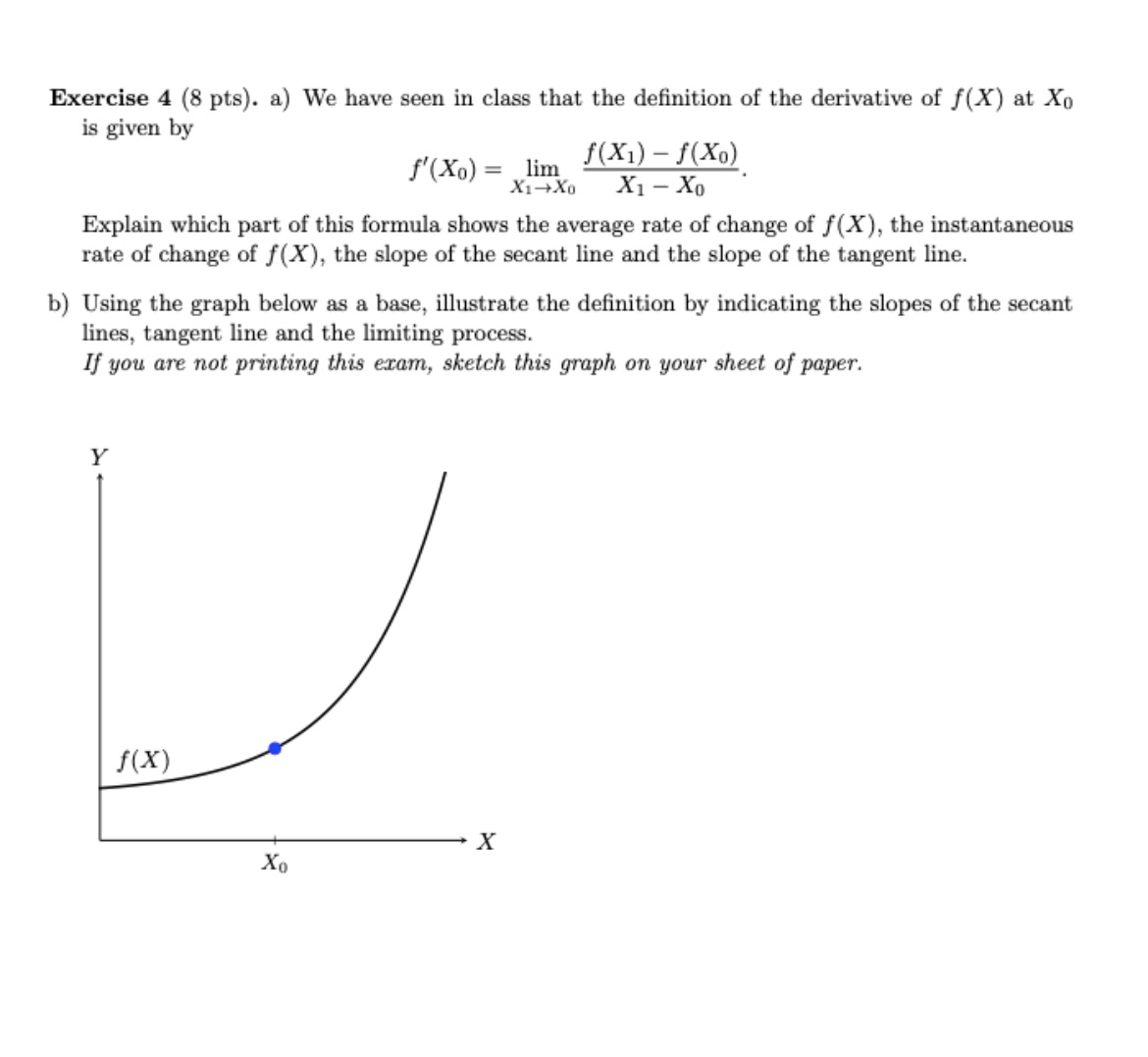
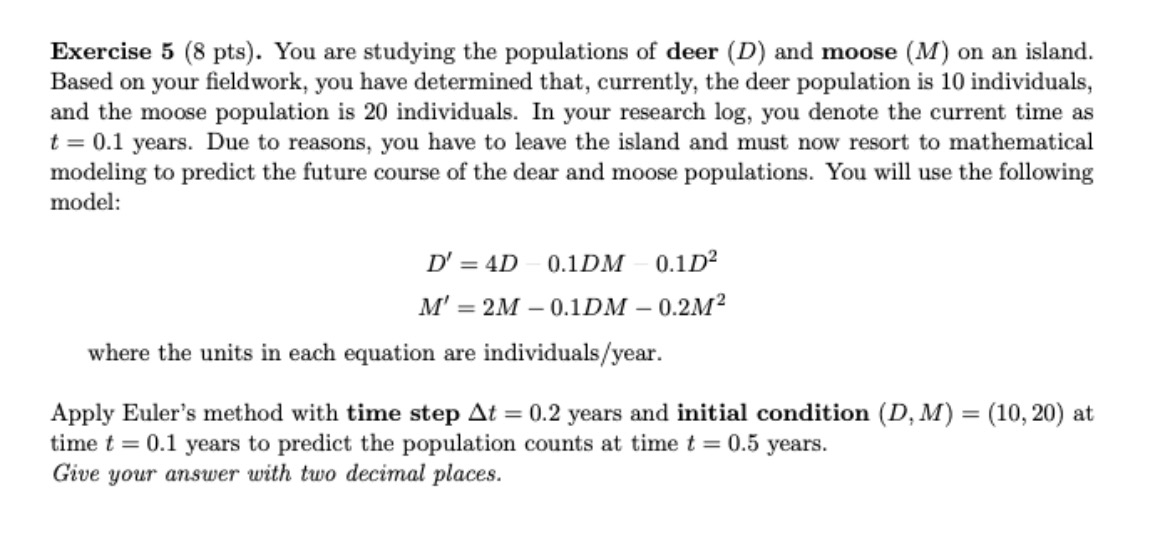
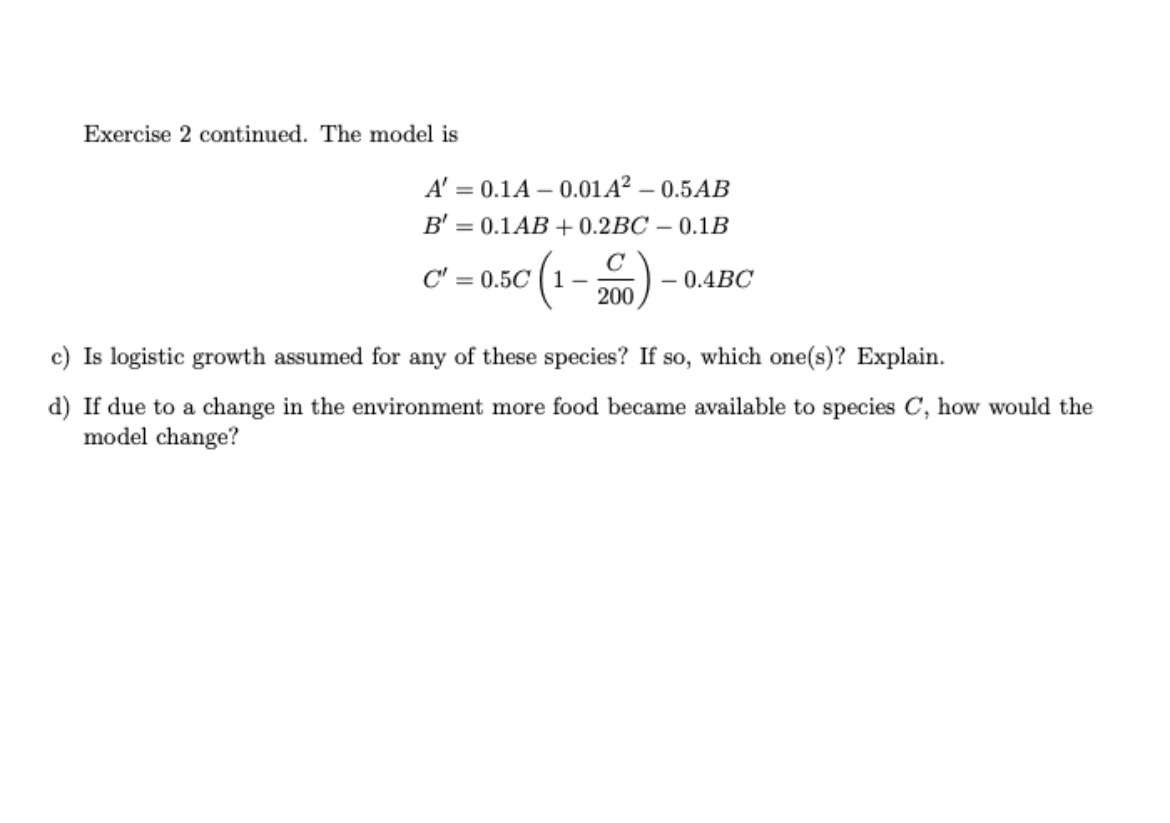
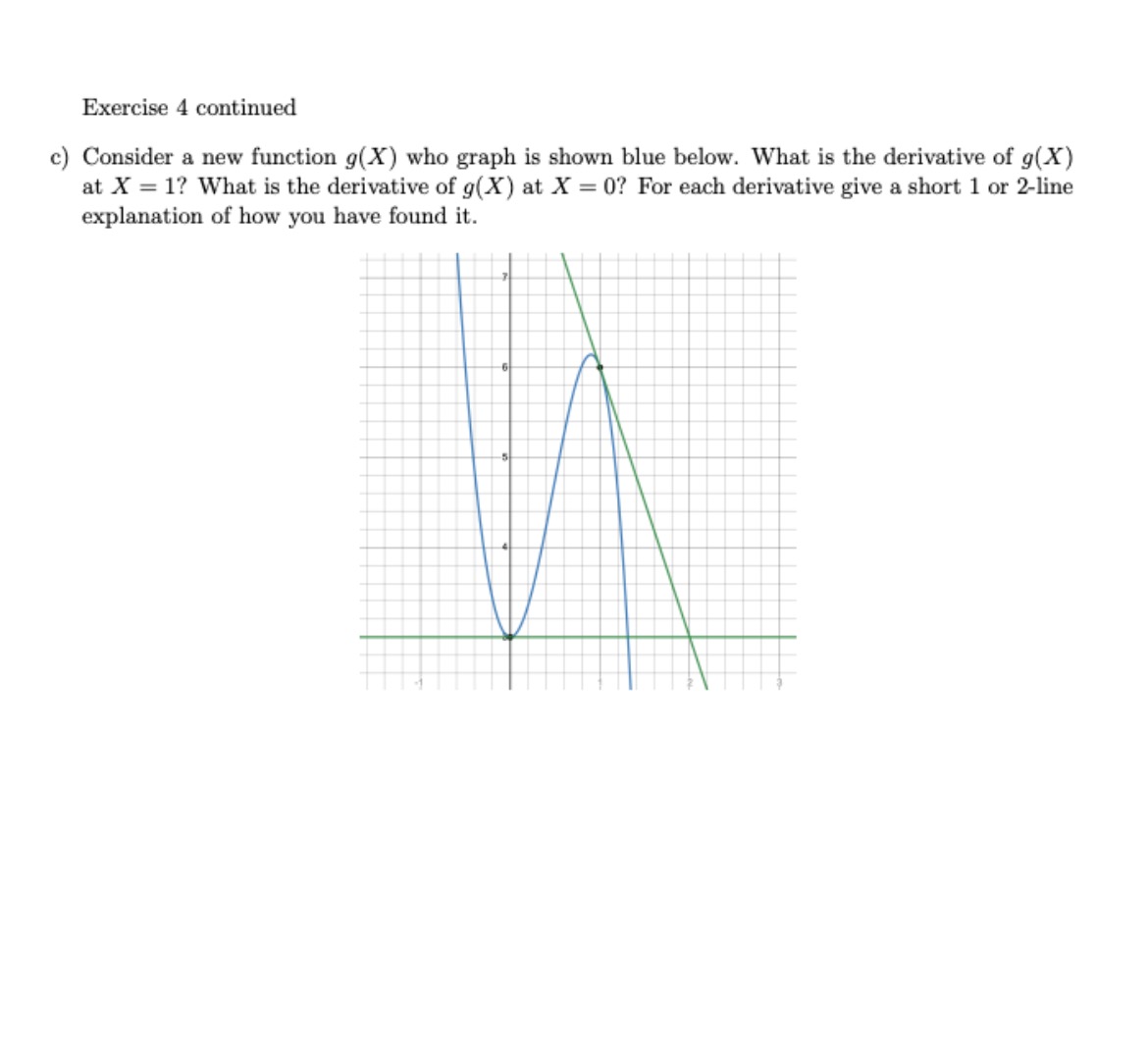
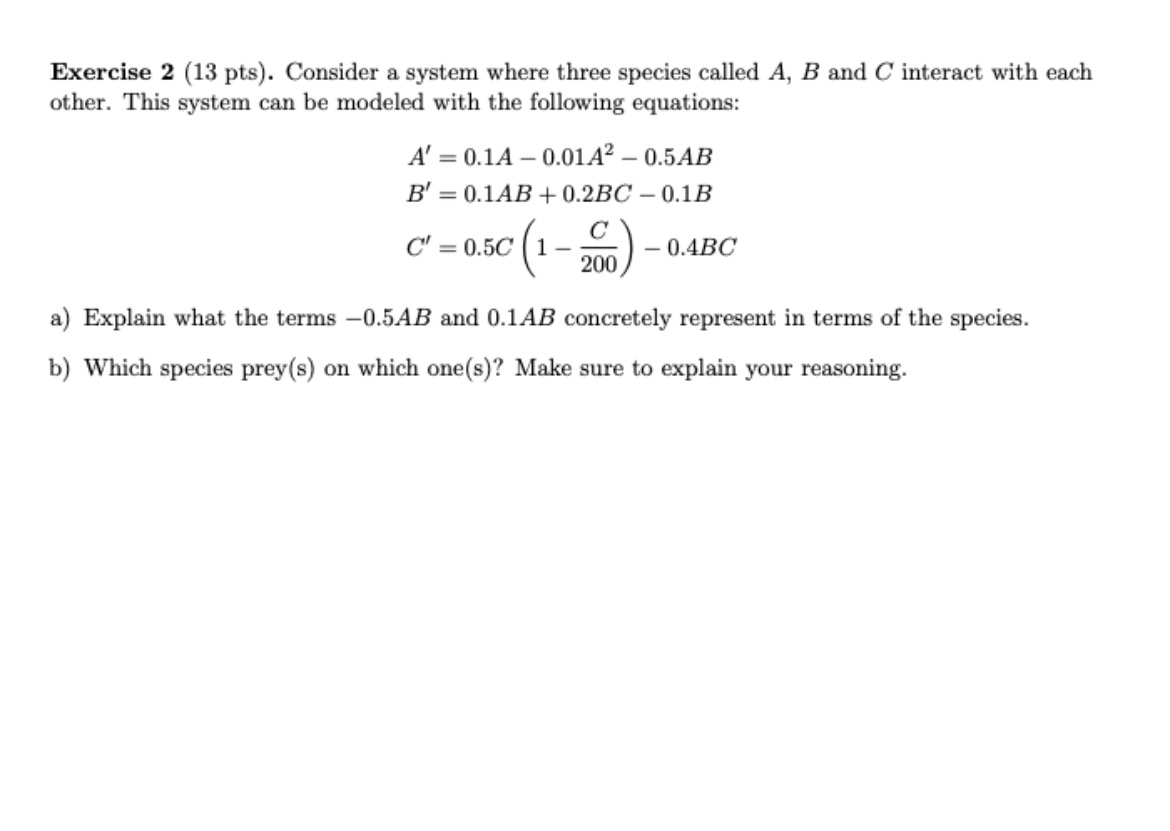
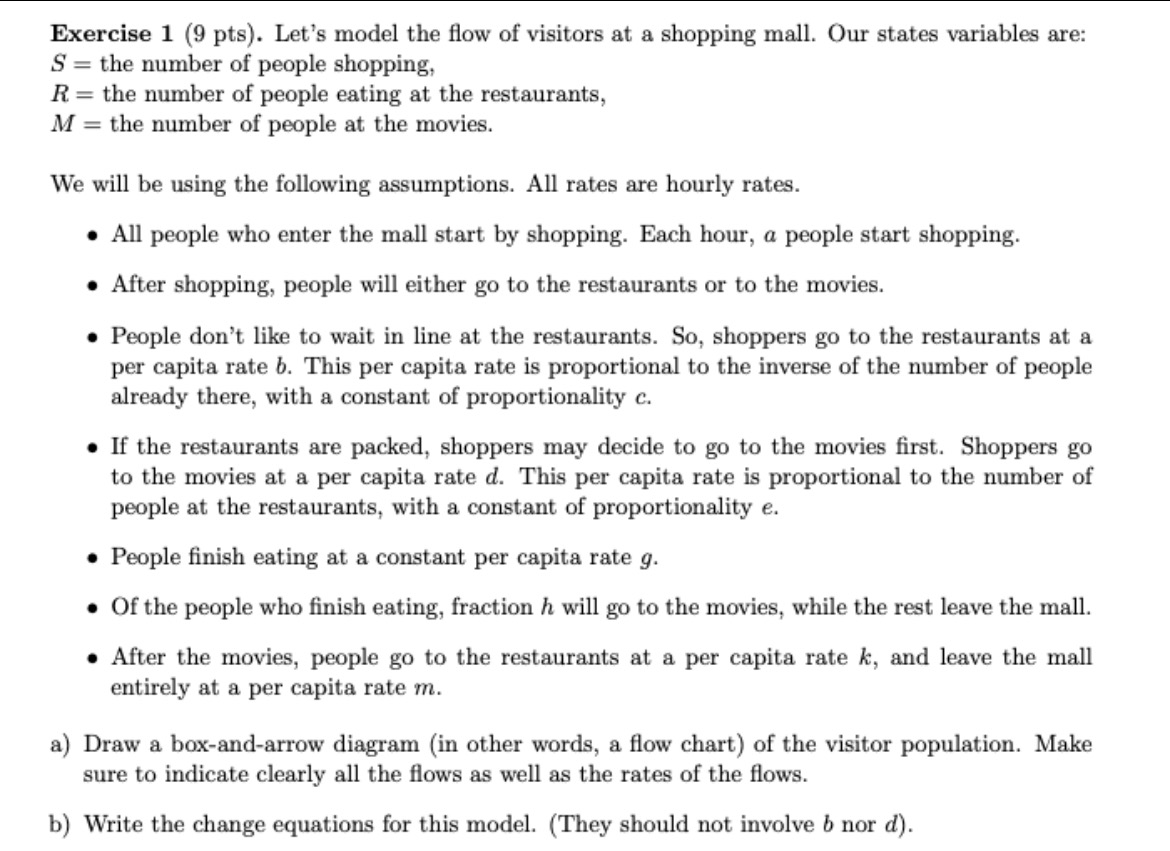
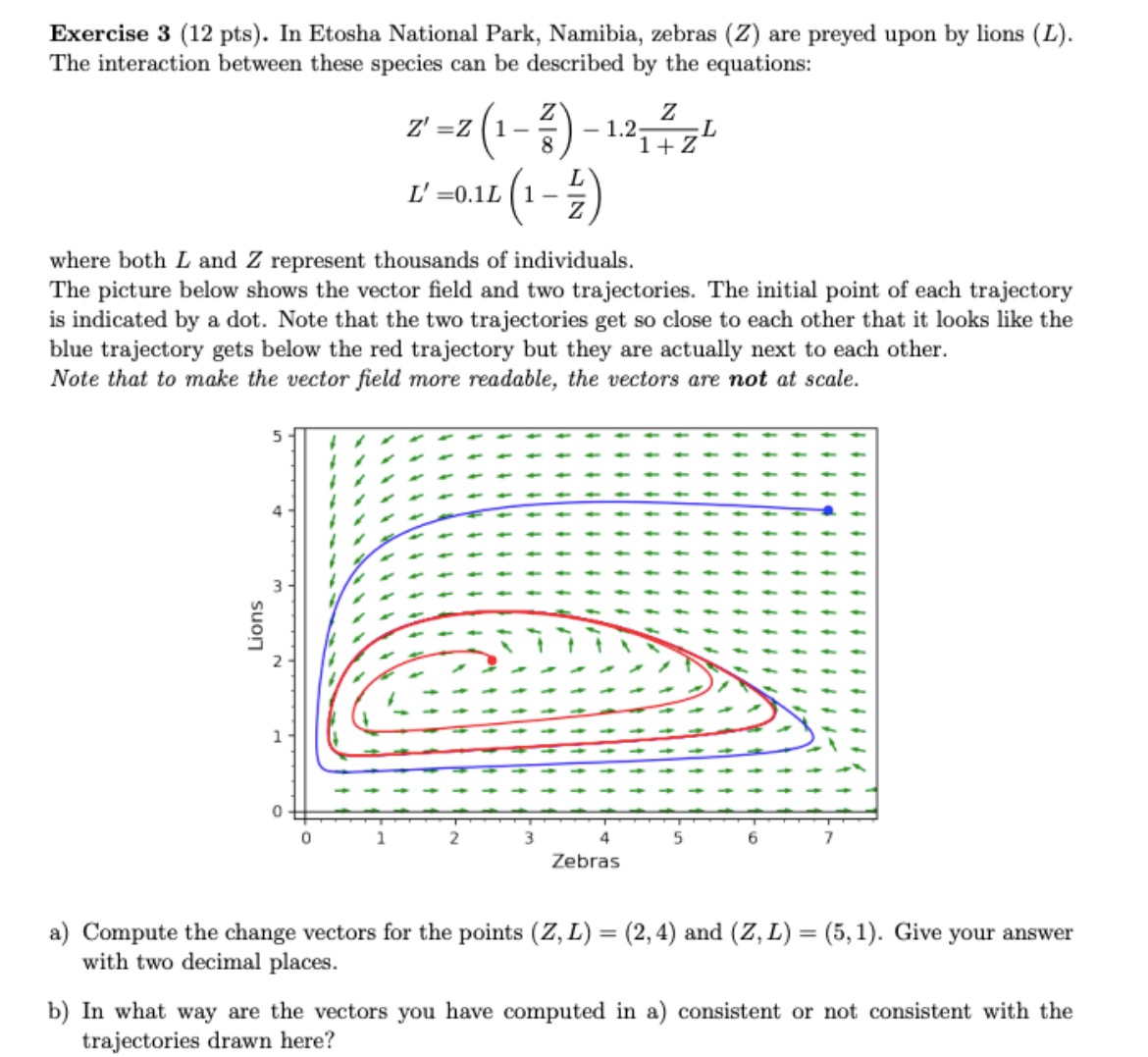
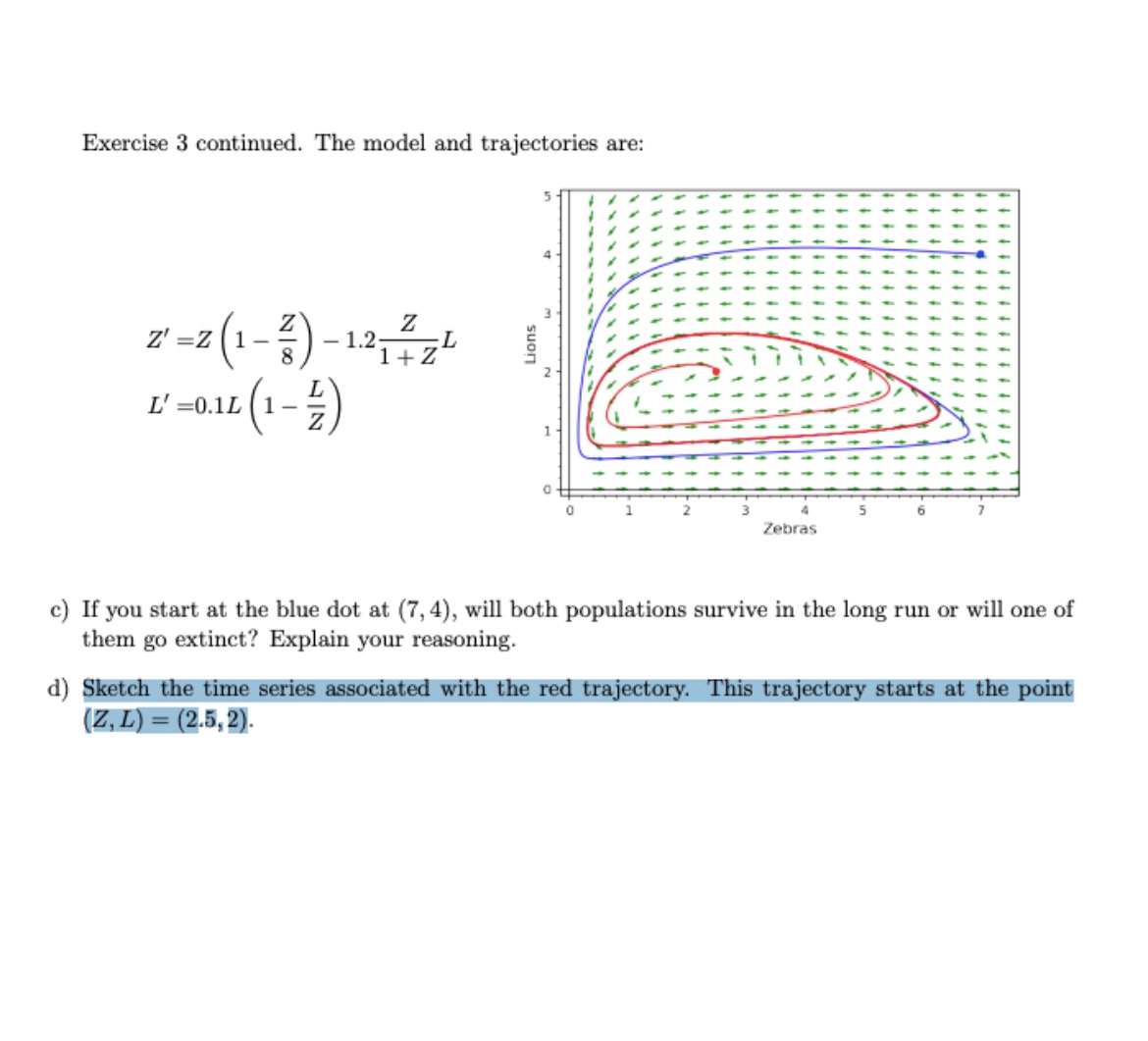
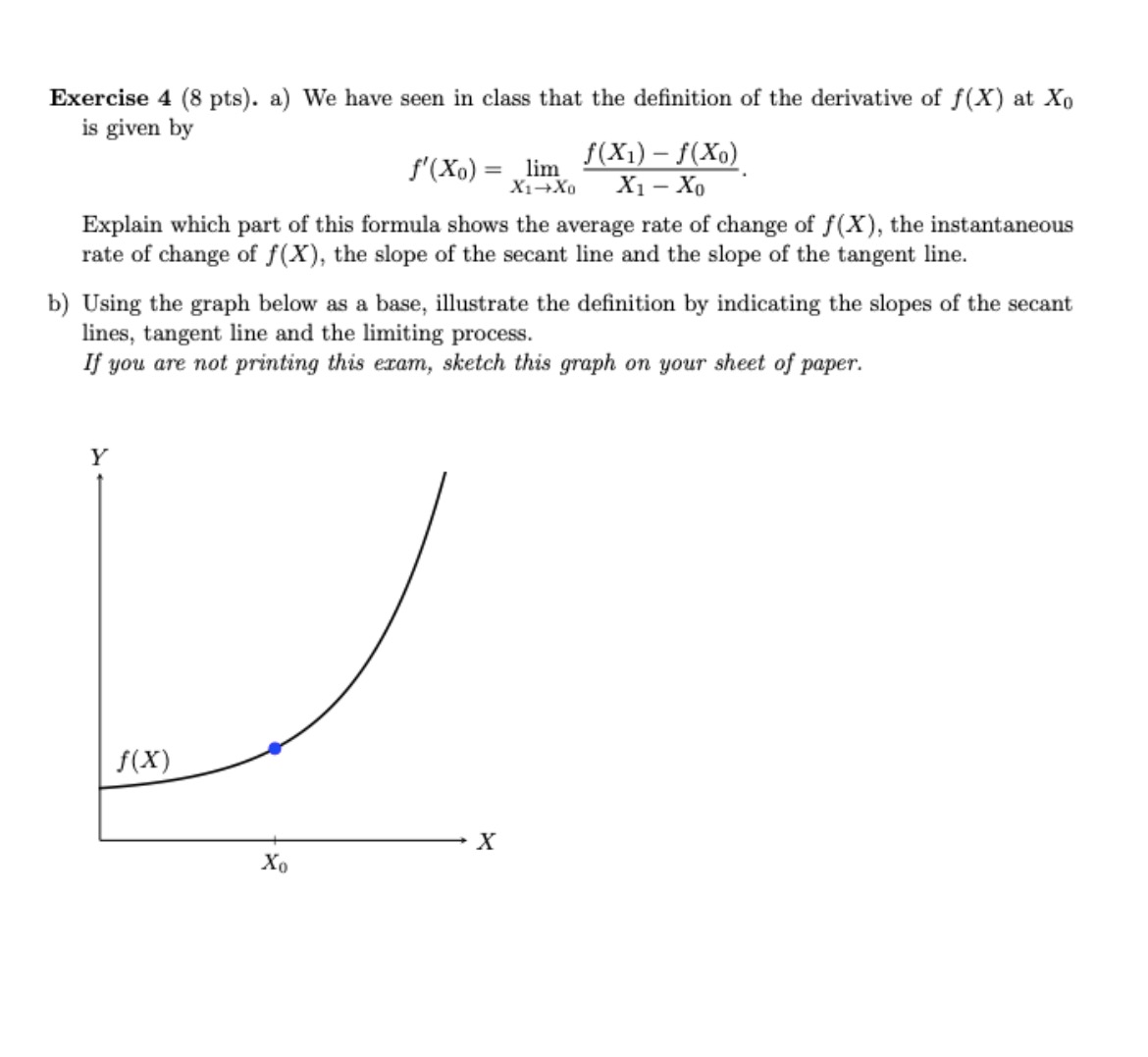
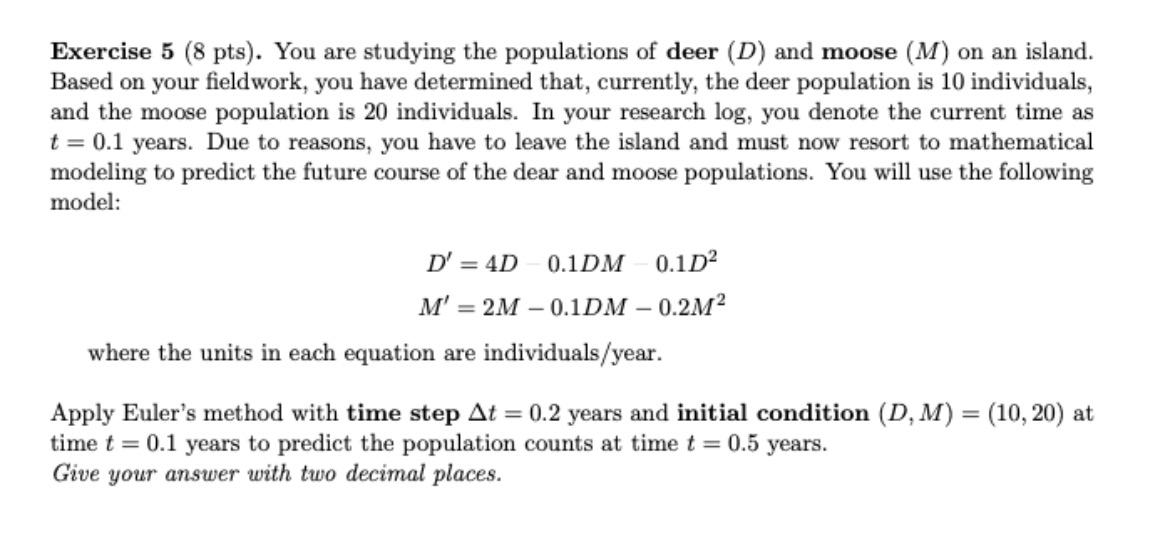
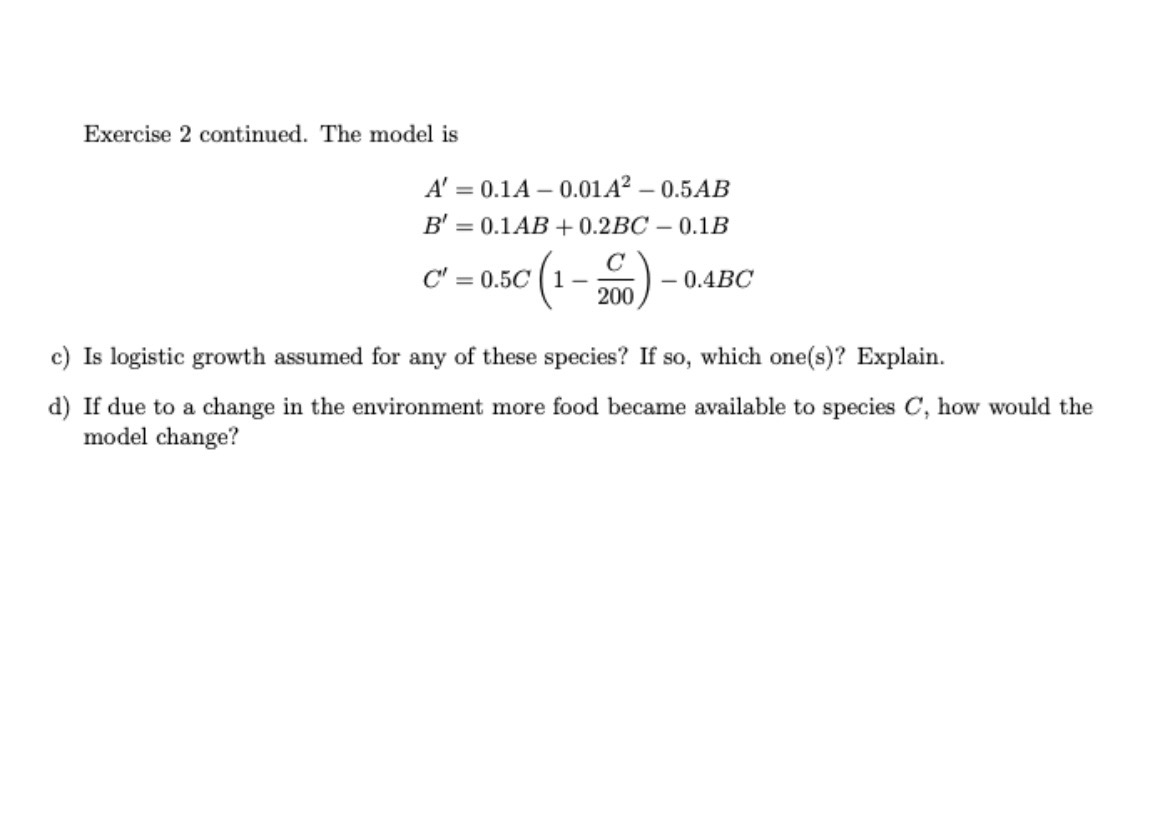
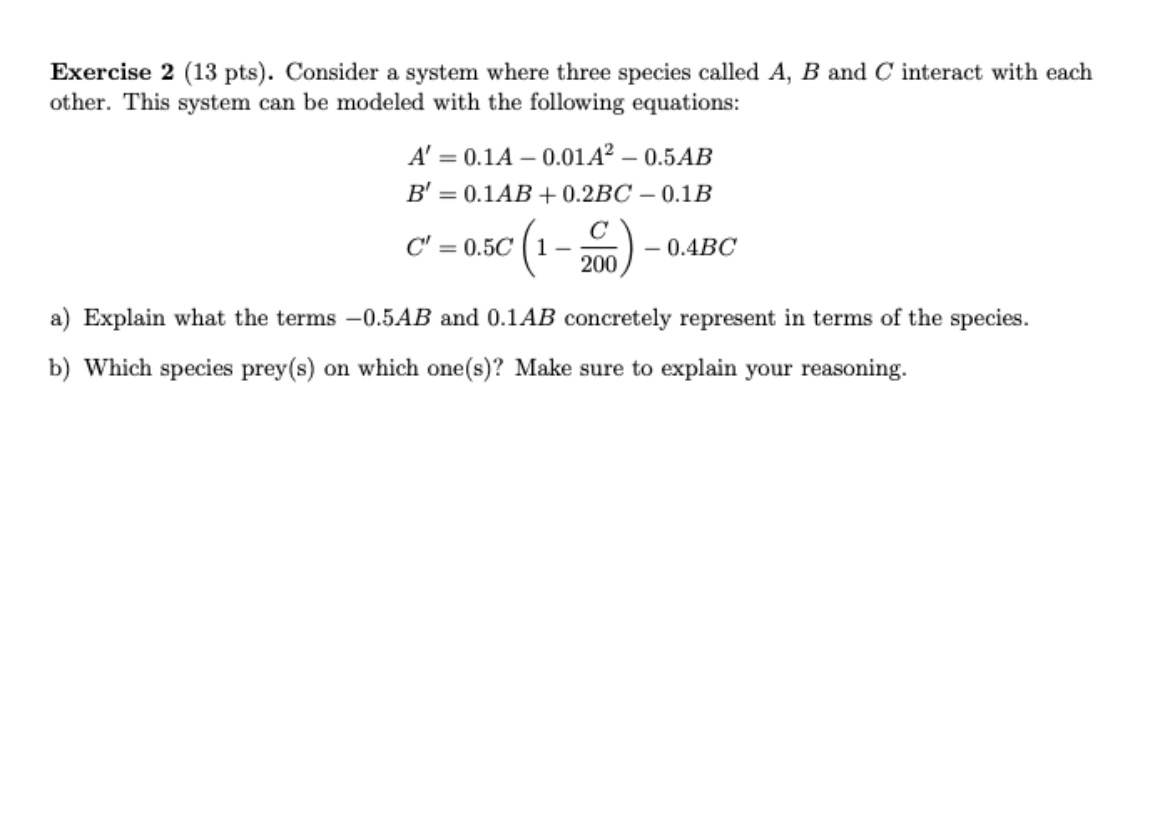
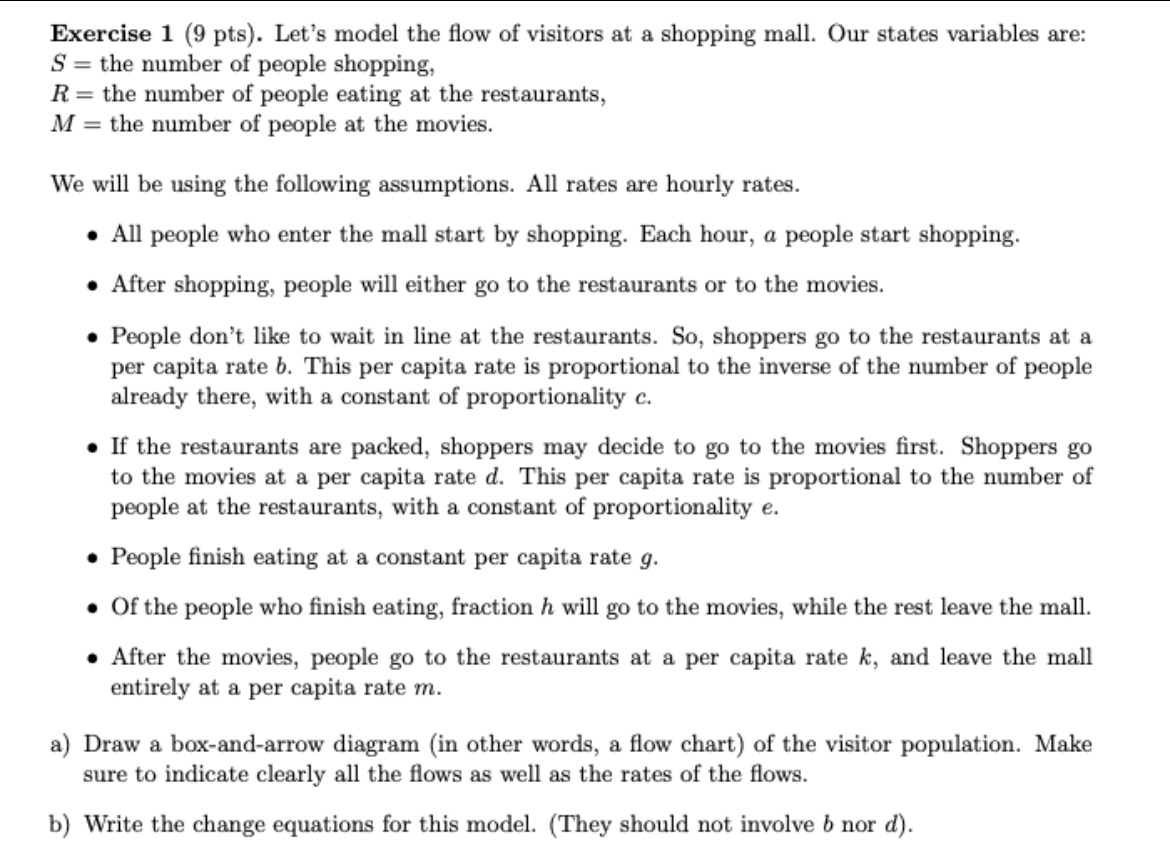
Exercise 4 continued e) Consider a new function 9(X) who graph is shown blue below. What is the derivative of 9(X) at X = 1? What is the derivative of 9(X) at X = 0? For each derivative give a short 1 or 2-]ine explanation of how you have found it. Exercise 2 (13 pts). Consider a system where three species called A, B and C interact with each other. This system can be modeled with the following equations: A' = 0.111 0.0m2 0.5AB 3' = 0.1AB + 0.230 0.13 c C =0.5C (l E) 0.4.30 a) Explain what the terms 0.5AB and 0.1AB concretely represent in terms of the species. b) Which special prey(s) on which one(s)? Make sure to explain your reasoning. Exercise 1 (9 pts). Let's model the ow of visitors at a shopping mall. Our states variables are: S = the number of people shopping, R = the number of people eating at the restaurants, M = the number of people at the movies. We will be using the following assumptions. All rates are hourly rates. a All people who enter the mall start by shopping. Each hour, a people start shopping. a After shopping, people will either go to the restaurants or to the movies. 0 People don't like to wait in line at the restaurants. 30, shoppers go to the restaurants at a per capita rate 6. This per capita rate is proportional to the inverse of the number of people already there, with a constant of proportionality c. I If the restaurants are packed, shoppers may decide to go to the movies rst. Shoppers go to the movies at a per capita rate d. This per capita rate is proportional to the number of people at the restaurants, with a constant of proportionality e. I People nish eating at a constant per capita rate 9. e Of the people who nish eating, fraction II will go to the movies, while the rest leave the mall. a After the movies, people go to the restaurants at a per capita rate It, and leave the mall entirely at a per capita rate 111.. a) Draw a bmt-and-arrow diagram (in other words, a. ow chart) of the visitor population. Make sure to indicate clearly all the ows as well as the rates of the ows. h) Write the change equations for this model. (They should not involve b nor (1]. Exercise 3 (12 pts). In Etosha National Park, Namibia, zebras (Z) are preyed upon by lions (L). The interaction between these species can be described by the equations: Z' =Z 1- - - 1.27 Z 1+ Z L' =0.11 1 - 2 where both L and Z represent thousands of individuals. The picture below shows the vector field and two trajectories. The initial point of each trajectory is indicated by a dot. Note that the two trajectories get so close to each other that it looks like the blue trajectory gets below the red trajectory but they are actually next to each other. Note that to make the vector field more readable, the vectors are not at scale. 3 Lions 2 Zebras a) Compute the change vectors for the points (Z, L) = (2, 4) and (Z, L) = (5, 1). Give your answer with two decimal places. b) In what way are the vectors you have computed in a) consistent or not consistent with the trajectories drawn here?Exercise 3 continued. The model and trajectories are: Z' =Z 1 -2 Z -121+ 2 L Lions 2 L' =0.11 1 - - Zebras c) If you start at the blue dot at (7, 4), will both populations survive in the long run or will one of them go extinct? Explain your reasoning. d) Sketch the time series associated with the red trajectory. This trajectory starts at the point (Z, L) = (2.5,2).Exercise 4 (8 pts). :1) We have seen in class that the definition of the derivative of f(X) at X9 . . by \"gm , _ f(X1)"f(Xo) \"Kw-gnaw- Explain which part of this formula. shows the average rate of change of f(X), the instantaneous rate of change of f (X ). the slope of the secsnt line and the slope of the tangent line. b) Using the graph below as a base, illustrate the denition by indicating the slopes of the secant lines, tangent line and the limiting process. If you am not printing this mm, sketch this graph on your sheet of paper. 11X) Exercise 5 (8 pte). You are studying the populations of deer (D) and moose (M) on an island. Based on your eldwork, you have determined that, currently, the deer population is 10 individuals, and the moose population is 20 individuals. In your research log, you denote the current time as t = 0.1 years. Due to reasons, you have to leave the island and must now resort to mathematical modeling to predict the future course of the dear and moose populations. You will use the following model: D' = 41) 0.10M 0.11)2 M' = 2M 0.1DM 0.2M\" where the units in each equation are individualafyear. Apply Euler's method with time step At = 0.2 years and initial condition (D, M ) = (10, 20) at time t = 0.1 years to predict the population counts at time t = 0.5 years. Give your answer with two decimal places. Exercise 2 continued. The model is A' = 0.1A 0.01113 0.5AB B' = 0.1AB + 0.230 t 0.13 c C' = 0.50 (1 E) 0.430 c) In logistic growth assumed for any of these species? If so, which one(s)? Explain. d) If due to a. change in the environment more food became available to species 0, how would the model change
Step by Step Solution
There are 3 Steps involved in it

Get step-by-step solutions from verified subject matter experts
 Study Help