







Question: Exercise 4. Suppose that an intermediary faces a certain number of buyers and sellers. The intermediary sets usage prices P, and P, to be paid,
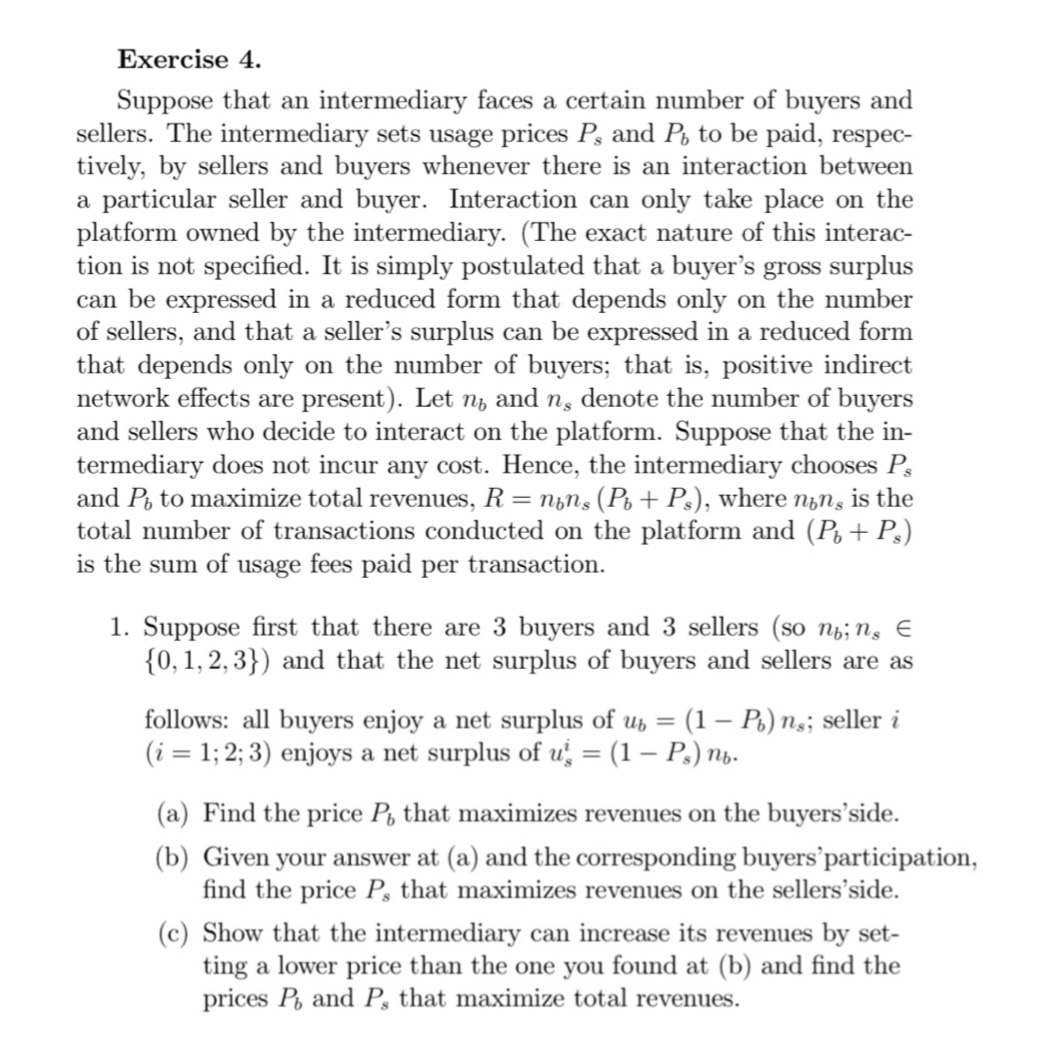
Exercise 4. Suppose that an intermediary faces a certain number of buyers and sellers. The intermediary sets usage prices P, and P, to be paid, respec- tively, by sellers and buyers whenever there is an interaction between a particular seller and buyer. Interaction can only take place on the platform owned by the intermediary. (The exact nature of this interac- tion is not specified. It is simply postulated that a buyer's gross surplus can be expressed in a reduced form that depends only on the number of sellers, and that a seller's surplus can be expressed in a reduced form that depends only on the number of buyers: that is, positive indirect network effects are present). Let n;, and n, denote the number of buyers and sellers who decide to interact on the platform. Suppose that the in- termediary does not incur any cost. Hence, the intermediary chooses P and P, to maximize total revenues, R = nyn, (P, + Ps), where nyn is the total number of transactions conducted on the platform and (P, + P;) is the sum of usage fees paid per transaction. 1. Suppose first that there are 3 buyers and 3 sellers (so n,;n, {0,1,2,3}) and that the net surplus of buyers and sellers are as follows: all buyers enjoy a net surplus of u, = (1 F,) n,; seller (i = 1;2; 3) enjoys a net surplus of u', = (1 P,) n,. (a) Find the price P, that maximizes revenues on the buyers'side. (b) Given your answer at (a) and the corresponding buyers'participation, find the price P, that maximizes revenues on the sellers'side. (c) Show that the intermediary can increase its revenues by set- ting a lower price than the one you found at (b) and find the prices P, and P, that maximize total revenues
Step by Step Solution
There are 3 Steps involved in it

Get step-by-step solutions from verified subject matter experts
 Study Help