







Question: Exercise 4.2. This exercise illustrates how one can use a spin-polarized neutron source and a spin-resolving detector to probe magnetic (or spin-flip) excitations in a
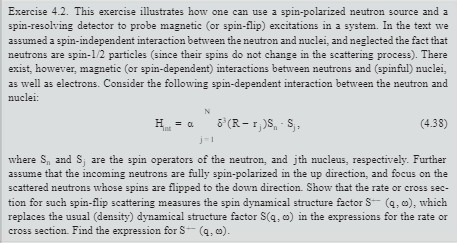
Exercise 4.2. This exercise illustrates how one can use a spin-polarized neutron source and a spin-resolving detector to probe magnetic (or spin-flip) excitations in a system. In the text we assumed a spin-independent interaction between the neutron and nuclei, and neglected the fact that neutrons are spin-1 2 particles (since their spins do not change in the scattering process). There exist, however, magnetic (or spin-dependent) interactions between neutrons and (spinful) nuclei, as well as electrons. Consider the following spin-dependent interaction between the neutron and nuclei: H = Q 5(R - r )S, - S; ; (4.38) where S, and S are the spin operators of the neutron, and jth nucleus, respectively. Further assume that the incoming neutrons are fully spin-polarized in the up direction, and focus on the scattered neutrons whose spins are flipped to the down direction. Show that the rate or cross gec- tion for such spin-flip scattering measures the spin dynamical structure factor $ (q, o), which replaces the usual (density) dynamical structure factor S(q, ) in the expressions for the rate or cross section. Find the expression for $ (q, 0)
Step by Step Solution
There are 3 Steps involved in it

Get step-by-step solutions from verified subject matter experts
 Study Help