







Question: Exercise (9 points) Consider a country operating under flexible exchange rates and characterized by: Consumption: C = 0.8(Y - T) +20; Investment: 1 = -1001
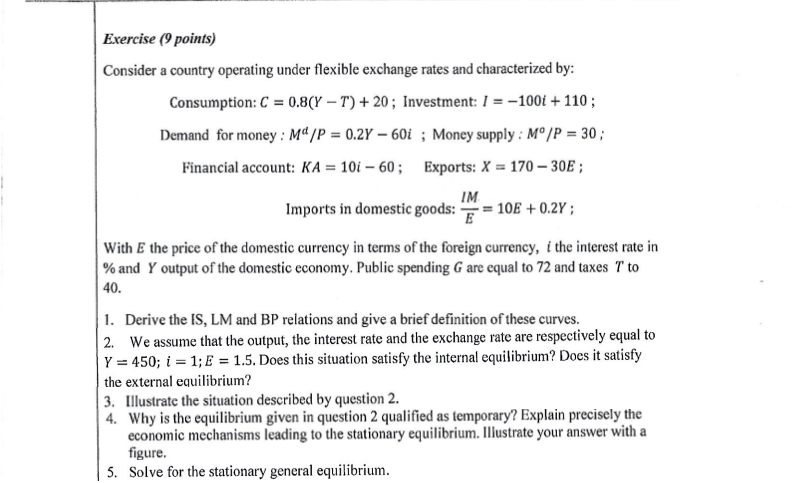
Exercise (9 points) Consider a country operating under flexible exchange rates and characterized by: Consumption: C = 0.8(Y - T) +20; Investment: 1 = -1001 + 110 ; Demand for money: Md/P = 0.2Y 60i ; Money supply: M/P = 30; Financial account: KA = 10i 60; Exports: X = 170 - 30E ; IM Imports in domestic goods: 10E+0.28; With the price of the domestic currency in terms of the foreign currency, i the interest rate in % and Youtput of the domestic economy. Public spending G are equal to 72 and taxes i to 40. 1. Derive the IS, LM and BP relations and give a brief definition of these curves. 2. We assume that the output, the interest rate and the exchange rate are respectively equal to Y = 450; i = 1;E = 1.5. Does this situation satisfy the internal equilibrium? Does it satisfy the external equilibrium? 3. Illustrate the situation described by question 2. 4. Why is the equilibrium given in question 2 qualified as temporary? Explain precisely the economic mechanisms leading to the stationary equilibrium. Illustrate your answer with a figure. 5. Solve for the stationary general equilibrium. Exercise (9 points) Consider a country operating under flexible exchange rates and characterized by: Consumption: C = 0.8(Y - T) +20; Investment: 1 = -1001 + 110 ; Demand for money: Md/P = 0.2Y 60i ; Money supply: M/P = 30; Financial account: KA = 10i 60; Exports: X = 170 - 30E ; IM Imports in domestic goods: 10E+0.28; With the price of the domestic currency in terms of the foreign currency, i the interest rate in % and Youtput of the domestic economy. Public spending G are equal to 72 and taxes i to 40. 1. Derive the IS, LM and BP relations and give a brief definition of these curves. 2. We assume that the output, the interest rate and the exchange rate are respectively equal to Y = 450; i = 1;E = 1.5. Does this situation satisfy the internal equilibrium? Does it satisfy the external equilibrium? 3. Illustrate the situation described by question 2. 4. Why is the equilibrium given in question 2 qualified as temporary? Explain precisely the economic mechanisms leading to the stationary equilibrium. Illustrate your answer with a figure. 5. Solve for the stationary general equilibrium
Step by Step Solution
There are 3 Steps involved in it

Get step-by-step solutions from verified subject matter experts
 Study Help