







Question: Exercise E.23. (Difficulty 3) Bob has to plan his working life for the next T years. There are m jobs that Bob can do, and
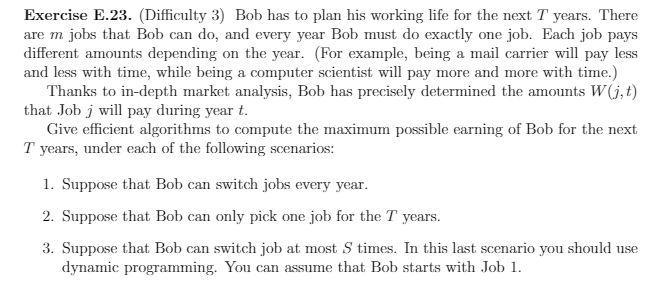
Exercise E.23. (Difficulty 3) Bob has to plan his working life for the next T years. There are m jobs that Bob can do, and every year Bob must do exactly one job. Each job pays different amounts depending on the year. (For example, being a mail carrier will pay less and less with time, while being a computer scientist will pay more and more with time.) Thanks to in-depth market analysis, Bob has precisely determined the amounts WG,t) that Job i will pay during year t. Give efficient algorithms to compute the maximum possible earning of Bob for the next 1 years, under each of the following scenarios: 1. Suppose that Bob can switch jobs every year. 2. Suppose that Bob can only pick one job for the T years. 3. Suppose that Bob can switch job at most S times. In this last scenario you should use dynamic programming. You can assume that Bob starts with Job 1. Exercise E.23. (Difficulty 3) Bob has to plan his working life for the next T years. There are m jobs that Bob can do, and every year Bob must do exactly one job. Each job pays different amounts depending on the year. (For example, being a mail carrier will pay less and less with time, while being a computer scientist will pay more and more with time.) Thanks to in-depth market analysis, Bob has precisely determined the amounts WG,t) that Job i will pay during year t. Give efficient algorithms to compute the maximum possible earning of Bob for the next 1 years, under each of the following scenarios: 1. Suppose that Bob can switch jobs every year. 2. Suppose that Bob can only pick one job for the T years. 3. Suppose that Bob can switch job at most S times. In this last scenario you should use dynamic programming. You can assume that Bob starts with Job 1
Step by Step Solution
There are 3 Steps involved in it

Get step-by-step solutions from verified subject matter experts
 Study Help