







Question: Experiment 2: For the second experiment, you will move the slider to inelastic. Change the velocity of ball 1 before the collision and record
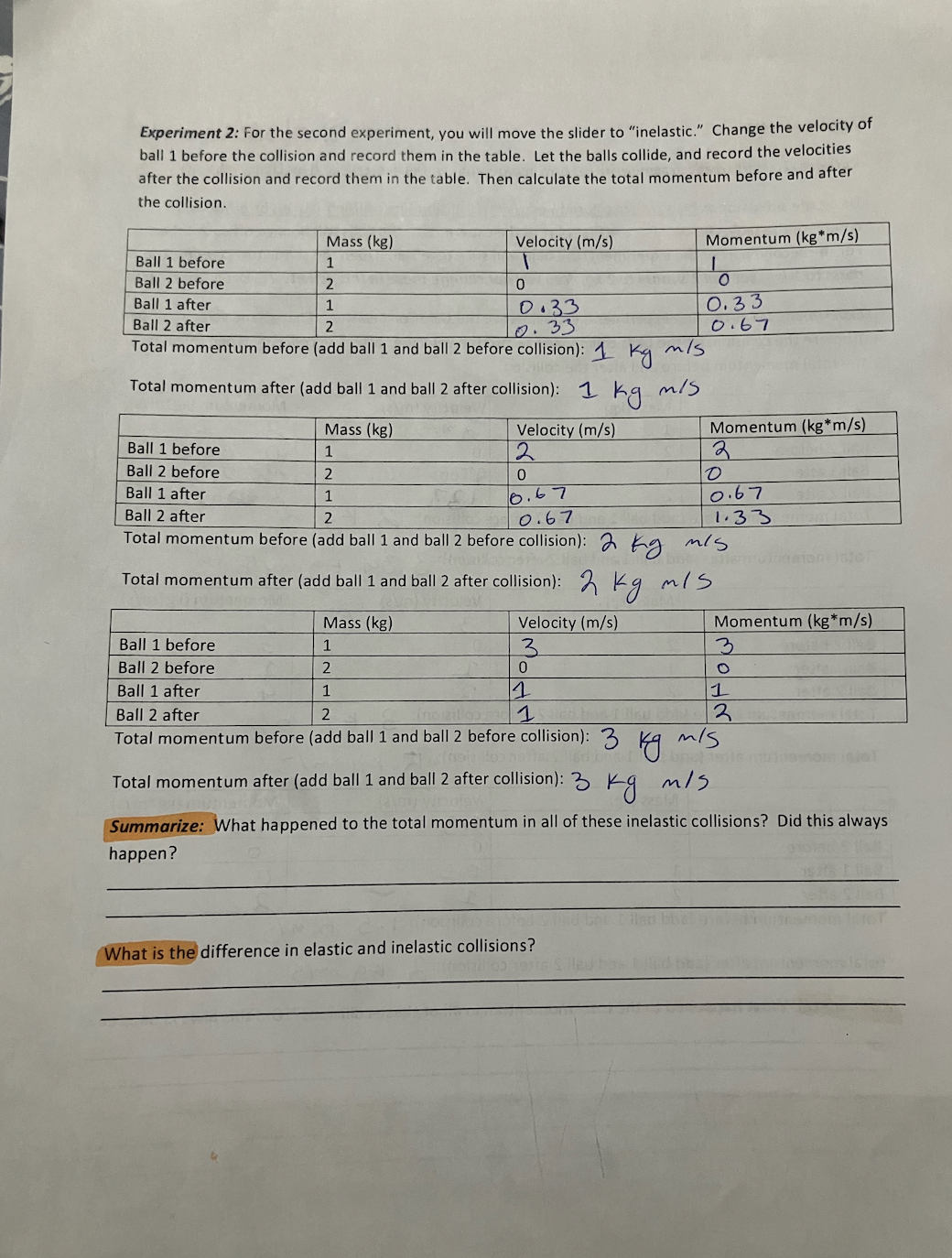
Experiment 2: For the second experiment, you will move the slider to "inelastic." Change the velocity of ball 1 before the collision and record them in the table. Let the balls collide, and record the velocities after the collision and record them in the table. Then calculate the total momentum before and after the collision. Mass (kg) Velocity (m/s) Momentum (kg*m/s) Ball 1 before 1 I Ball 2 before 2 0 0 Ball 1 after Ball 2 after 1 2 0.33 0.33 0.33 0.67 m/s Total momentum before (add ball 1 and ball 2 before collision): 1 Kg Total momentum after (add ball 1 and ball 2 after collision): 1 kg m/s Mass (kg) Ball 1 before 1 Ball 2 before 2 Ball 1 after Ball 2 after 1 2 Velocity (m/s) Momentum (kg*m/s) 2 2 0 0 0.67 0.67 0.67 1.33 Total momentum before (add ball 1 and ball 2 before collision): 2 kg m/s Total momentum after (add ball 1 and ball 2 after collision): 2 kg m/s Mass (kg) Ball 1 before 1 Ball 2 before 2 Ball 1 after 1 Ball 2 after 2 Velocity (m/s) 3 0 1 1 Momentum (kg*m/s) 3 1 2 Total momentum before (add ball 1 and ball 2 before collision): 3 kg m/s Total momentum after (add ball 1 and ball 2 after collision): 3 kg m/s Summarize: What happened to the total momentum in all of these inelastic collisions? Did this always happen? What is the difference in elastic and inelastic collisions?
Step by Step Solution
There are 3 Steps involved in it

Get step-by-step solutions from verified subject matter experts
 Study Help