







Question: explain how various coordination methods could be used to coordinate patient experience work at academic medical center using information systems,and task committees more specifically Integrative
explain how various coordination methods could be used to coordinate patient experience work at academic medical center using information systems,and task committees more specifically 
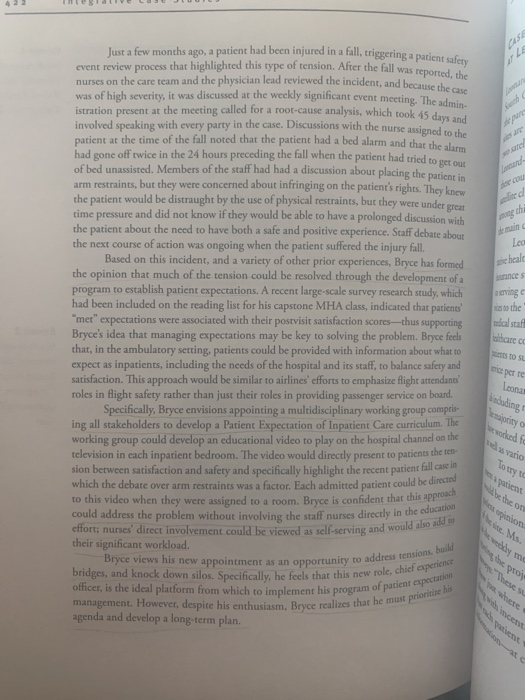
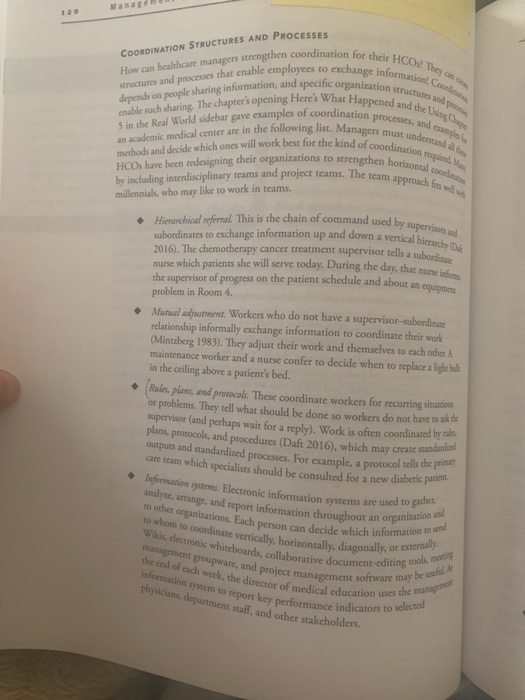
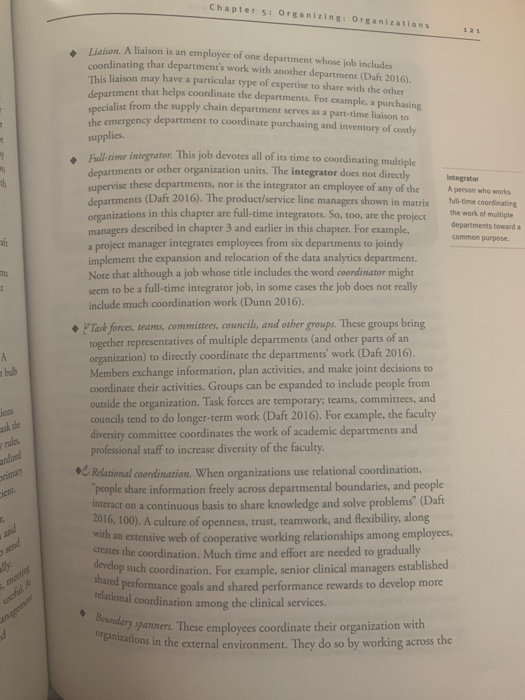
Integrative Case Studies PS Hospit CASE: MANAGING THE PATIENT EXPERIENCE: FACING THE TENSION BETWEEN QUALITY MEASURES AND PATIENT SATISFACTION Bryce Jackson has recently been appointed chief experience officer for Academic Medical Center (AMC), a large tertiary-care health system consisting of six hospitals with a total of 1,500 inpatient beds and an annual average of 60,000 discharges. In this role, he will oversee the Department of Patient Experience, which has responsibility for patient satisfaction data, patient family complaints/grievances, patient advocacy, volunteer services, information desks, and employee engagement. Bryce will report directly to the chief quality and patient safety officer, who is responsible for quality and performance improvement across the system. Bryce has a decade of experience working in various middle management roles within AMC's Department of Patient Experience. During this time, he has noted a growing tension between patient satisfaction and quality measures. At AMC, although all health system leaders are tasked with improving satisfaction and quality measures, fragmentation and tension result from the involvement of different leaders tasked with improving specific metrics. Bryce recently completed a master's in healthcare administration (MHA) program through a school of public health affiliated with AMC, and he found during his studies that he is not the only one to notice the growing tension. Prominent health administrators and researchers have noted that the current structure of the Centers for Medicare & Medicaid Services (CMS) Hospital Value-Based Purchasing (HVBP) program has contributed to, and perpetuates, this tension. One specific issue is that the CMS HVBP program now reimburses for an ever-increasing number of metrics. The pie charts in exhibits 1 and 2 illustrate the changes in the HVBP program at AMC. The propor- tion of the reimbursement pie that is derived from patient satisfaction scores (the Hospital Consumer Assessment of Healthcare Providers and Systems, or HCAHPS survey) has remained relatively steady, but the other segments of this pie are continually shifting. In 2013, clinical process measures filled out the rest of the pic, but for the coming fiscal year, outcomes and efficiency will be added, incorporating a variety of metrics related to quality and patient safety. Bryce feels that use of this reimbursement pie at AMC has resulted in fragmenta tion of the concept of patient experience, as well as tension among organizational leaders challenged with maximizing performance for the individual metrics in each leader's piece of the pie. Discussions with peers at other institutions have convinced Bryce that this problem is not isolated to AMC; in fact, these tensions are felt in health systems across the country patient often becoming the victim of the tension. For instance, steps taken to meet a goal The competing priorities are most evident at the point of patient care, with the in patient fall prevention-a key quality and safety metric-may be in direct conflict with goal of improving the patient's experience as reflected in patient satisfaction scores. During nursing staff have discussed this problem. Staff are concerned that use of bed alarms will lead to hospitalized patients feeling restrained, thereby worsening their experience of care and lowering the resulting patient satisfaction scores. Just a few months ago, a patient had been injured in a fall, triggering a patient safety clied mgh Lea sie heale ces event review process that highlighted this type of tension. After the fall was reported, the nurses on the care team and the physician lead reviewed the incident, and because the case was of high severity, it was discussed at the weekly significant event meeting. The admin istration present at the meeting called for a root-cause analysis, which took 45 days and involved speaking with every party in the case. Discussions with the nurse assigned to the patient at the time of the fall noted that the patient had a bed alarm and that the alarm had gone off twice in the 24 hours preceding the fall when the patient had tried to get out of bed unassisted. Members of the staff had had a discussion about placing the patient in arm restraints, but they were concerned about infringing on the patient's rights. They knew the patient would be distraught by the use of physical restraints, but they were under great time pressure and did not know if they would be able to have a prolonged discussion with the patient about the need to have both a safe and positive experience. Staff debate about the next course of action was ongoing when the patient suffered the injury fall. Based on this incident, and a variety of other prior experiences, Bryce has formed the opinion that much of the tension could be resolved through the development of a program to establish patient expectations. A recent large-scale survey research study, which had been included on the reading list for his capstone MHA class, indicated that patients' "met" expectations were associated with their postvisit satisfaction scores-thus supporting Bryce's idea that managing expectations may be key to solving the problem. Bryce feels that, in the ambulatory setting, patients could be provided with information about what to expect as inpatients, including the needs of the hospital and its staff, to balance safety and satisfaction. This approach would be similar to airlines' efforts to emphasize flight attendants roles in flight safety rather than just their roles in providing passenger service on board. Specifically, Bryce envisions appointing a multidisciplinary working group compris ing all stakeholders to develop a Patient Expectation of Inpatient Care curriculum. The working group could develop an educational video to play on the hospital channel on the television in each inpatient bedroom. The video would directly present to patients the ten sion between satisfaction and safety and specifically highlight the recent patient fall case in which the debate over arm restraints was a factor. Each admitted patient could be directed to this video when they were assigned to a room. Bryce is confident that this approach could address the problem without involving the staff nurses directly in the education effort; nurses' direct involvement could be viewed as self-serving and would also add to their significant workload. erving ces to the whare o Sto su brice per te Leona ndoding aripriya dvativo To try es patient the line. Ms. de proy Bryce views his new appointment as an opportunity to address tensions, build officer, is the ideal platform from which to implement his program of patient expectation bridges, and knock down silos. Specifically, he feels that this new role, chief experience management. However, despite his enthusiasm, Bryce realizes that he must priorities agenda and develop a long-term plan. COORDINATION STRUCTURES AND PROCESSES How can healthcare managers strengthen coordination for their HCO exchange information Cool They can be structures and processes that enable employees to depends on people sharing information, and specific organization structures and 5 in the Real World sidebar gave examples of coordination processes, and cum an academic medical center are in the following list. Managers must understand HCOs have been redesigning their organizations to strengthen horizontal com by including interdisciplinary teams and project teams. The team approach fits w millennials, who may like to work in teams, Hierarchical refert. This is the chain of command used by supervison and subordinates to exchange information up and down a vertical hierarchy Da 2016). The chemotherapy cancer treatment supervisor tells a subordinate nurse which patients she will serve today. During the day, that nurse informa the supervisor of progress on the patient schedule and about an equipmen problem in Room 4. Mutual adjustment. Workers who do not have a supervisor subordinane relationship informally exchange information to coordinate their work (Mintzberg 1983). They adjust their work and themselves to each other. maintenance worker and a nurse confer to decide when to replace a light bulb in the ceiling above a patient's bed. Rules, plans, and protocols. These coordinate workers for recurring situations or problems. They tell what should be done so workers do not have to ask de supervisor (and perhaps wait for a reply). Work is often coordinated by rules plans, protocols, and procedures (Daft 2016), which may create standards outputs and standardized processes. For example, a protocol tells the price care team which specialists should be consulted for a new diabetic patient. Information system Electronic information systems are used to gather analyze, arrange, and report information throughout an organization and to other organizations. Each person can decide which information to send Wilds, electronic whiteboards, collaborative document-editing tools, men management groupware, and project management software may be useful Information system to report key performance indicators to selected physicians, department staff, and other stakeholders. Chapter 5: Organizing: Organizations th Integrator A person who works coating the work of multiple departments toward common purpose 1 Liaison. A liaison is an employee of one department whose job includes coordinating that department's work with another department (Daft 2016). This liaison may have a particular type of expertise to share with the other department that helps coordinate the departments. For example, a purchasing specialist from the supply chain department serves as a part-time liaison to the emergency department to coordinate purchasing and inventory of costly supplies. Full-time integrator. This job devotes all of its time to coordinating multiple departments or other organization units. The integrator does not directly supervise these departments, nor is the integrator an employee of any of the departments (Daft 2016). The product/service line managers shown in matrix organizations in this chapter are full-time integrators. So, too, are the project managers described in chapter 3 and earlier in this chapter. For example, a project manager integrates employees from six departments to jointly implement the expansion and relocation of the data analytics department. Note that although a job whose title includes the word coordinator might seem to be a full-time integrator job, in some cases the job does not really include much coordination work (Dunn 2016). Task forces, teams, committees, councils, and other groups. These groups bring together representatives of multiple departments (and other parts of an organization) to directly coordinate the departments' work (Daft 2016). Members exchange information, plan activities, and make joint decisions to coordinate their activities. Groups can be expanded to include people from outside the organization. Task forces are temporary, teams, committees, and councils tend to do longer-term work (Daft 2016). For example, the faculty diversity committee coordinates the work of academic departments and professional staff to increase diversity of the faculty. Relational coordination. When organizations use relational coordination, "people share information freely across departmental boundaries, and people interact on a continuous basis to share knowledge and solve problems (Daft 2016, 100). A culture of openness, trust, teamwork, and flexibility, along with an extensive web of cooperative working relationships among employees, creates the coordination. Much time and effort are needed to gradually develop such coordination. For example, senior clinical managers established shared performance goals and shared performance rewards to develop more among the clinical services. Boundary spanners. These employees coordinate their organization with organizations in the external environment. They do so by working across the bul jons relational coordination Step by Step Solution
There are 3 Steps involved in it
1 Expert Approved Answer
Step: 1 Unlock

Question Has Been Solved by an Expert!
Get step-by-step solutions from verified subject matter experts
Step: 2 Unlock
Step: 3 Unlock
 Study Help