



Question: Explain types of sample biases mentioned in below scenario. How can they be avoided and how can these type of biases be statistically corrected? (15
Explain types of sample biases mentioned in below scenario. How can they be avoided and how can these type of biases be statistically corrected? (15 marks) 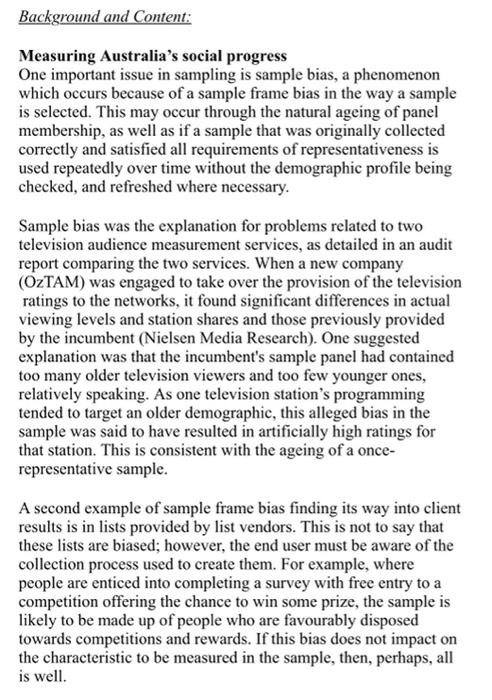
Background and Content: Measuring Australia's social progress One important issue in sampling is sample bias, a phenomenon which occurs because of a sample frame bias in the way a sample is selected. This may occur through the natural ageing of panel membership, as well as if a sample that was originally collected correctly and satisfied all requirements of representativeness is used repeatedly over time without the demographic profile being checked, and refreshed where necessary. Sample bias was the explanation for problems related to two television audience measurement services, as detailed in an audit report comparing the two services. When a new company (OZTAM) was engaged to take over the provision of the television ratings to the networks, it found significant differences in actual viewing levels and station shares and those previously provided by the incumbent (Nielsen Media Research). One suggested explanation was that the incumbent's sample panel had contained too many older television viewers and too few younger ones, relatively speaking. As one television station's programming tended to target an older demographic, this alleged bias in the sample was said to have resulted in artificially high ratings for that station. This is consistent with the ageing of a once- representative sample. A second example of sample frame bias finding its way into client results is in lists provided by list vendors. This is not to say that these lists are biased; however, the end user must be aware of the collection process used to create them. For example, where people are enticed into completing a survey with free entry to a competition offering the chance to win some prize, the sample is likely to be made up of people who are favourably disposed towards competitions and rewards. If this bias does not impact on the characteristic to be measured in the sample, then, perhaps, all is well Step by Step Solution
There are 3 Steps involved in it
1 Expert Approved Answer
Step: 1 Unlock

Question Has Been Solved by an Expert!
Get step-by-step solutions from verified subject matter experts
Step: 2 Unlock
Step: 3 Unlock