







Question: Explain why NH3 (ammonia) is considered a base under the Bronsted-Lowry definition, but is not an Arrhenius base. HTML Editor BIUA AIEE 2 1
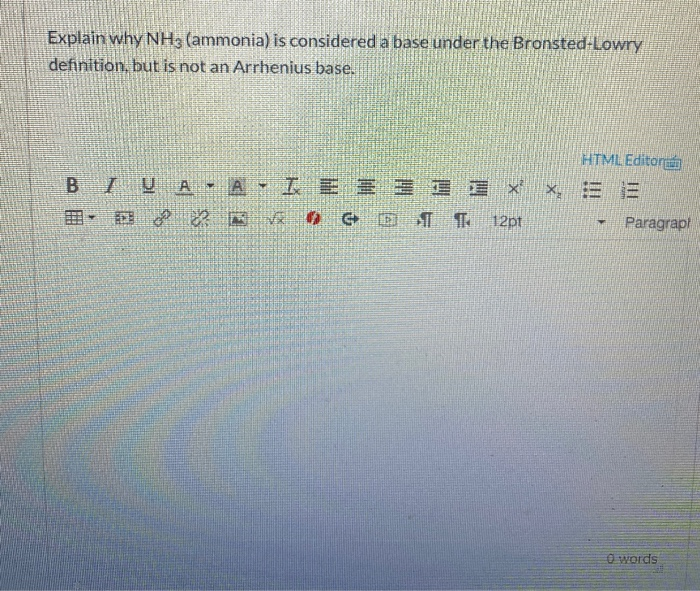


Explain why NH3 (ammonia) is considered a base under the Bronsted-Lowry definition, but is not an Arrhenius base. HTML Editor BIUA AIEE 2 1 1 x XE E 12pt Paragraph O words Based on what you know about the solubility of gases in water, explain in detail why would there be fewer fish per m of water able to live in Lake Titicaca, Peru (which is at an altitude of 3,812 m or 12,580 ft above sea level) than can live in eac m of water in the Great Lakes (at sea level). B IUA A . GT 12pt HTML Editor Paragrap Aworde Why can a strong acid or strong base never make a buffer solution when weak acids and bases can? BIUA 88 HTML Editor A IEEE E E SGD 12pt Paragrap O words
Step by Step Solution
There are 3 Steps involved in it
NH ammonia is considered a base under the BronstedLowry definition because it can accept a proton H ... View full answer

Get step-by-step solutions from verified subject matter experts
Document Format (2 attachments)

663e37a2ca1a1_959589.pdf
180 KBs PDF File

663e37a2ca1a1_959589.docx
120 KBs Word File
 Study Help