







Question: Explain your rationale for selecting the articles you have: 150- 200 words Articles are A cross-cultural meta-analysis of how leader emotional intelligence influences subordinate task
Explain your rationale for selecting the articles you have: 150- 200 words
Articles are
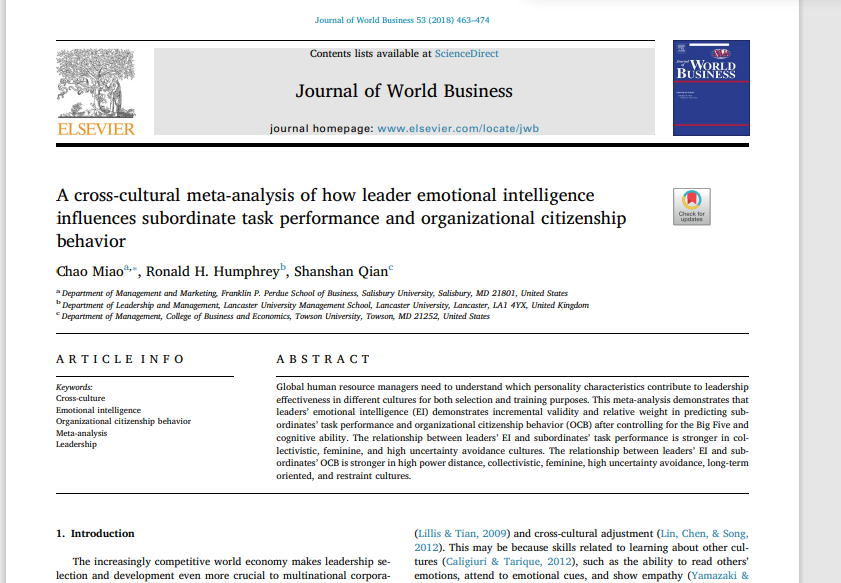
A cross-cultural meta-analysis of how leader emotional intelligence influences subordinate task performance and organizational citizenship behavior by Chao Miaoa, , Ronald.Humphrey Shanshan Qian
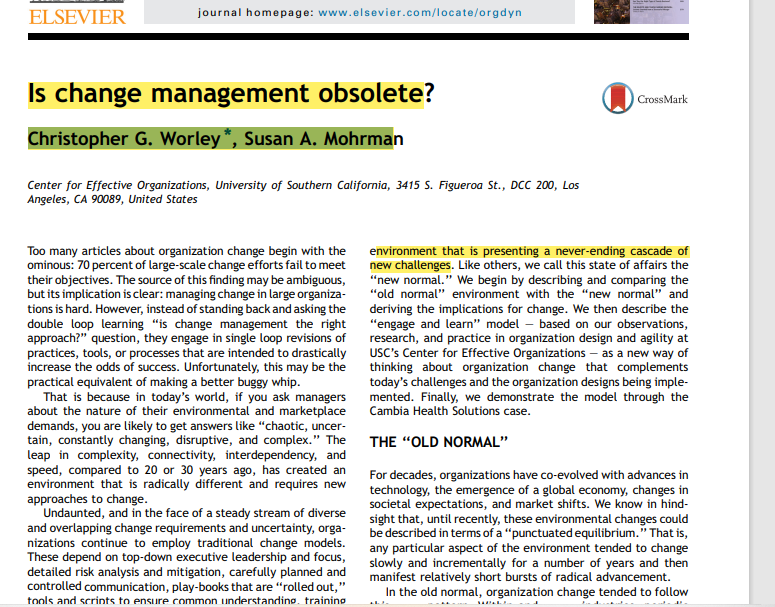
Is change management obsolete ?? by Christopher G. Worley *, Susan A. Mohrma
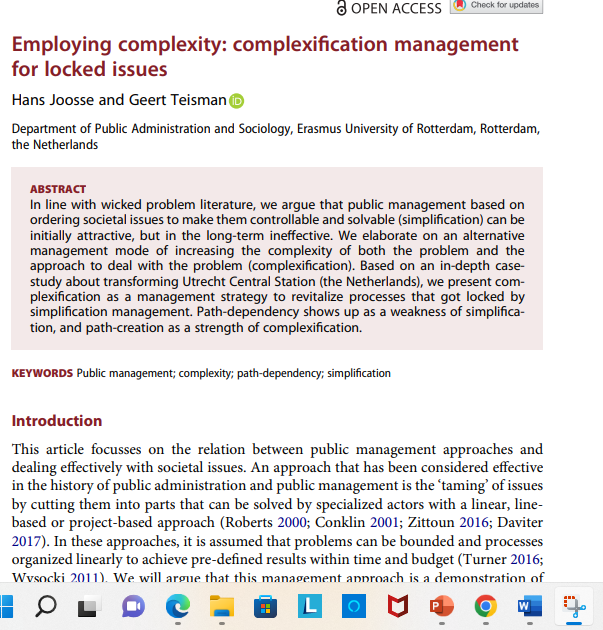
Employing complexity: complexification management for locked issues by Hans Joosse & Geert Teisman
 , Shanshan Qian
Is change management obsolete ?? by Christopher G. Worley *, Susan A. Mohrma
Employing complexity: complexification management for locked issues by Hans Joosse & Geert Teisman
Employing complexity: complexification management for locked issues Hans Joosse and Geert Teisman (D Department of Public Administration and Sociology, Erasmus University of Rotterdam, Rotterdam, the Netherlands ABSTRACT In line with wicked problem literature, we argue that public management based on ordering societal issues to make them controllable and solvable (simplification) can be initially attractive, but in the long-term ineffective. We elaborate on an alternative management mode of increasing the complexity of both the problem and the approach to deal with the problem (complexification). Based on an in-depth casestudy about transforming Utrecht Central Station (the Netherlands), we present complexification as a management strategy to revitalize processes that got locked by simplification management. Path-dependency shows up as a weakness of simplification, and path-creation as a strength of complexification. KEYWORDS Public management; complexity; path-dependency; simplification Introduction This article focusses on the relation between public management approaches and dealing effectively with societal issues. An approach that has been considered effective in the history of public administration and public management is the 'taming' of issues by cutting them into parts that can be solved by specialized actors with a linear, linebased or project-based approach (Roberts 2000; Conklin 2001; Zittoun 2016; Daviter 2017). In these approaches, it is assumed that problems can be bounded and processes organized linearly to achieve pre-defined results within time and budget (Turner 2016; Wvsocki 2011). We will aroue that this management annroach is a demonstration of Center for Effective Organizations, University of Southern California, 3415 S. Figueroa St., DCC 200, Los Angeles, CA 90089, United States Too many articles about organization change begin with the environment that is presenting a never-ending cascade of ominous: 70 percent of large-scale change efforts fail to meet new challenges. Like others, we call this state of affairs the their objectives. The source of this finding may be ambiguous, "new normal." We begin by describing and comparing the but its implication is clear: managing change in large organiza- "old normal" environment with the "new normal" and tions is hard. However, instead of standing back and asking the deriving the implications for change. We then describe the double loop learning "is change management the right "engage and learn" model - based on our observations, approach?" question, they engage in single loop revisions of research, and practice in organization design and agility at increase the odds of success. Unfortunately, this may be the thinking about organization change that complements practical equivalent of making a better buggy whip. today's challenges and the organization designs being imple- That is because in today's world, if you ask managers mented. Finally, we demonstrate the model through the about the nature of their environmental and marketplace demands, you are likely to get answers like "chaotic, uncertain, constantly changing, disruptive, and complex." The THE "OLD NORMAL" leap in complexity, connectivity, interdependency, and speed, compared to 20 or 30 years ago, has created an For decades, organizations have co-evolved with advances in environment that is radically different and requires new technology, the emergence of a global economy, changes in approaches to change. Undaunted, and in the face of a steady stream of diverse sight that, until recently, these environmental changes could and overlapping change requirements and uncertainty, orga- sight that, until recently, these environmental changes could nizations continue to employ traditional change models. any particular aspect of the environment tended to change These depend on top-down executive leadership and focus, slowly and incrementally for a number of years and then detailed risk analysis and mitigation, carefully planned and manifest relatively short bursts of radical advancement. controlled communication, play-books that are "rolled out," In the old normal, organization change tended to follow A cross-cultural meta-analysis of how leader emotional intelligence influences subordinate task performance and organizational citizenship behavior Chao Miao a,z, Ronald H. Humphrey b, Shanshan Qian c a Department of Management and Marketing Franklin P. Perdue School of Business, Salisbury University, Solistury, MD 21801, United States b Department of Leadership and Management, Lancaster Uriversity Management School, Lancaster University, Lancaster, LAI 4YX, United Kingdam "Department of Monagement, College of Business and Economics, Towson Liviversity, Towson, MD 21252, Lnited States 1. Introduction (Lillis \& Tian, 2009) and cross-cultural adjustment (Lin, Chen, \& Song, 2012). This may be because skills related to learning about other cul- The increasingly competitive world economy makes leadership se- tures (Caligiuri \& Tarique, 2012), such as the ability to read others' lection and development even more crucial to multinational corpora- emotions, attend to emotional cues, and show empathy (Yamazaki \&
Step by Step Solution
There are 3 Steps involved in it

Get step-by-step solutions from verified subject matter experts
 Study Help