







Question: (40 pts) Consider the Heckscher-Ohlin model with two countries: Home and Foreign. There are two factors capital and labor , and two goods: computers
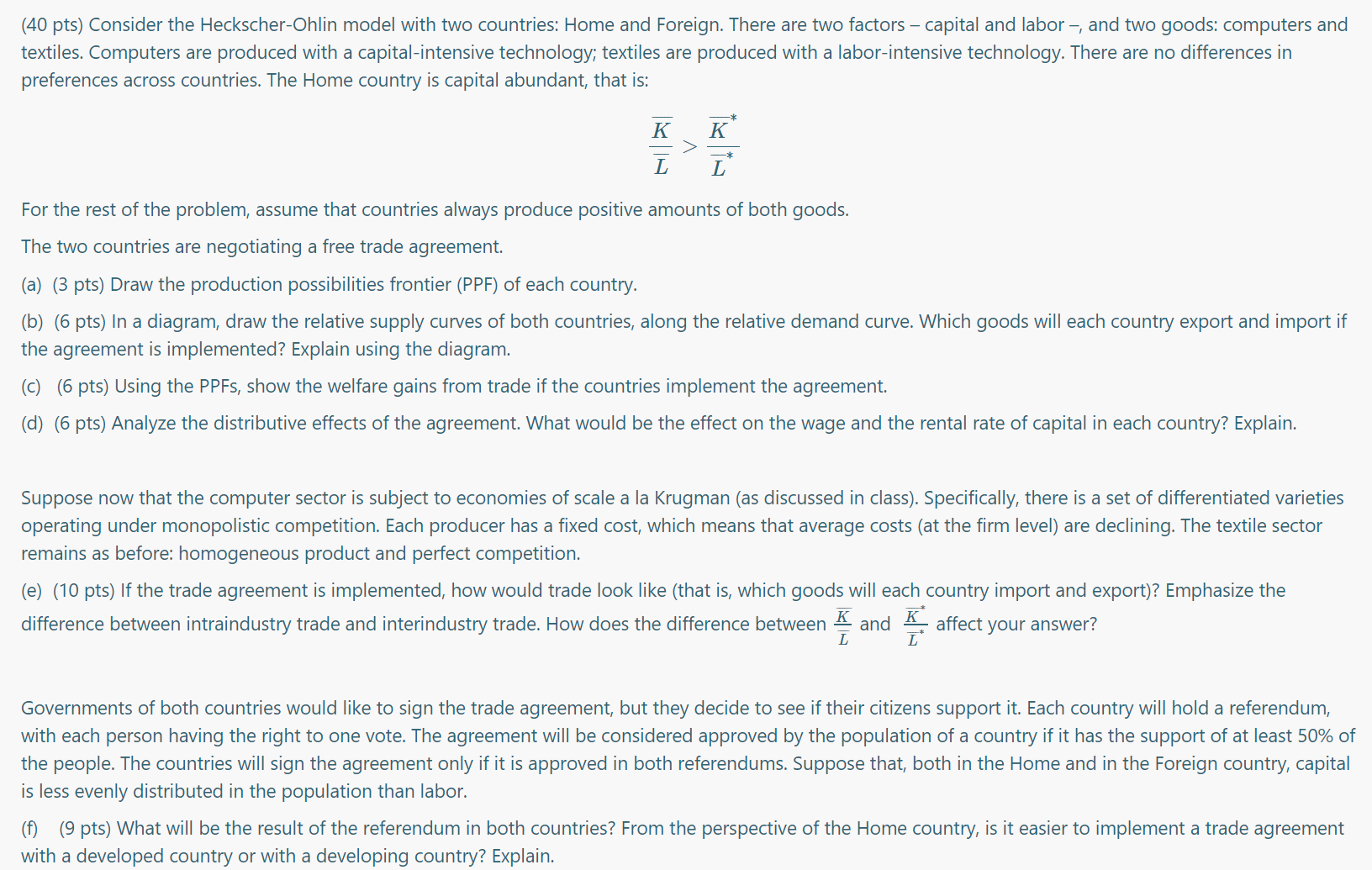
(40 pts) Consider the Heckscher-Ohlin model with two countries: Home and Foreign. There are two factors capital and labor , and two goods: computers and textiles. Computers are produced with a capital-intensive technology; textiles are produced with a labor-intensive technology. There are no differences in preferences across countries. The Home country is capital abundant, that is: For the rest of the problem, assume that countries always produce positive amounts of both goods. The two countries are negotiating a free trade agreement. (a) (3 pts) Draw the production possibilities frontier (PPF) of each country. (b) (6 pts) In a diagram, draw the relative supply curves of both countries, along the relative demand curve. Which goods will each country export and import if the agreement is implemented? Explain using the diagram. (c) (6 pts) Using the PPFs, show the welfare gains from trade if the countries implement the agreement. (d) (6 pts) Analyze the distributive effects of the agreement. What would be the effect on the wage and the rental rate of capital in each country? Explain. Suppose now that the computer sector is subject to economies of scale a la Krugman (as discussed in class). Specifically, there is a set of differentiated varieties operating under monopolistic competition. Each producer has a fixed cost, which means that average costs (at the firm level) are declining. The textile sector remains as before: homogeneous product and perfect competition. (e) (10 pts) If the trade agreement is implemented, how would trade look like (that is, which goods will each country import and export)? Emphasize the difference between intraindustry trade and interindustry trade. How does the difference between and r affect your answer? Governments of both countries would like to sign the trade agreement, but they decide to see if their citizens support it. Each country will hold a referendum, with each person having the right to one vote. The agreement will be considered approved by the population of a country if it has the support of at least 50% of the people. The countries will sign the agreement only if it is approved in both referendums. Suppose that, both in the Home and in the Foreign country, capital is less evenly distributed in the population than labor. (f) (9 pts) What will be the result of the referendum in both countries? From the perspective of the Home country, is it easier to implement a trade agreement with a developed country or with a developing country? Explain.
Step by Step Solution
There are 3 Steps involved in it

Get step-by-step solutions from verified subject matter experts
 Study Help