



Question: F G H K L Note Cells C17 and C18 include the initial cash flows today Column D through G are the operating cash flows.
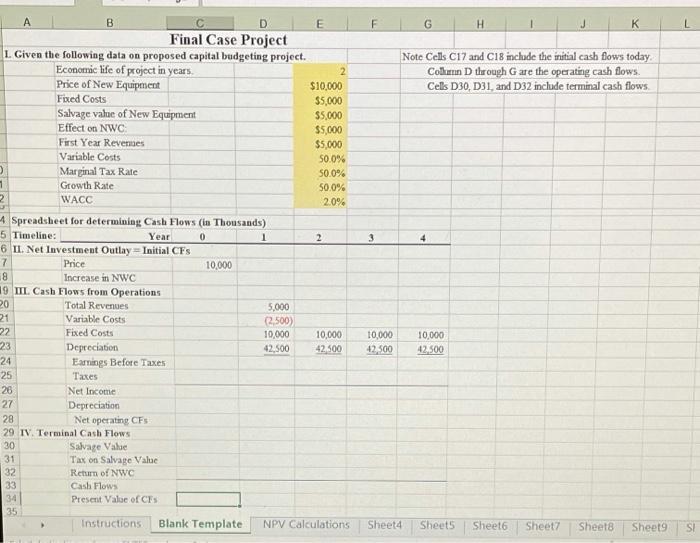
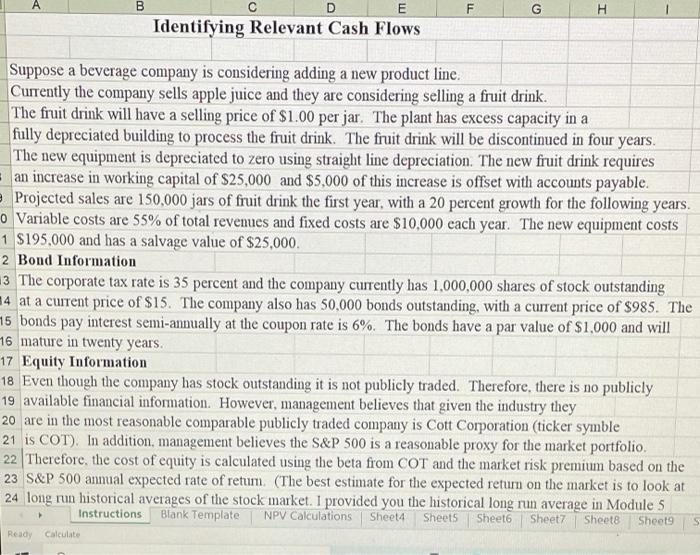
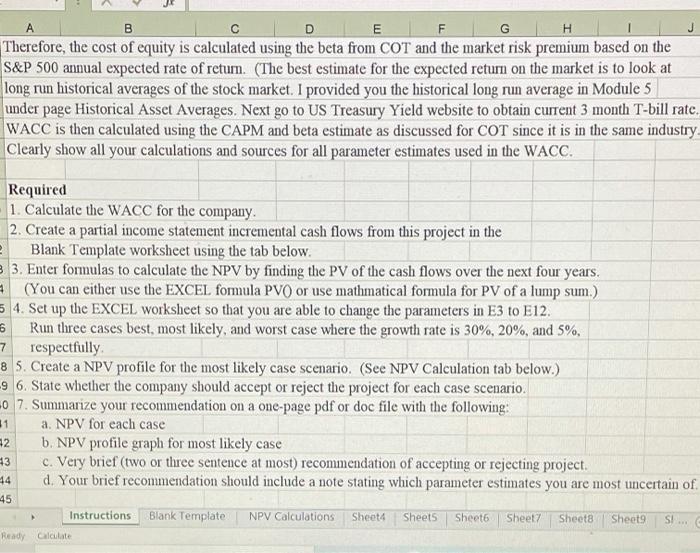
F G H K L Note Cells C17 and C18 include the initial cash flows today Column D through G are the operating cash flows. Celis D30, D31, and D32 include terminal cash flows 3 B E Final Case Project 1. Given the following data on proposed capital budgeting project. Economic life of project in years. 2 Price of New Equipment $10,000 Fixed Costs $5,000 Salvage value of New Equipment $5,000 Effect on NWC $5,000 First Year Revenues $5,000 Variable Costs 50.0% 3 Marginal Tax Rate 50.0% 1 Growth Rate 50.0% 2 WACC 20% 4 Spreadsheet for determining Cash Flows (in Thousands) 5 Timeline: Year 0 1 2 6 II. Net Investment Outlay = Initial CFS 7 Price 10,000 8 Increase in NWC 19 III Cash Flows from Operations 20 Total Revenues 5,000 21 Variable Costs (2500) 22 Fixed Costs 10,000 10,000 23 Depreciation 42.500 42.500 24 Earnings Before Taxes 25 Taxes Net Income 27 Depreciation 28 Net operating CFS 29 IV. Terminal Cash Flows 30 Salvage Value 31 Tax on Salvage Value 32 Return of NWC 33 Cash Flows 34 Present Value of CTS 35 Instructions Blank Template NPV Calculations 10,000 42.500 10,000 42,500 26 Sheet4 Sheets Sheet Sheet Sheets Sheet B G H E Identifying Relevant Cash Flows Suppose a beverage company is considering adding a new product line. Currently the company sells apple juice and they are considering selling a fruit drink. The fruit drink will have a selling price of $1.00 per jar. The plant has excess capacity in a fully depreciated building to process the fruit drink. The fruit drink will be discontinued in four years. The new equipment is depreciated to zero using straight line depreciation. The new fruit drink requires = an increase in working capital of $25,000 and $5,000 of this increase is offset with accounts payable. e Projected sales are 150,000 jars of fruit drink the first year, with a 20 percent growth for the following years. 0 Variable costs are 55% of total revenues and fixed costs are $10,000 each year. The new equipment costs 1 $195,000 and has a salvage value of $25,000. 2 Bond Information 3 The corporate tax rate is 35 percent and the company currently has 1,000,000 shares of stock outstanding 14 at a current price of $15. The company also has 50,000 bonds outstanding, with a current price of $985. The 45 bonds pay interest semi-annually at the coupon rate is 6%. The bonds have a par value of $1,000 and will 16 mature in twenty years. 17 Equity Information 18 Even though the company has stock outstanding it is not publicly traded. Therefore, there is no publicly 19 available financial information. However, management believes that given the industry they 20 are in the most reasonable comparable publicly traded company is Cott Corporation (ticker symble 21 is COT). In addition, management believes the S&P 500 is a reasonable proxy for the market portfolio. 22 Therefore, the cost of equity is calculated using the beta from COT and the market risk premium based on the 23 S&P 500 annual expected rate of retum. (The best estimate for the expected return on the market is to look at 24 long run historical averages of the stock market. I provided you the historical long run average in Module 5 Blank Template NPV Calculations Sheets Sheet Instructions Sheet4 Sheets Sheet6 Sheet S Ready Calculate B E G H Therefore, the cost of equity is calculated using the beta from COT and the market risk premium based on the S&P 500 annual expected rate of retum. (The best estimate for the expected return on the market is to look at long run historical averages of the stock market. I provided you the historical long run average in Module 5 under page Historical Asset Averages. Next go to US Treasury Yield website to obtain current 3 month T-bill rate. WACC is then calculated using the CAPM and beta estimate as discussed for COT since it is in the same industry Clearly show all your calculations and sources for all parameter estimates used in the WACC. 2 Required 1. Calculate the WACC for the company. 2. Create a partial income statement incremental cash flows from this project in the 2 Blank Template worksheet using the tab below. 3 3. Enter formulas to calculate the NPV by finding the PV of the cash flows over the next four years, (You can either use the EXCEL formula PVO or use mathmatical formula for PV of a lump sum.) 5 4. Set up the EXCEL worksheet so that you are able to change the parameters in E3 to E12. 6 Run three cases best, most likely, and worst case where the growth rate is 30%, 20%, and 5%, 7 respectfully 8 5. Create a NPV profile for the most likely case scenario. (See NPV Calculation tab below.) -9 6. State whether the company should accept or reject the project for each case scenario. -0 7. Summarize your recommendation on a one-page pdf or doc file with the following: a. NPV for each case b. NPV profile graph for most likely case c. Very brief (two or three sentence at most) recommendation of accepting or rejecting project. d. Your brief recommendation should include a note stating which parameter estimates you are most uncertain of 31 2 43 14 45 Instructions Ready Calculate Blank Template NPV Calculations Sheet Sheets Sheet6 Sheet 7 Sheets Sheet S!... F G H K L Note Cells C17 and C18 include the initial cash flows today Column D through G are the operating cash flows. Celis D30, D31, and D32 include terminal cash flows 3 B E Final Case Project 1. Given the following data on proposed capital budgeting project. Economic life of project in years. 2 Price of New Equipment $10,000 Fixed Costs $5,000 Salvage value of New Equipment $5,000 Effect on NWC $5,000 First Year Revenues $5,000 Variable Costs 50.0% 3 Marginal Tax Rate 50.0% 1 Growth Rate 50.0% 2 WACC 20% 4 Spreadsheet for determining Cash Flows (in Thousands) 5 Timeline: Year 0 1 2 6 II. Net Investment Outlay = Initial CFS 7 Price 10,000 8 Increase in NWC 19 III Cash Flows from Operations 20 Total Revenues 5,000 21 Variable Costs (2500) 22 Fixed Costs 10,000 10,000 23 Depreciation 42.500 42.500 24 Earnings Before Taxes 25 Taxes Net Income 27 Depreciation 28 Net operating CFS 29 IV. Terminal Cash Flows 30 Salvage Value 31 Tax on Salvage Value 32 Return of NWC 33 Cash Flows 34 Present Value of CTS 35 Instructions Blank Template NPV Calculations 10,000 42.500 10,000 42,500 26 Sheet4 Sheets Sheet Sheet Sheets Sheet B G H E Identifying Relevant Cash Flows Suppose a beverage company is considering adding a new product line. Currently the company sells apple juice and they are considering selling a fruit drink. The fruit drink will have a selling price of $1.00 per jar. The plant has excess capacity in a fully depreciated building to process the fruit drink. The fruit drink will be discontinued in four years. The new equipment is depreciated to zero using straight line depreciation. The new fruit drink requires = an increase in working capital of $25,000 and $5,000 of this increase is offset with accounts payable. e Projected sales are 150,000 jars of fruit drink the first year, with a 20 percent growth for the following years. 0 Variable costs are 55% of total revenues and fixed costs are $10,000 each year. The new equipment costs 1 $195,000 and has a salvage value of $25,000. 2 Bond Information 3 The corporate tax rate is 35 percent and the company currently has 1,000,000 shares of stock outstanding 14 at a current price of $15. The company also has 50,000 bonds outstanding, with a current price of $985. The 45 bonds pay interest semi-annually at the coupon rate is 6%. The bonds have a par value of $1,000 and will 16 mature in twenty years. 17 Equity Information 18 Even though the company has stock outstanding it is not publicly traded. Therefore, there is no publicly 19 available financial information. However, management believes that given the industry they 20 are in the most reasonable comparable publicly traded company is Cott Corporation (ticker symble 21 is COT). In addition, management believes the S&P 500 is a reasonable proxy for the market portfolio. 22 Therefore, the cost of equity is calculated using the beta from COT and the market risk premium based on the 23 S&P 500 annual expected rate of retum. (The best estimate for the expected return on the market is to look at 24 long run historical averages of the stock market. I provided you the historical long run average in Module 5 Blank Template NPV Calculations Sheets Sheet Instructions Sheet4 Sheets Sheet6 Sheet S Ready Calculate B E G H Therefore, the cost of equity is calculated using the beta from COT and the market risk premium based on the S&P 500 annual expected rate of retum. (The best estimate for the expected return on the market is to look at long run historical averages of the stock market. I provided you the historical long run average in Module 5 under page Historical Asset Averages. Next go to US Treasury Yield website to obtain current 3 month T-bill rate. WACC is then calculated using the CAPM and beta estimate as discussed for COT since it is in the same industry Clearly show all your calculations and sources for all parameter estimates used in the WACC. 2 Required 1. Calculate the WACC for the company. 2. Create a partial income statement incremental cash flows from this project in the 2 Blank Template worksheet using the tab below. 3 3. Enter formulas to calculate the NPV by finding the PV of the cash flows over the next four years, (You can either use the EXCEL formula PVO or use mathmatical formula for PV of a lump sum.) 5 4. Set up the EXCEL worksheet so that you are able to change the parameters in E3 to E12. 6 Run three cases best, most likely, and worst case where the growth rate is 30%, 20%, and 5%, 7 respectfully 8 5. Create a NPV profile for the most likely case scenario. (See NPV Calculation tab below.) -9 6. State whether the company should accept or reject the project for each case scenario. -0 7. Summarize your recommendation on a one-page pdf or doc file with the following: a. NPV for each case b. NPV profile graph for most likely case c. Very brief (two or three sentence at most) recommendation of accepting or rejecting project. d. Your brief recommendation should include a note stating which parameter estimates you are most uncertain of 31 2 43 14 45 Instructions Ready Calculate Blank Template NPV Calculations Sheet Sheets Sheet6 Sheet 7 Sheets Sheet S
Step by Step Solution
There are 3 Steps involved in it

Get step-by-step solutions from verified subject matter experts