







Question: f) What are UPS expectations from involvement in APQC ? g) Explain the challenges that UPS faces in delivering quality services? How they can be
 f) What are UPS expectations from involvement in APQC ?
g) Explain the challenges that UPS faces in delivering quality services? How they can be coped up in order to remain competitive in global market?
h) How the adopted Approaches benefit the UPS in terms of its benefits?
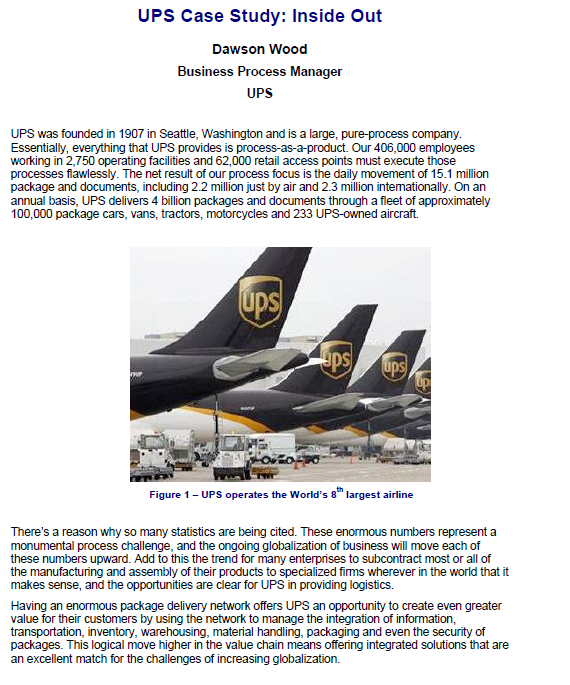
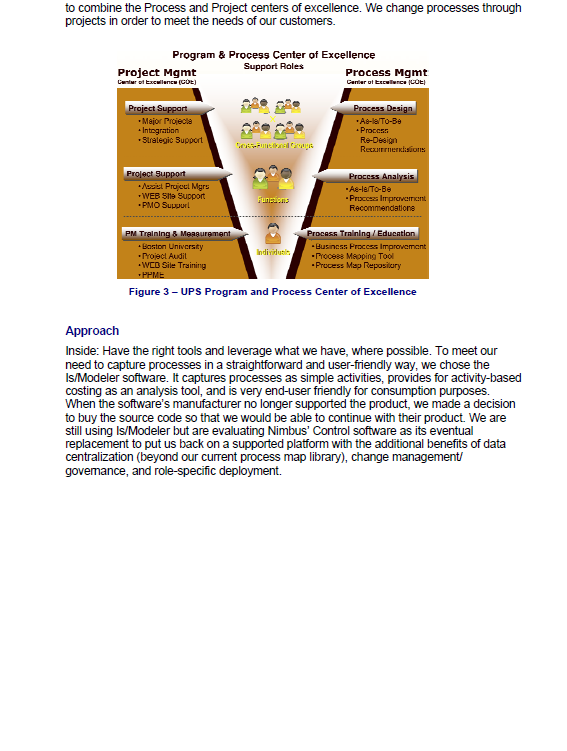
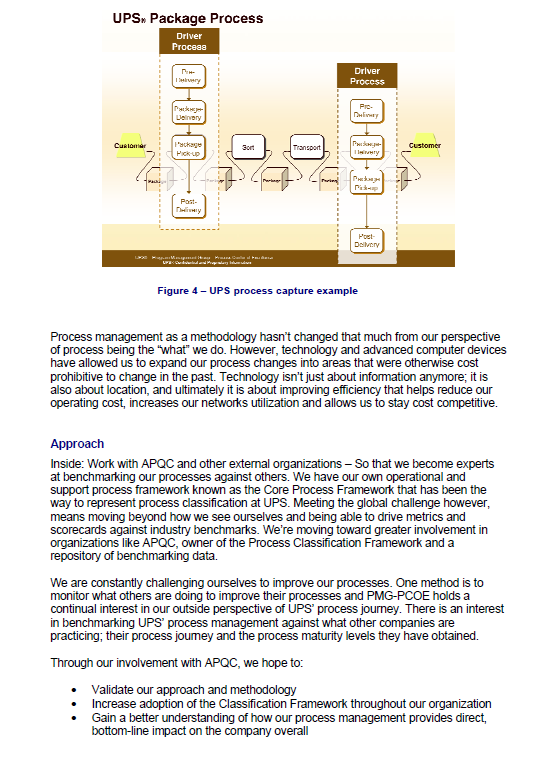
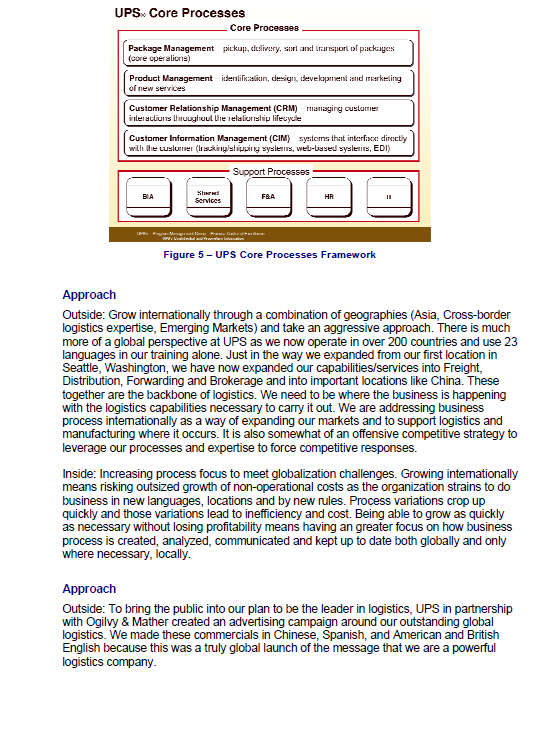
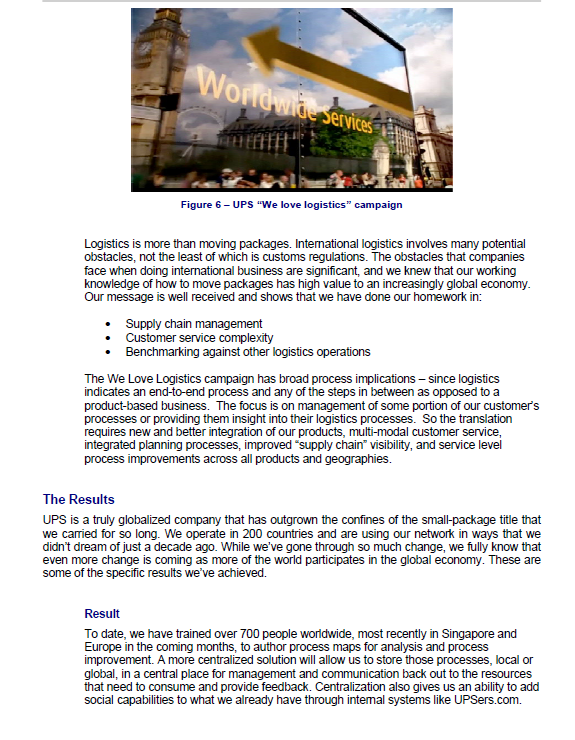
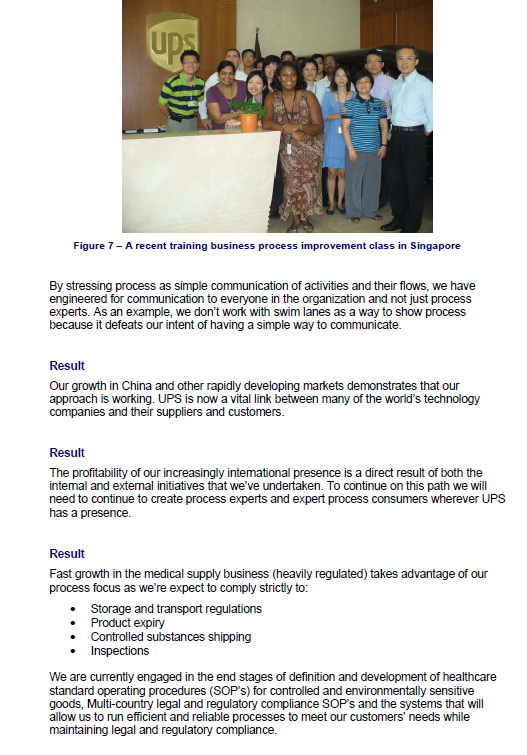
UPS Case Study: Inside Out Dawson Wood Business Process Manager UPS UPS was founded in 1907 in Seattle, Washington and is a large, pure-process company. Essentially, everything that UPS provides is process-as-a-product. Our 406,000 employees working in 2,750 operating facilities and 62,000 retail access points must execute those processes flawlessly. The net result of our process focus is the daily movement of 15.1 million package and documents, including 2.2 million just by air and 2.3 million interationally. On an annual basis, UPS delivers 4 billion packages and documents through a fleet of approximately 100,000 package cars, vans, tractors, motorcycles and 233 UPS-owned aircraft. UDS UPS ups) up Figure 1 - UPS operates the World's 8th largest airline There's a reason why so many statistics are being cited. These enormous numbers represent a monumental process challenge, and the ongoing globalization of business will move each of these numbers upward. Add to this the trend for many enterprises to subcontract most or all of the manufacturing and assembly of their products to specialized firms wherever in the world that it makes sense, and the opportunities are clear for UPS in providing logistics. Having an enormous package delivery network offers UPS an opportunity to create even greater value for their customers by using the network to manage the integration of information, transportation, inventory, warehousing, material handling, packaging and even the security of packages. This logical move higher in the value chain means offering integrated solutions that are an excellent match for the challenges of increasing globalization. to combine the Process and Project centers of excellence. We change processes through projects in order to meet the needs of our customers. Program & Process Center of Excellence Support Roles Project Mgmt Process Mgmt Centro Excellence (COE) Center of Excellent Project Support Major Projecte - Integration Strategic Support Process Design As-l/To-Be Process Re-Design Recamerksom Project Support Mexist Project Mars WEB SIT Support PMO Support Process Analysis As-le/To-Be - Process Improvec Recommendations Functions PM Training & Measurement Boston University Project Audit .WCB Sile Training Individuals Process Training / Education Business Process Improvement - Process Mapping Tool - Process Map Repository PPME Figure 3 - UPS Program and Process Center of Excellence Approach Inside: Have the right tools and leverage what we have, where possible. To meet our need to capture processes in a straightforward and user-friendly way, we chose the Is/Modeler software. It captures processes as simple activities, provides for activity-based costing as an analysis tool, and is very end-user friendly for consumption purposes. When the software's manufacturer no longer supported the product, we made a decision to buy the source code so that we would be able to continue with their product. We are still using Is/Modeler but are evaluating Nimbus' Control software as its eventual replacement to put us back on a supported platform with the additional benefits of data centralization (beyond our current process map library), change management/ govemance, and role-specific deployment UPS. Package Process Driver Procesa very Driver Process Pre- Dwy Uovary Curton Transport Customer Pickup 1 Purina Post- Delivery Muscat Figure 4 - UPS process capture example Process management as a methodology hasn't changed that much from our perspective of process being the "what we do. However, technology and advanced computer devices have allowed us to expand our process changes into areas that were otherwise cost prohibitive to change in the past. Technology isn't just about information anymore, it is also about location, and ultimately it is about improving efficiency that helps reduce our operating cost, increases our networks utilization and allows us to stay cost competitive. Approach Inside: Work with APQC and other external organizations - So that we become experts at benchmarking our processes against others. We have our own operational and support process framework known as the Core Process Framework that has been the way to represent process classification at UPS. Meeting the global challenge however, means moving beyond how we see ourselves and being able to drive metrics and scorecards against industry benchmarks. We're moving toward greater involvement in organizations like APQC, owner of the Process Classification Framework and a repository of benchmarking data. We are constantly challenging ourselves to improve our processes. One method is to monitor what others are doing to improve their processes and PMG-PCOE holds a continual interest in our outside perspective of UPS process journey. There is an interest in benchmarking UPS process management against what other companies are practicing; their process journey and the process maturity levels they have obtained. Through our involvement with APQC, we hope to: Validate our approach and methodology Increase adoption of the Classification Framework throughout our organization Gain a better understanding of how our process management provides direct, bottom-line impact on the company overall UPS. Core Processes Core Processes Package Management prikup, ciclinery, surt and transport of packages (core operalions) Product Management identification, design, development and rearkeling of new services Customer Relationship Management (CRM)manying customer interacliuits hughuul the relaliurrsip lifecycle Customer Information Management (CIM) systems that interface directly will be usluter (Irscking slipping systems, web-based systems, EDI) Support Processes BIA Sus Services FAA HR Figure 5 - UPS Core Processes Framework Approach Outside: Grow internationally through a combination of geographies (Asia, Cross-border logistics expertise, Emerging Markets) and take an aggressive approach. There is much more of a global perspective at UPS as we now operate in over 200 countries and use 23 languages in our training alone. Just in the way we expanded from our first location in Seattle, Washington, we have now expanded our capabilities/services into Freight, Distribution, Forwarding and Brokerage and into important locations like China. These together are the backbone of logistics. We need to be where the business is happening with the logistics capabilities necessary to carry it out. We are addressing business process internationally as a way of expanding our markets and to support logistics and manufacturing where it occurs. It is also somewhat of an offensive competitive strategy to leverage our processes and expertise to force competitive responses. Inside: Increasing process focus to meet globalization challenges. Growing interationally means risking outsized growth of non-operational costs as the organization strains to do business in new languages, locations and by new rules. Process variations crop up quickly and those variations lead to inefficiency and cost. Being able to grow as quickly as necessary without losing profitability means having an greater focus on how business process is created, analyzed communicated and kept up to date both globally and only where necessary, locally. Approach Outside: To bring the public into our plan to be the leader in logistics, UPS in partnership with Ogilvy & Mather created an advertising campaign around our outstanding global logistics. We made these commercials in Chinese, Spanish, and American and British English because this was a truly global launch of the message that we are a powerful logistics company. Worldwide Services Figure 6 - UPS We love logistics" campaign Logistics is more than moving packages. International logistics involves many potential obstacles, not the least of which is customs regulations. The obstacles that companies face when doing international business are significant, and we knew that our working knowledge of how to move packages has high value to an increasingly global economy. Our message is well received and shows that we have done our homework in: Supply chain management Customer service complexity Benchmarking against other logistics operations The We Love Logistics campaign has broad process implications - since logistics indicates an end-to-end process and any of the steps in between as opposed to a product-based business. The focus is on management of some portion of our customer's processes or providing them insight into their logistics processes. So the translation requires new and better integration of our products, multi-modal customer service, integrated planning processes, improved "supply chain visibility, and service level process improvements across all products and geographies. The Results UPS is a truly globalized company that has outgrown the confines of the small-package title that we carried for so long. We operate in 200 countries and are using our network in ways that we didn't dream of just a decade ago. While we've gone through so much change, we fully know that even more change is coming as more of the world participates in the global economy. These are some of the specific results we've achieved. Result To date, we have trained over 700 people worldwide, most recently in Singapore and Europe in the coming months, to author process maps for analysis and process improvement. A more centralized solution will allow us to store those processes, local or global, in a central place for management and communication back out to the resources that need to consume and provide feedback. Centralization also gives us an ability to add social capabilities to what we already have through intemal systems like UPSers.com. ups Figure 7 - A recent training business process improvement class in Singapore By stressing process as simple communication of activities and their flows, we have engineered for communication to everyone in the organization and not just process experts. As an example, we don't work with swim lanes as a way to show process because it defeats our intent of having a simple way to communicate. Result Our growth in China and other rapidly developing markets demonstrates that our approach is working. UPS is now a vital link between many of the world's technology companies and their suppliers and customers. Result The profitability of our increasingly intemational presence is a direct result of both the intemal and external initiatives that we've undertaken. To continue on this path we will need to continue to create process experts and expert process consumers wherever UPS has a presence. Result Fast growth in the medical supply business (heavily regulated) takes advantage of our process focus as we're expect to comply strictly to: Storage and transport regulations Product expiry Controlled substances shipping Inspections We are currently engaged in the end stages of definition and development of healthcare standard operating procedures (SOP's) for controlled and environmentally sensitive goods, Multi-country legal and regulatory compliance SOP's and the systems that will allow us to run efficient and reliable processes to meet our customers' needs while maintaining legal and regulatory complianceStep by Step Solution
There are 3 Steps involved in it
1 Expert Approved Answer
Step: 1 Unlock

Question Has Been Solved by an Expert!
Get step-by-step solutions from verified subject matter experts
Step: 2 Unlock
Step: 3 Unlock
 Study Help