Question: FEMA IS-251 course help with abswers please 1. An Alerting Administrator is tasked with developing plans, policies, and procedures for IPAWS use. Without evaluating any
FEMA IS-251 course
help with abswers please
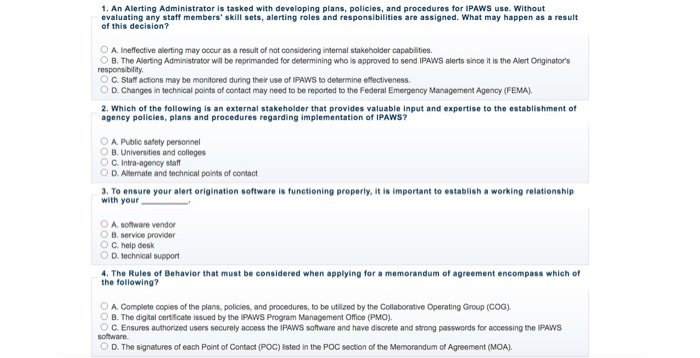
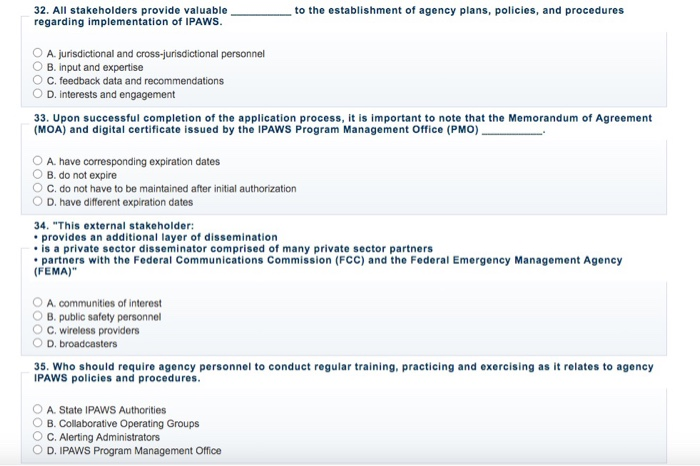
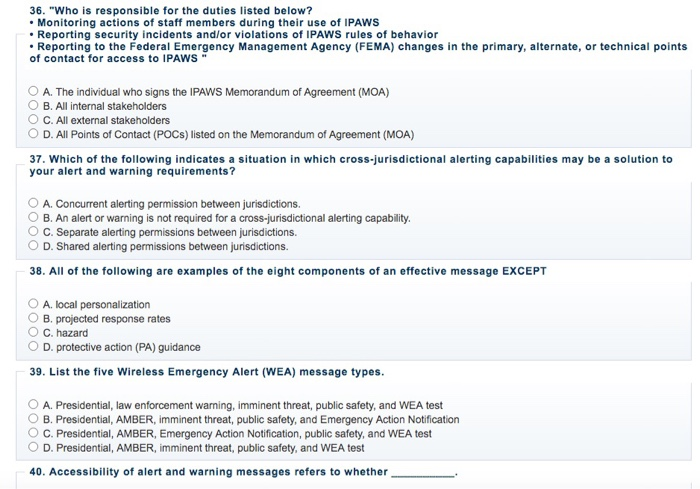
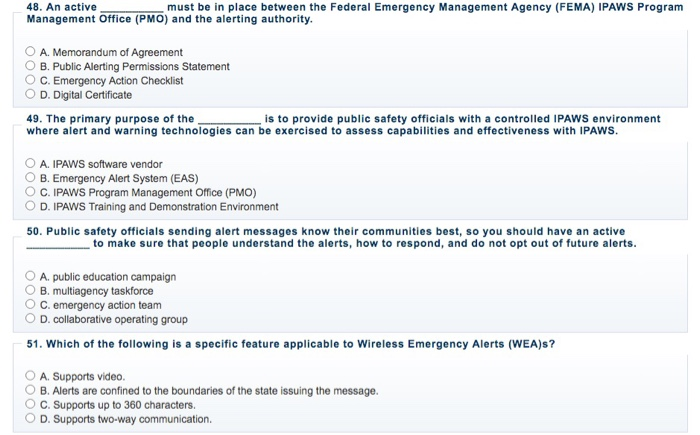
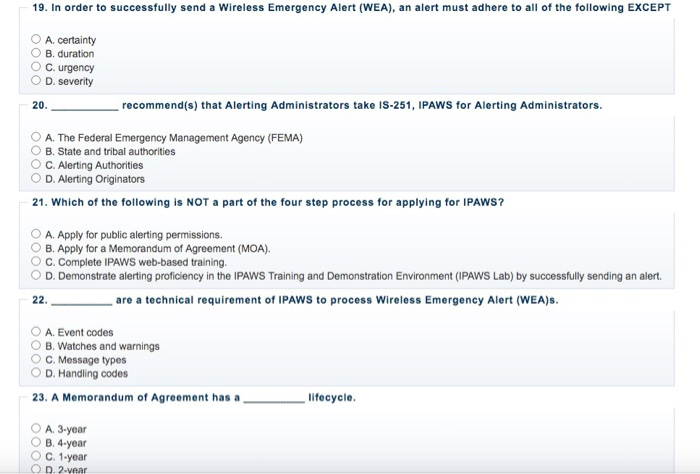
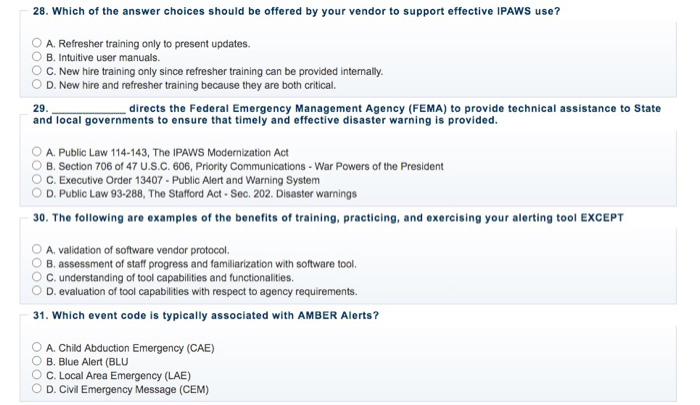
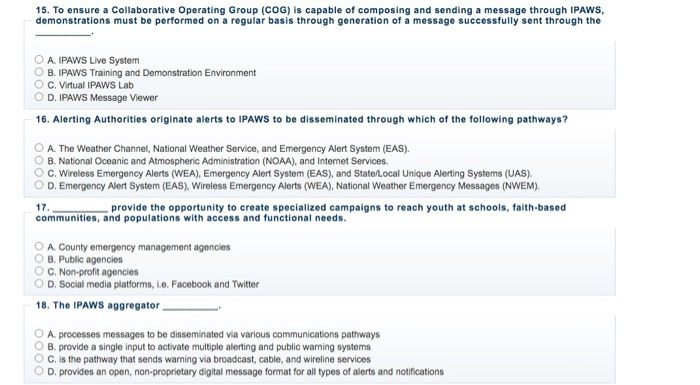
1. An Alerting Administrator is tasked with developing plans, policies, and procedures for IPAWS use. Without evaluating any staff members' skill sets, alerting roles and responsibilities are assigned. What may happen as a result of this decision? O A ineffective alerting may occur as a result of not considering internal stakeholder capabilities. OB. The Alerting Administrator will be reprimanded for determining who is approved to send IPAWS alerts since it is the Alert Originator's responsibility OC Staff actions may be monitored during their use of IPAWS to determine effectiveness OD. Changes in technical points of contact may need to be reported to the Federal Emergency Management Agency (FEMA). 2. Which of the following is an external stakeholder that provides valuable input and expertise to the establishment of agency policies, plans and procedures regarding implementation of IPAWS? O A. Public safety personnel OB. Universities and colleges O Cintra-agency staff OD. Alternate and technical points of contact 3. To ensure your alert origination software is functioning properly. It is important to establish a working relationship with your O A software vendor OB.service provider OC. helpdesk OD technical support 4. The Rules of Behavior that must be considered when applying for a memorandum of agreement encompass which of the O A Complete copies of the plans, policies, and procedures, to be utilized by the Collaborative Operating Group (COG). OB. The digital certificate issued by the IPAWS Program Management Office (PMO). OC. Ensures authorized users securely access the IPAWS software and have discrete and strong passwords for accessing the IPAWS software O D. The signatures of each Point of contact (POC) listed in the POC section of the Memorandum of Agreement (MOA). 32. All stakeholders provide valuable regarding implementation of IPAWS. to the establishment of agency plans, policies, and procedures A. jurisdictional and cross-jurisdictional personnel B. input and expertise C. feedback data and recommendations D. interests and engagement 33. Upon successful completion of the application process, it is important to note that the Memorandum of Agreement (MOA) and digital certificate issued by the IPAWS Program Management Office (PMO). A. have corresponding expiration dates B. do not expire C. do not have to be maintained after initial authorization D. have different expiration dates 34. "This external stakeholder: provides an additional layer of dissemination is a private sector disseminator comprised of many private sector partners partners with the Federal Communications Commission (FCC) and the Federal Emergency Management Agency (FEMA)" A. communities of interest B. public safety personnel C. wireless providers D. broadcasters 35. Who should require agency personnel to conduct regular training, practicing and exercising as it relates to agency IPAWS policies and procedures. OOOO A. State IPAWS Authorities B. Collaborative Operating Groups C. Alerting Administrators O D.IPAWS Program Management Office . 36. "Who is responsible for the duties listed below? Monitoring actions of staff members during their use of IPAWS Reporting security incidents and/or violations of IPAWS rules of behavior Reporting to the Federal Emergency Management Agency (FEMA) changes in the primary, alternate, or technical points of contact for access to IPAWS A. The individual who signs the IPAWS Memorandum of Agreement (MOA) B. All internal stakeholders C. All external stakeholders D. All Points of Contact (POCs) listed on the Memorandum of Agreement (MOA) 37. Which of the following indicates a situation in which cross-jurisdictional alerting capabilities may be a solution to your alert and warning requirements? A. Concurrent alerting permission between jurisdictions. B. An alert or warning is not required for a cross-jurisdictional alerting capability. C. Separate alerting permissions between jurisdictions. D. Shared alerting permissions between jurisdictions. 38. All of the following are examples of the eight components of an effective message EXCEPT OOOO A. local personalization B. projected response rates C. hazard D. protective action (PA) guidance 39. List the five Wireless Emergency Alert (WEA) message types. 0 0 0 0 A. Presidential, law enforcement warning, imminent threat, public safety, and WEA test B. Presidential, AMBER, imminent threat, public safety, and Emergency Action Notification C. Presidential, AMBER, Emergency Action Notification, public safety, and WEA test D. Presidential, AMBER, imminent threat, public safety, and WEA test 40. Accessibility of alert and warning messages refers to whether 48. An active must be in place between the Federal Emergency Management Agency (FEMA) IPAWS Program Management Office (PMO) and the alerting authority. A. Memorandum of Agreement B. Public Alerting Permissions Statement C. Emergency Action Checklist O D. Digital Certificate 49. The primary purpose of the is to provide public safety officials with a controlled IPAWS environment where alert and warning technologies can be exercised to assess capabilities and effectiveness with IPAWS. A. IPAWS software vendor B. Emergency Alert System (EAS) C. IPAWS Program Management Office (PMO) OD. IPAWS Training and Demonstration Environment 50. Public safety officials sending alert messages know their communities best, so you should have an active to make sure that people understand the alerts, how to respond, and do not opt out of future alerts. OOOO A. public education campaign B. multiagency taskforce C. emergency action team D. collaborative operating group 51. Which of the following is a specific feature applicable to Wireless Emergency Alerts (WEA)s? OOOO A. Supports video. B. Alerts are confined to the boundaries of the state issuing the message. C. Supports up to 360 characters. D. Supports two-way communication 19. In order to successfully send a Wireless Emergency Alert (WEA), an alert must adhere to all of the following EXCEPT A. certainty B, duration C. urgency D. severity 20. recommend(s) that Alerting Administrators take IS-251, IPAWS for Alerting Administrators. OOOO A. The Federal Emergency Management Agency (FEMA) B. State and tribal authorities C. Alerting Authorities D. Alerting Originators 21. Which of the following is NOT a part of the four step process for applying for IPAWS? A. Apply for public alerting permissions. B. Apply for a Memorandum of Agreement (MOA). OC. Complete IPAWS web-based training. D. Demonstrate alerting proficiency in the IPAWS Training and Demonstration Environment (IPAWS Lab) by successfully sending an alert. are a technical requirement of IPAWS to process Wireless Emergency Alert (WEA)s. 22. A. Event codes B. Watches and warnings C. Message types O D. Handling codes 23. A Memorandum of Agreement has a lifecycle. O A. 3-year OB. 4-year C. 1-year OD 2.var 28. Which of the answer choices should be offered by your vendor to support effective IPAWS use? A. Refresher training only to present updates. B. Intuitive user manuals. C. New hire training only since refresher training can be provided internally. D. New hire and refresher training because they are both critical. 29. directs the Federal Emergency Management Agency (FEMA) to provide technical assistance to State and local governments to ensure that timely and effective disaster warning is provided. A. Public Law 114-143, The IPAWS Modernization Act B. Section 706 of 47 U.S.C. 606, Priority Communications - War Powers of the President C. Executive Order 13407 - Public Alert and Warning System D. Public Law 93-288, The Stafford Act - Sec. 202. Disaster warnings 30. The following are examples of the benefits of training, practicing, and exercising your alerting tool EXCEPT OOOO A. validation of software vendor protocol. B. assessment of staff progress and familiarization with software tool. C. understanding of tool capabilities and functionalities. D. evaluation of tool capabilities with respect to agency requirements. 31. Which event code is typically associated with AMBER Alerts? A. Child Abduction Emergency (CAE) B. Blue Alert (BLU C. Local Area Emergency (LAE) D. Civil Emergency Message (CEM) 15. To ensure a Collaborative Operating Group (COG) is capable of composing and sending a message through IPAWS, demonstrations must be performed on a regular basis through generation of a message successfully sent through the A. IPAWS Live System OB. IPAWS Training and Demonstration Environment O C. Virtual IPAWS Lab OD. IPAWS Message Viewer 16. Alerting Authorities originate alerts to IPAWS to be disseminated through which of the following pathways? A. The Weather Channel, National Weather Service, and Emergency Alert System (EAS). B. National Oceanic and Atmospheric Administration (NOAA), and Internet Services. C. Wireless Emergency Alerts (WEA), Emergency Alert System (EAS), and State/Local Unique Alerting Systems (UAS). OD. Emergency Alert System (EAS), Wireless Emergency Alerts (WEA), National Weather Emergency Messages (NWEM). provide the opportunity to create specialized campaigns to reach youth at schools, faith-based communities, and populations with access and functional needs. 17. A. County emergency management agencies B. Public agencies O C. Non-profit agencies OD. Social media platforms, i.e. Facebook and Twitter 18. The IPAWS aggregator A. processes messages to be disseminated via various communications pathways B. provide a single input to activate multiple alerting and public warning systems O C. Is the pathway that sends warning via broadcast, cable, and wireline services OD. provides an open, non-proprietary digital message format for all types of alerts and notifications









 Study Help