







Question: $F=Fleft(X_{1}, X_{2}, ldots, X_{N} ight)$ is called a homogeneous function of order $k$ if $Fleft(lambda X_{1}, lambda X_{2}, ldots, lambda X_{N} ight)=lambda^{k} Fleft(x_{1}, X_{2}, ldots,
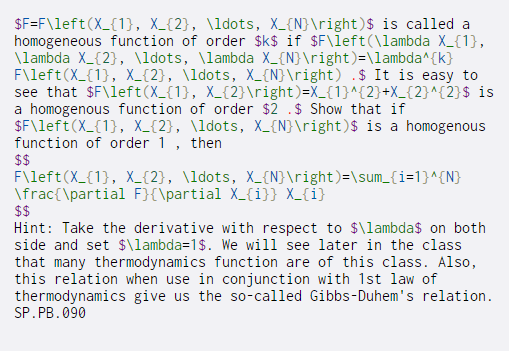
$F=F\left(X_{1}, X_{2}, \ldots, X_{N} ight)$ is called a homogeneous function of order $k$ if $F\left(\lambda X_{1}, \lambda X_{2}, \ldots, \lambda X_{N} ight)=\lambda^{k} F\left(x_{1}, X_{2}, \ldots, X_{N} ight) $ It is easy to see that $F\left(x_{1}, X_{2} ight)=x_{1}^{2}+x_{2}^{2}$ is a homogenous function of order $2 $ Show that if $F\left(X_{1}, X_{2}, \ldots, X_{N} ight)$ is a homogenous function of order 1, then $$ F\left(x_{1}, X_{2}, \ldots, X_{N} ight)=\sum_{i=1}^{N} \frac{\partial F}{\partial X_{i}} X_{i} $$ Hint: Take the derivative with respect to $\lambda$ on both side and set $\lambda=1$. We will see later in the class that many thermodynamics function are of this class. Also, this relation when use in conjunction with 1st law of thermodynamics give us the so-called Gibbs-Duhem's relation. SP.PB. 090
Step by Step Solution
There are 3 Steps involved in it

Get step-by-step solutions from verified subject matter experts
 Study Help