



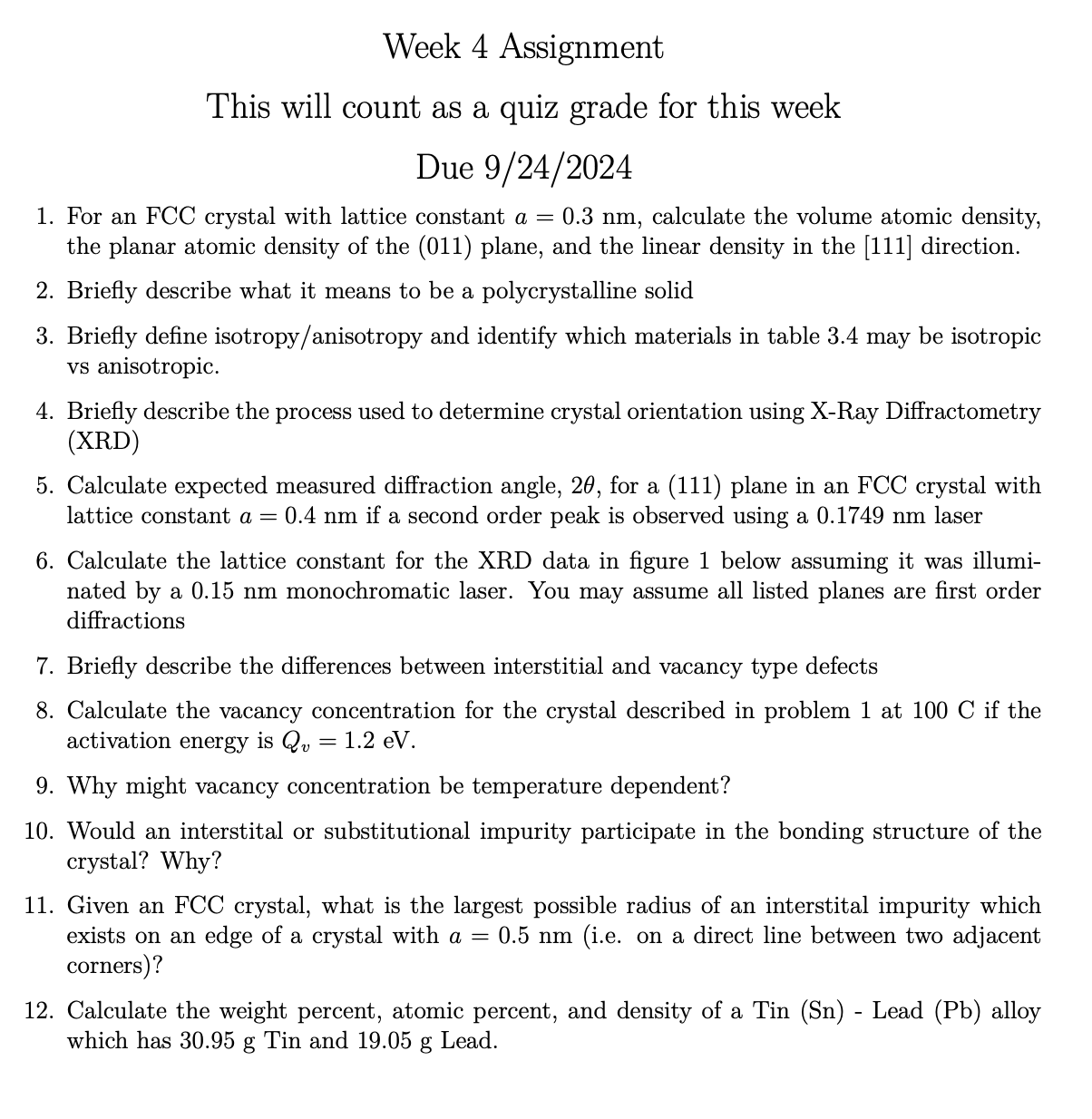
Question: Figure 1 : XRD data For an FCC crystal with lattice constant a = 0 . 3 n m , calculate the volume atomic density,
Figure : XRD data
For an FCC crystal with lattice constant calculate the volume atomic density,
the planar atomic density of the plane, and the linear density in the direction.
Briefly describe what it means to be a polycrystalline solid
Briefly define isotropyanisotropy and identify which materials in table may be isotropic
vs anisotropic.
Briefly describe the process used to determine crystal orientation using XRay Diffractometry
XRD
Calculate expected measured diffraction angle, for a plane in an FCC crystal with
lattice constant if a second order peak is observed using a nm laser
Calculate the lattice constant for the XRD data in figure below assuming it was illumi
nated by a nm monochromatic laser. You may assume all listed planes are first order
diffractions
Briefly describe the differences between interstitial and vacancy type defects
Calculate the vacancy concentration for the crystal described in problem at C if the
activation energy is
Why might vacancy concentration be temperature dependent?
Would an interstital or substitutional impurity participate in the bonding structure of the
crystal? Why?
Given an FCC crystal, what is the largest possible radius of an interstital impurity which
exists on an edge of a crystal with ie on a direct line between two adjacent
corners
Calculate the weight percent, atomic percent, and density of a Tin Sn
Step by Step Solution
There are 3 Steps involved in it
1 Expert Approved Answer
Step: 1 Unlock

Question Has Been Solved by an Expert!
Get step-by-step solutions from verified subject matter experts
Step: 2 Unlock
Step: 3 Unlock