







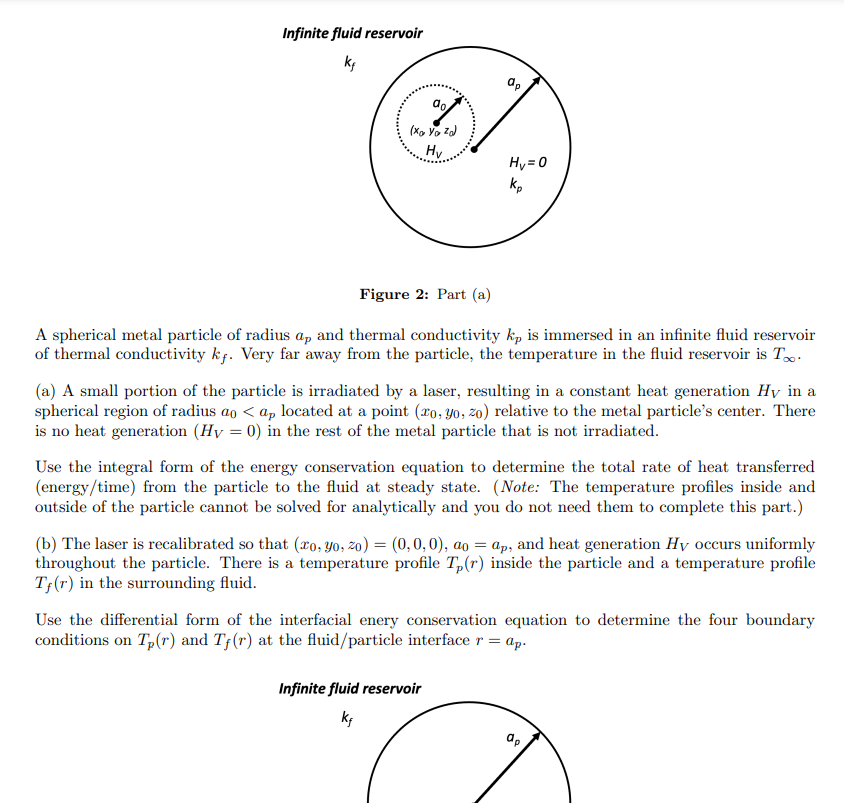
Question: Figure 2 : Part ( a ) A spherical metal particle of radius a p and thermal conductivity k p is immersed in an infinite
Figure : Part a
A spherical metal particle of radius and thermal conductivity is immersed in an infinite fluid reservoir
of thermal conductivity Very far away from the particle, the temperature in the fluid reservoir is
a A small portion of the particle is irradiated by a laser, resulting in a constant heat generation in a
spherical region of radius located a point relative the metal particle's center. There
heat generation the rest the metal particle that not irradiated.
Use the integral form the energy conservation equation determine the total rate heat transferred
ime from the particle the fluid steady state. : The temperature profiles inside and
outside the particle cannot solved for analytically and you not need them complete this part.
The laser recalibrated that and heat generation occurs uniformly
throughout the particle. There a temperature profile inside the particle and a temperature profile
the surrounding fluid.
Use the differential form the interfacial enery conservation equation determine the four boundary
conditions and the fluiarticle interface
Step by Step Solution
There are 3 Steps involved in it
1 Expert Approved Answer
Step: 1 Unlock

Question Has Been Solved by an Expert!
Get step-by-step solutions from verified subject matter experts
Step: 2 Unlock
Step: 3 Unlock
 Study Help