







Question: Fill in the blanks AG below. Here, we consider a binary solution system, composed of component-I and component-2. At the composition limit of 3 -
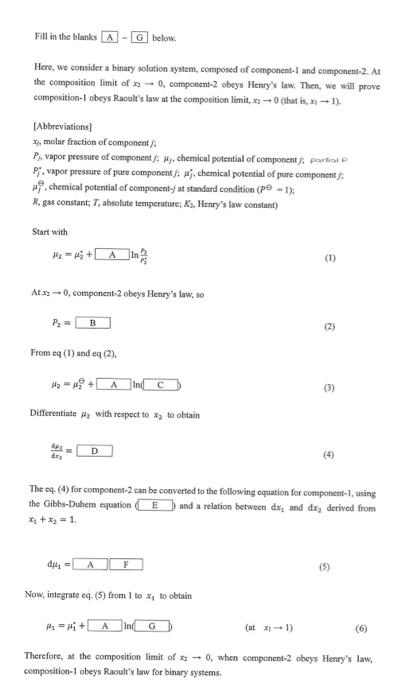
Fill in the blanks AG below. Here, we consider a binary solution system, composed of component-I and component-2. At the composition limit of 3 - 0 component-2 oboys Henry's law. Then, we will prove composition-I obeys Raoult's law at the composition limit, *3 - 0 (that is x + 1). [Abbreviations) x, molar fraction of component Ps, vapor pressure of component: Ny, chemical potential of component) portio Pjevapor pressure of pure component): . chemical potential of pure components: Mchemical potential of components at standard condition (p-1); R. gas constant, T, absolute temperature: K., Henry's law constant) Start with HE+ Ata, component-2 obeys Henry's law, so B (2) From eq (1) and eq (2). H3 + Anc (3) Differentiate with respect to X to obtain D dr (4) The cq. (4) for component-2 can be converted to the following equation for component-I, using the Gibbs-Duhem equation and a relation between dx, and dx, derived from * + x3 = 1 (5) Now, integrate eq. (5) from I to X, to obtain ME+AnG (a +1) (6) Therefore, at the composition limit of - 0, when component-2 obeys Henry's law, composition 1 obeys Raouli's law for binary systems
Step by Step Solution
There are 3 Steps involved in it

Get step-by-step solutions from verified subject matter experts
 Study Help