







Question: FINAL ASSESSMENT MULTIPLE CHOICE (10 marks) Circle the alternative that best completes the statement or answers the question 1) Conflict and negotiation are patterned responses
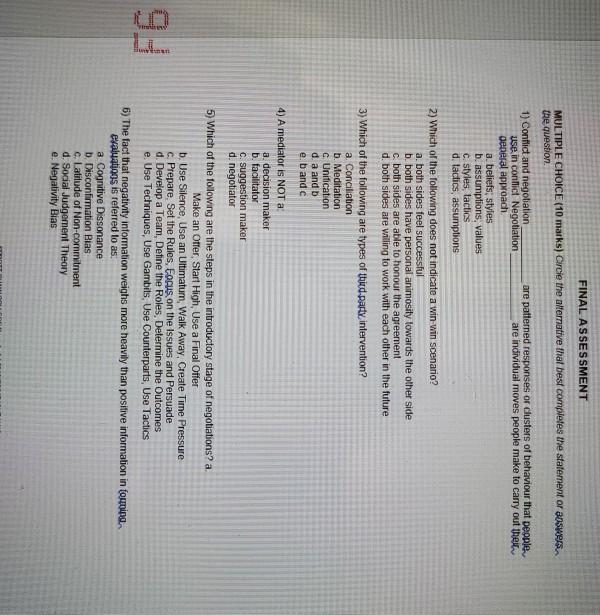
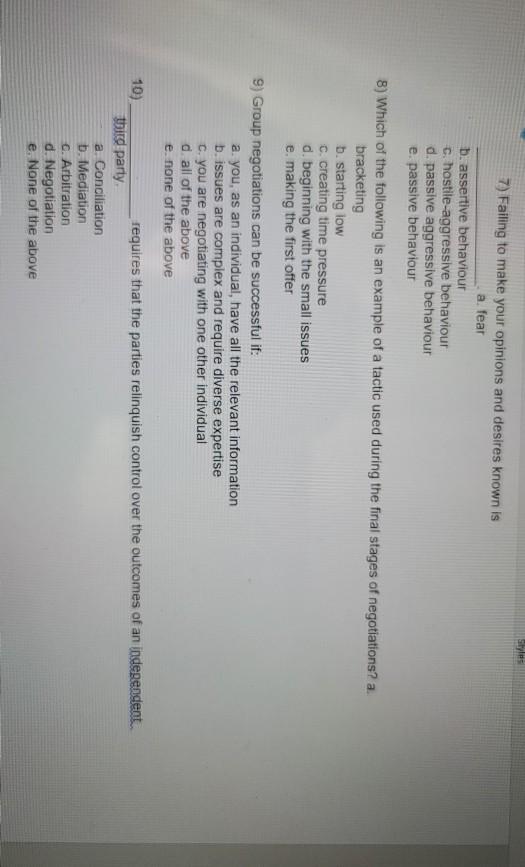
FINAL ASSESSMENT MULTIPLE CHOICE (10 marks) Circle the alternative that best completes the statement or answers the question 1) Conflict and negotiation are patterned responses or clusters of behaviour that people use in conflict Negotiation are individual moves people make to carry out their general approach a. beliefs, styles b. assumptions, values C. Styles, lactics d. tactics, assumptions 2) Which of the following does not indicate a win-win scenario? a. both sides feel successful b. both sides have personal animosity towards the other side c. both sides are able to honour the agreement d. both sides are willing to work with each other in the future 3) Which of the following are types of third party intervention? a Conciliation b. Meditation c Unification d. a and e.bandc 4) A mediator is NOT a a decision maker b. facilitator C. suggestion maker d. negotiator 90 5) Which of the following are the steps in the introductory stage of negotiations? a. Make an offer, Start High, Use a Final Offer b. Use Silence, Use an Ultimatum, Walk Away, Create Time Pressure c. Prepare. Set the Rules, Focus on the issues and Persuade d. Develop a Team, Define the Roles, Determine the Outcomes e. Use Techniques, Use Gambits. Use Counterparts. Use Tactics 6) The fact that negativity information weighs more heavily than positive information in foming evaluations is referred to as a Cognitive Dissonance b. Disconfirmation Bias c. Latitude of Non-commitment d. Social Judgement Theory e. Negativity Bias Styles 7.) Failing to make your opinions and desires known is a fear b. assertive behaviour c. hostile-aggressive behaviour d. passive aggressive behaviour e. passive behaviour 8) Which of the following is an example of a tactic used during the final stages of negotiations? a. bracketing b. starting low c. creating time pressure d. beginning with the small issues e. making the first offer 9) Group negotiations can be successful if: a. you, as an individual, have all the relevant information b. issues are complex and require diverse expertise C. you are negotiating with one other individual d all of the above e none of the above requires that the parties relinquish control over the outcomes of an independent third party a Conciliation b. Mediation 0. Arbitration d. Negotiation e. None of the above 10)
Step by Step Solution
There are 3 Steps involved in it
1 Expert Approved Answer
Step: 1 Unlock

Question Has Been Solved by an Expert!
Get step-by-step solutions from verified subject matter experts
Step: 2 Unlock
Step: 3 Unlock
 Study Help