



Question: Finally, we analyse f(x) near gaps in its domain. e) Find the point(s) x=a where f(a) is undefined. FORMATTING: List these points. If there
\ Finally, we analyse
f(x)near gaps in its domain.\ e) Find the point(s)
x=awhere
f(a)is undefined.\ FORMATTING: List these points. If there are two or more such points, you must separate them by semi-colons (?. Since we are asking for exact values, your answers may involve the logarithm function ).\ Answer:\ f) For each of the values of (Y) that you have found in (e), find the left-hand and right-hand limits of
fas
xapproaches
a. Then answer the questions below.\ FORMATTING: If there are two or more points, separate them with semi-colons (?. Since we are asking for exact values, your answers may involve the logarithmic function
ln(). You must use the notation of scientific calculators So
2xis written
2^(**)x, and so on. If there aren't any points, write empty.\ For which point(s)
ado we have
\\\\lim_(x->a^(-))f(x)=+\\\\infty ? Answer:\ For which point(s)
ado we have
\\\\lim_(x->a^(-))f(x)=-\\\\infty ? Answer:\ For which point(s) a do we have
\\\\lim_(x->a^(+))f(x)=+\\\\infty ? Answer:\ For which point(s) a do we have
\\\\lim_(x->a^(+))f(x)=-\\\\infty ? Answer:
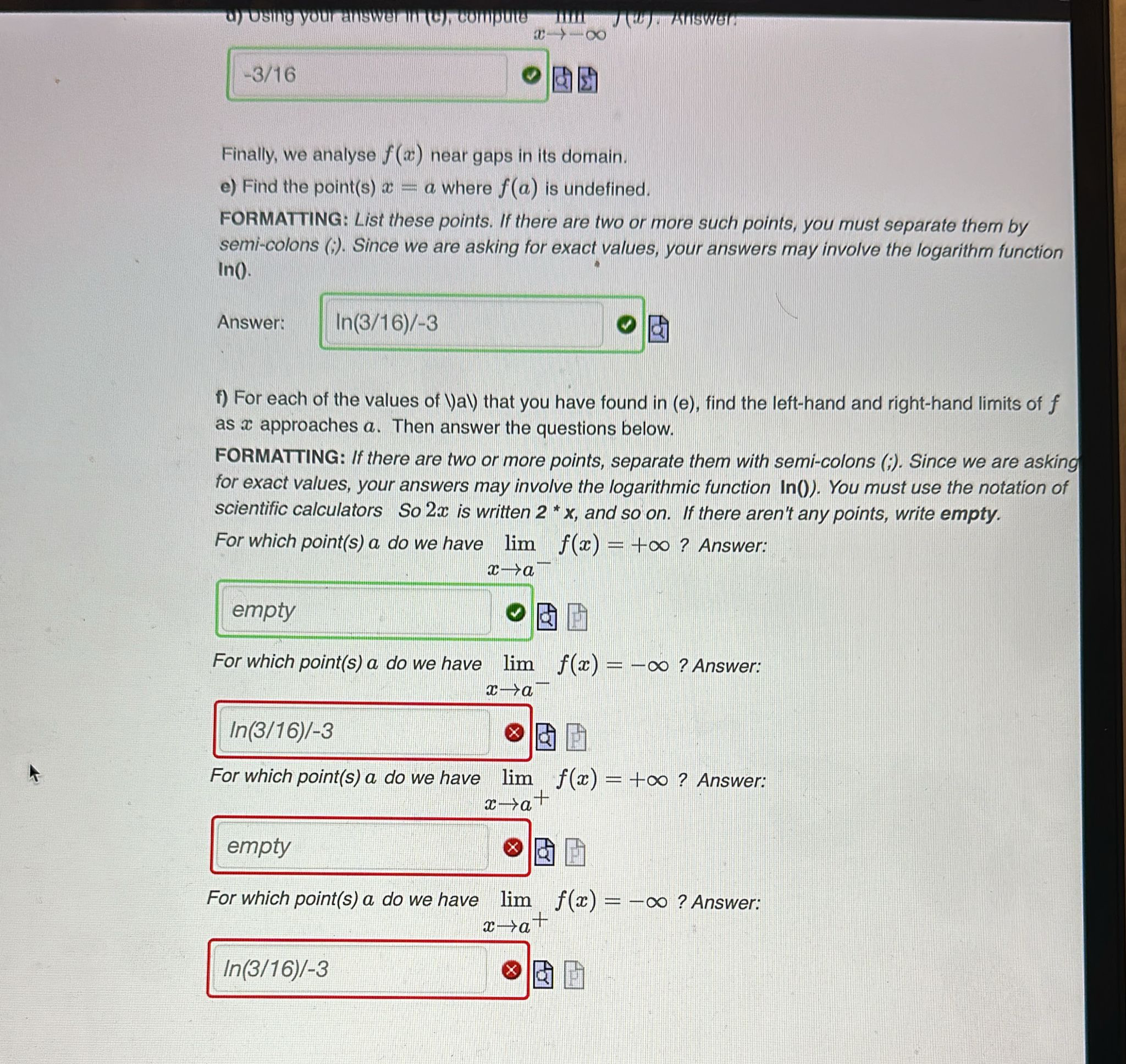
Finally, we analyse f(x) near gaps in its domain. e) Find the point(s) x=a where f(a) is undefined. FORMATTING: List these points. If there are two or more such points, you must separate them by semi-colons (;). Since we are asking for exact values, your answers may involve the logarithm function ln(). Answer: f) For each of the values of (Y)a) that you have found in (e), find the left-hand and right-hand limits of f as x approaches a. Then answer the questions below. FORMATTING: If there are two or more points, separate them with semi-colons (;). Since we are asking for exact values, your answers may involve the logarithmic function In()). You must use the notation of scientific calculators So 2x is written 2 * x, and so on. If there aren't any points, write empty. For which point(s) a do we have limxaf(x)=+ ? Answer: For which point(s) a do we have limxaf(x)= ? Answer: 2] For which point(s) a do we have limxa+f(x)=+ ? Answer: For which point(s) a do we have limxa+f(x)=
Step by Step Solution
There are 3 Steps involved in it

Get step-by-step solutions from verified subject matter experts