







Question: Find possible maximum/minimum points for the following functions by non-calculus arguments. (a) f(x)=4-2(x+3)2 Problem 2 Let f(x)=200x1/3 be the output quantity of a firm
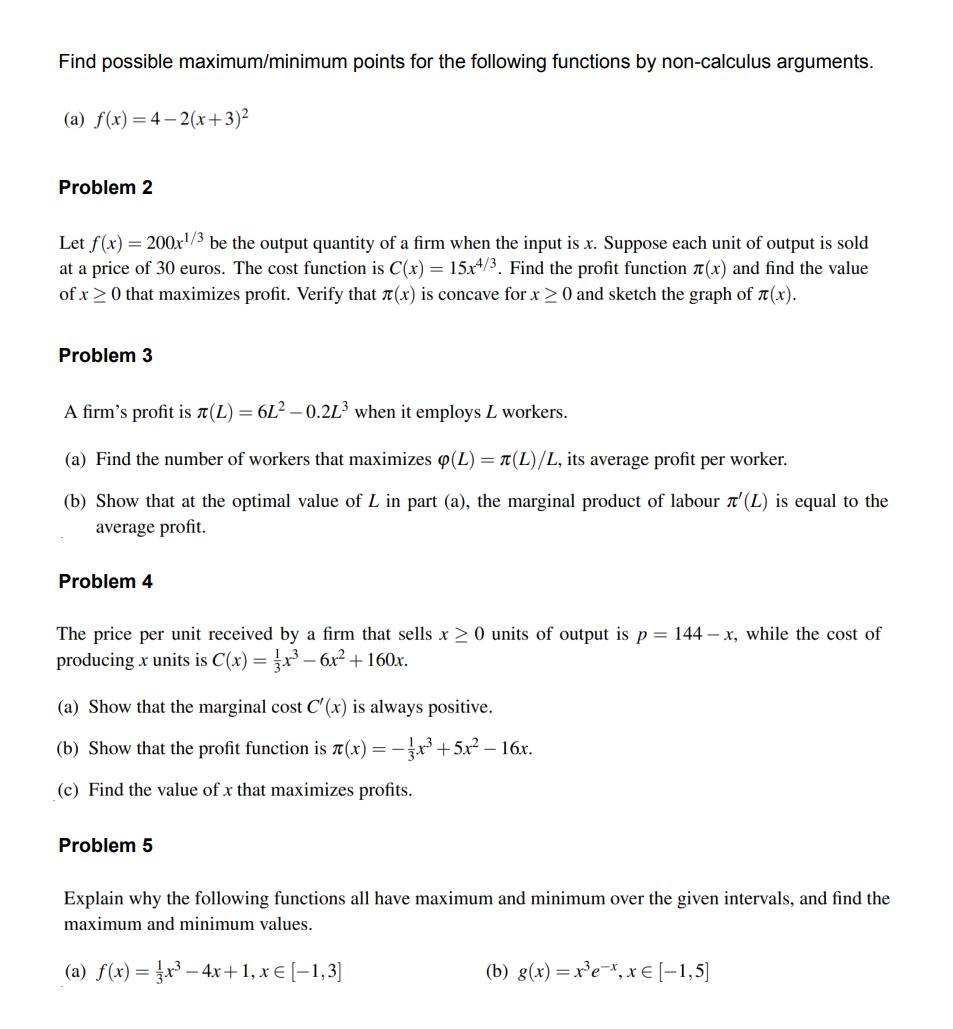
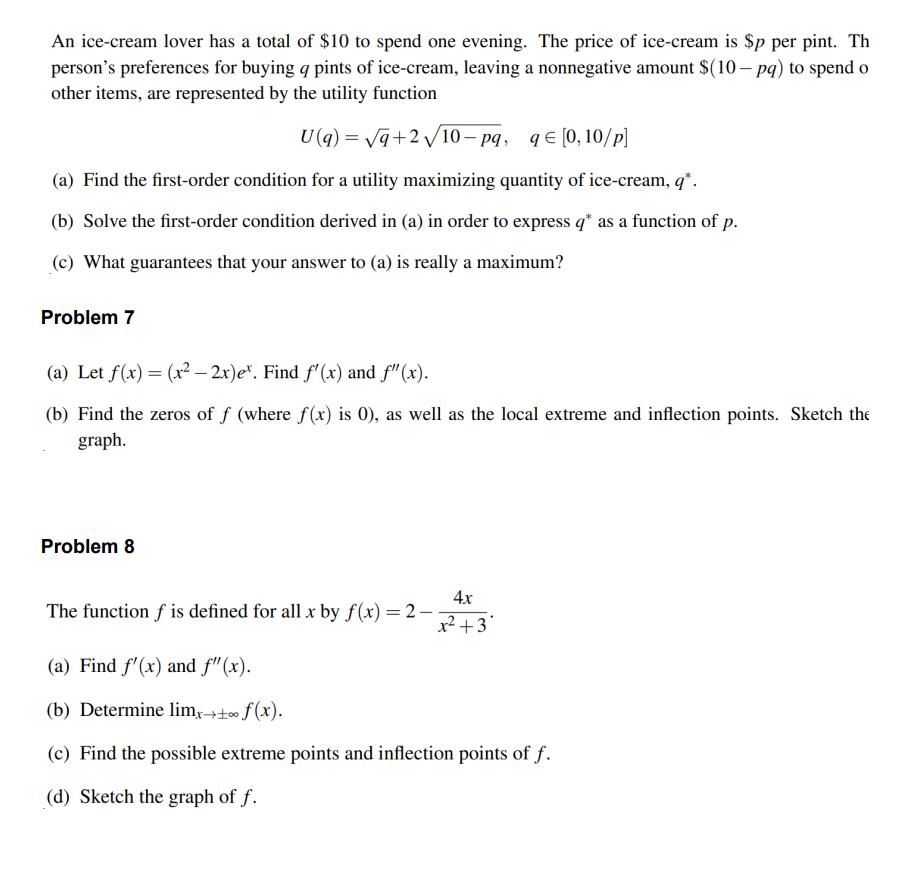
Find possible maximum/minimum points for the following functions by non-calculus arguments. (a) f(x)=4-2(x+3)2 Problem 2 Let f(x)=200x1/3 be the output quantity of a firm when the input is x. Suppose each unit of output is sold at a price of 30 euros. The cost function is C(x) = 15x4/3. Find the profit function (x) and find the value of x 0 that maximizes profit. Verify that (x) is concave for x > 0 and sketch the graph of (x). Problem 3 A firm's profit is (L) = 6L -0.2L when it employs L workers. (a) Find the number of workers that maximizes (L) = (L)/L, its average profit per worker. (b) Show that at the optimal value of L in part (a), the marginal product of labour ' (L) is equal to the average profit. Problem 4 The price per unit received by a firm that sells x 0 units of output is p = 144-x, while the cost of producing x units is C(x) = x-6x+160x. (a) Show that the marginal cost C'(x) is always positive. (b) Show that the profit function is 7(x) = -x+5x - 16x. (c) Find the value of x that maximizes profits. Problem 5 Explain why the following functions all have maximum and minimum over the given intervals, and find the maximum and minimum values. (a) f(x) = x-4x+1, x = [1,3] (b) g(x)=xe,x [1,5] An ice-cream lover has a total of $10 to spend one evening. The price of ice-cream is $p per pint. Th person's preferences for buying a pints of ice-cream, leaving a nonnegative amount $(10-pq) to spend o other items, are represented by the utility function U(a)=9+210-pq, q [0,10/p] (a) Find the first-order condition for a utility maximizing quantity of ice-cream, q*. (b) Solve the first-order condition derived in (a) in order to express q* as a function of p. (c) What guarantees that your answer to (a) is really a maximum? Problem 7 (a) Let f(x)=(x-2x)e. Find f'(x) and f"(x). (b) Find the zeros of f (where f(x) is 0), as well as the local extreme and inflection points. Sketch the graph. Problem 8 4x The function f is defined for all x by f(x) = 2-- x+3 (a) Find f'(x) and f"(x). (b) Determine limo f(x). (c) Find the possible extreme points and inflection points of f. (d) Sketch the graph of f.
Step by Step Solution
There are 3 Steps involved in it

Get step-by-step solutions from verified subject matter experts
 Study Help