







Question: Finding the normal depth in an open channel can be accomplished by using Manning's equation. Manning's equation relates the flow rate in the channel (discharge,
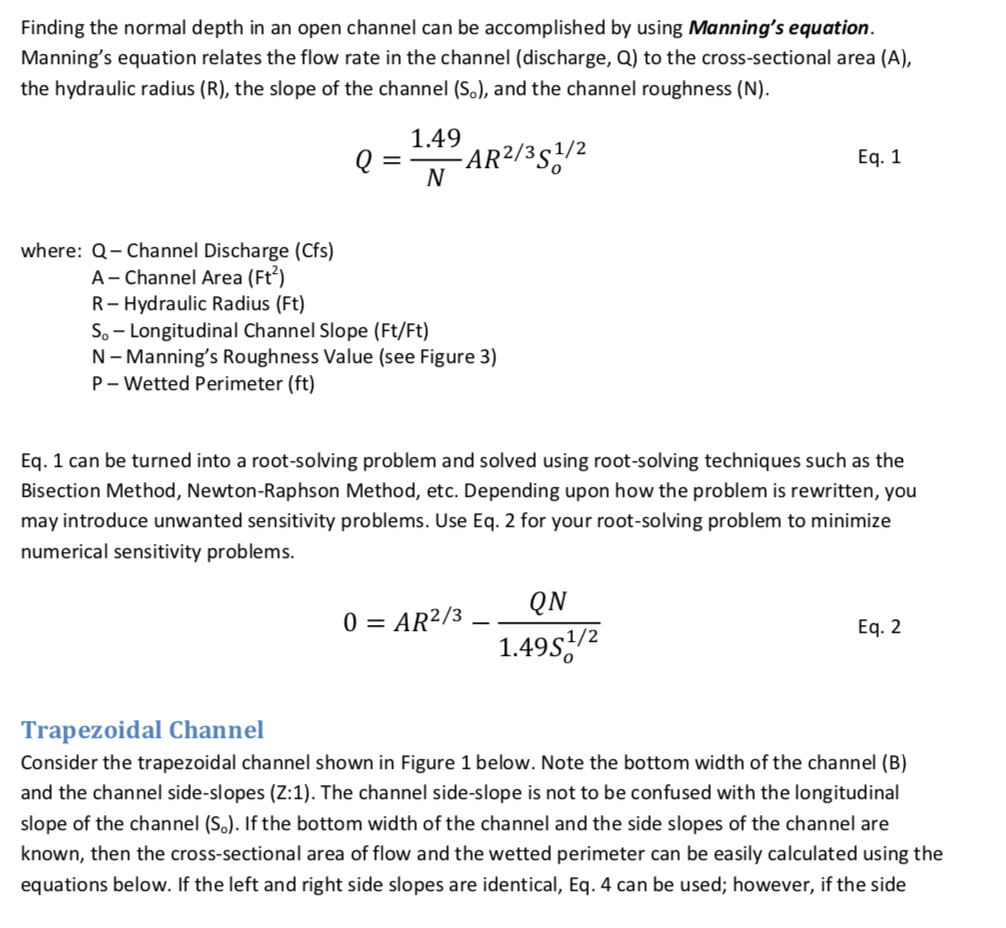
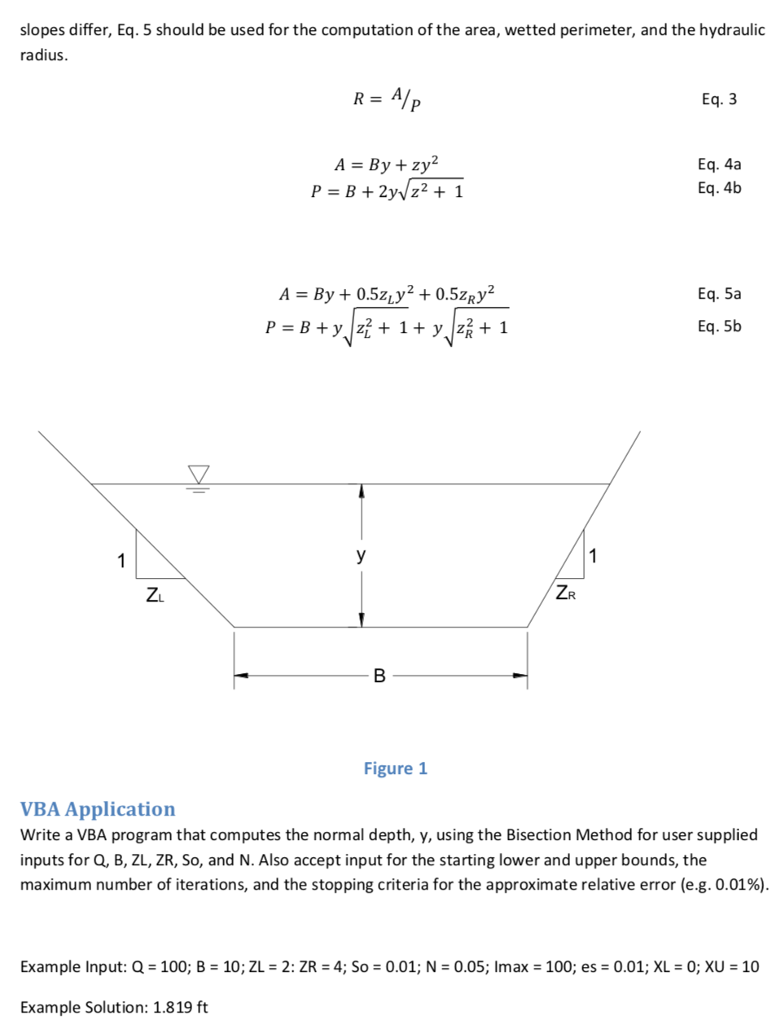
Finding the normal depth in an open channel can be accomplished by using Manning's equation. Manning's equation relates the flow rate in the channel (discharge, Q) to the cross-sectional area (A), the hydraulic radius (R), the slope of the channel (So), and the channel roughness (N). 1.49 AR2/8s1/2 Eq. 1 where: Q-Channel Discharge (Cfs) A- Channel Area (Ft2) R- Hydraulic Radius (Ft) So- Longitudinal Channel Slope (Ft/Ft) N-Manning's Roughness Value (see Figure 3) P- Wetted Perimeter (ft) Eq. 1 can be turned into a root-solving problem and solved using root-solving techniques such as the Bisection Method, Newton-Raphson Method, etc. Depending upon how the problem is rewritten, you may introduce unwanted sensitivity problems. Use Eq. 2 for your root-solving problem to minimize numerical sensitivity problems AR2/3 Eq. 2 1.49s/2 Trapezoidal Channel Consider the trapezoidal channel shown in Figure 1 below. Note the bottom width of the channel (B) and the channel side-slopes (Z:1). The channel side-slope is not to be confused with the longitudinal slope of the channel (So). If the bottom width of the channel and the side slopes of the channel are known, then the cross-sectional area of flow and the wetted perimeter can be easily calculated using the equations below. If the left and right side slopes are identical, Eq. 4 can be used; however, if the side Finding the normal depth in an open channel can be accomplished by using Manning's equation. Manning's equation relates the flow rate in the channel (discharge, Q) to the cross-sectional area (A), the hydraulic radius (R), the slope of the channel (So), and the channel roughness (N). 1.49 AR2/8s1/2 Eq. 1 where: Q-Channel Discharge (Cfs) A- Channel Area (Ft2) R- Hydraulic Radius (Ft) So- Longitudinal Channel Slope (Ft/Ft) N-Manning's Roughness Value (see Figure 3) P- Wetted Perimeter (ft) Eq. 1 can be turned into a root-solving problem and solved using root-solving techniques such as the Bisection Method, Newton-Raphson Method, etc. Depending upon how the problem is rewritten, you may introduce unwanted sensitivity problems. Use Eq. 2 for your root-solving problem to minimize numerical sensitivity problems AR2/3 Eq. 2 1.49s/2 Trapezoidal Channel Consider the trapezoidal channel shown in Figure 1 below. Note the bottom width of the channel (B) and the channel side-slopes (Z:1). The channel side-slope is not to be confused with the longitudinal slope of the channel (So). If the bottom width of the channel and the side slopes of the channel are known, then the cross-sectional area of flow and the wetted perimeter can be easily calculated using the equations below. If the left and right side slopes are identical, Eq. 4 can be used; however, if the side
Step by Step Solution
There are 3 Steps involved in it

Get step-by-step solutions from verified subject matter experts
 Study Help