







Question: First, read the NASA case at the end of ch.12 in the textbook and answer the following questions. Q1. Which team processes do you believe
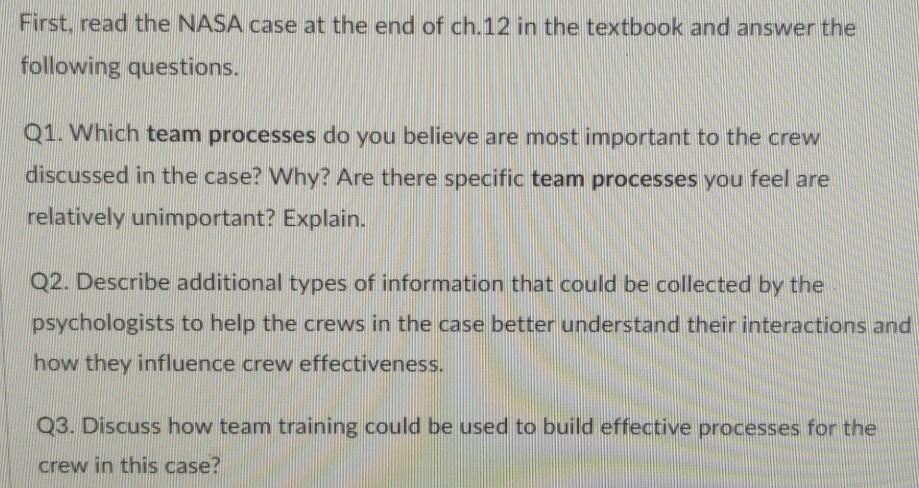
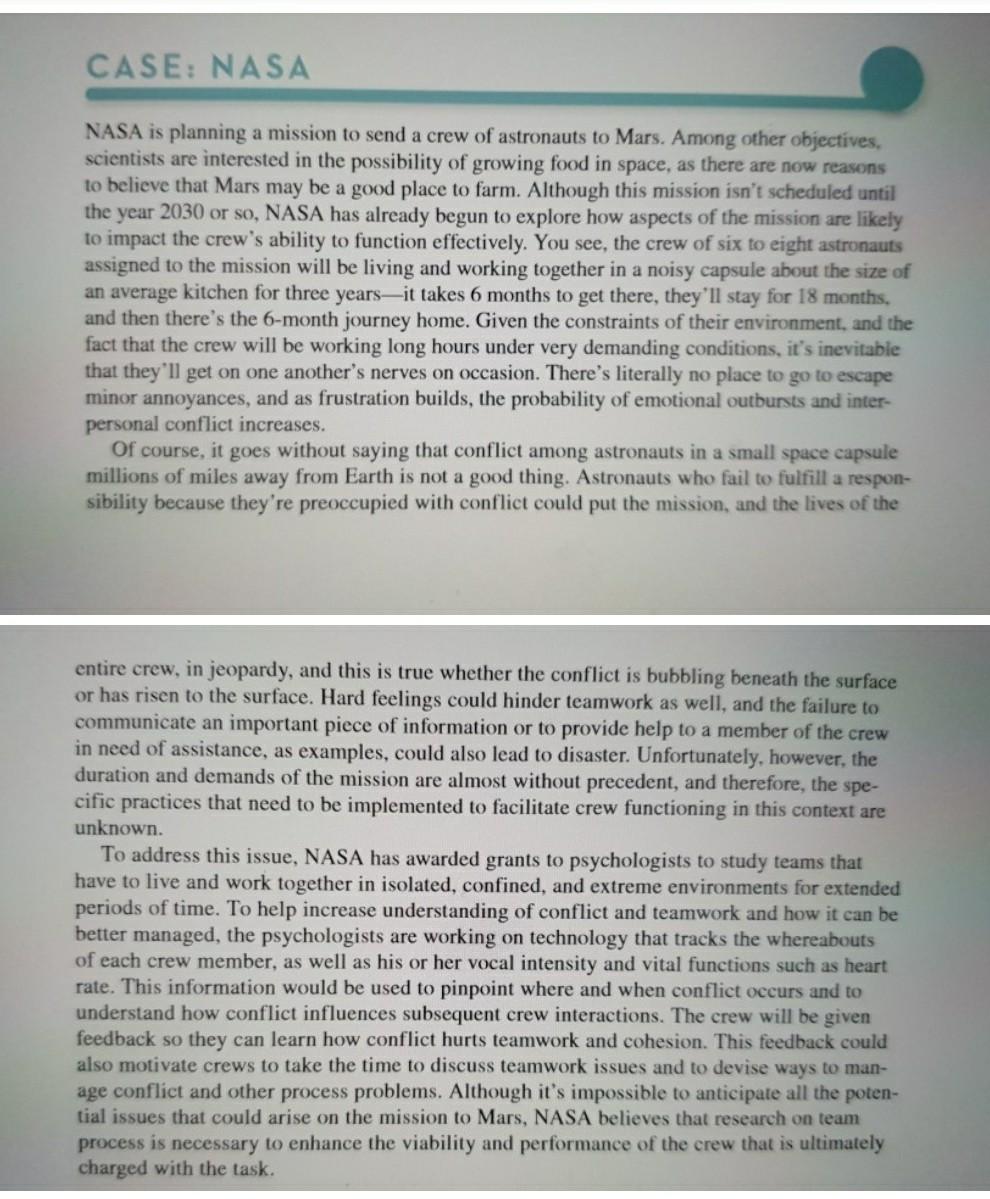
First, read the NASA case at the end of ch.12 in the textbook and answer the following questions. Q1. Which team processes do you believe are most important to the crew discussed in the case? Why? Are there specific team processes you feel are relatively unimportant? Explain. Q2. Describe additional types of information that could be collected by the psychologists to help the crews in the case better understand their interactions and how they influence crew effectiveness. Q3. Discuss how team training could be used to build effective processes for the crew in this case? CASE: NASA NASA is planning a mission to send a crew of astronauts to Mars. Among other objectives, scientists are interested in the possibility of growing food in space, as there are now reasons to believe that Mars may be a good place to farm. Although this mission isn't scheduled until the year 2030 or so, NASA has already begun to explore how aspects of the mission are likely to impact the crew's ability to function effectively. You see, the crew of six to eight astronauts assigned to the mission will be living and working together in a noisy capsule about the size of an average kitchen for three yearsit takes 6 months to get there, they'll stay for 18 months. and then there's the 6-month journey home. Given the constraints of their environment, and the fact that the crew will be working long hours under very demanding conditions, it's inevitable that they'll get on one another's nerves on occasion. There's literally no place to go to escape minor annoyances, and as frustration builds, the probability of emotional outbursts and inter- personal conflict increases. Of course, it goes without saying that conflict among astronauts in a small space capsule millions of miles away from Earth is not a good thing. Astronauts who fail to fulfill a respon- sibility because they're preoccupied with conflict could put the mission, and the lives of the entire crew, in jeopardy, and this is true whether the conflict is bubbling beneath the surface or has risen to the surface. Hard feelings could hinder teamwork as well, and the failure to communicate an important piece of information or to provide help to a member of the crew in need of assistance, as examples, could also lead to disaster. Unfortunately, however, the duration and demands of the mission are almost without precedent, and therefore, the spe- cific practices that need to be implemented to facilitate crew functioning in this context are unknown. To address this issue, NASA has awarded grants to psychologists to study teams that have to live and work together in isolated, confined, and extreme environments for extended periods of time. To help increase understanding of conflict and teamwork and how it can be better managed, the psychologists are working on technology that tracks the whereabouts of each crew member, as well as his or her vocal intensity and vital functions such as heart rate. This information would be used to pinpoint where and when conflict occurs and to understand how conflict influences subsequent crew interactions. The crew will be given feedback so they can learn how conflict hurts teamwork and cohesion. This feedback could also motivate crews to take the time to discuss teamwork issues and to devise ways to man- age conflict and other process problems. Although it's impossible to anticipate all the poten- tial issues that could arise on the mission to Mars, NASA believes that research on team process is necessary to enhance the viability and performance of the crew that is ultimately charged with the task
Step by Step Solution
There are 3 Steps involved in it
1 Expert Approved Answer
Step: 1 Unlock

Question Has Been Solved by an Expert!
Get step-by-step solutions from verified subject matter experts
Step: 2 Unlock
Step: 3 Unlock
 Study Help