







Question: first two questions on top thats it Read Case 11.4, Consenting to Sexual Harassment. Make a first post in your group that answers the following
first two questions on top thats it 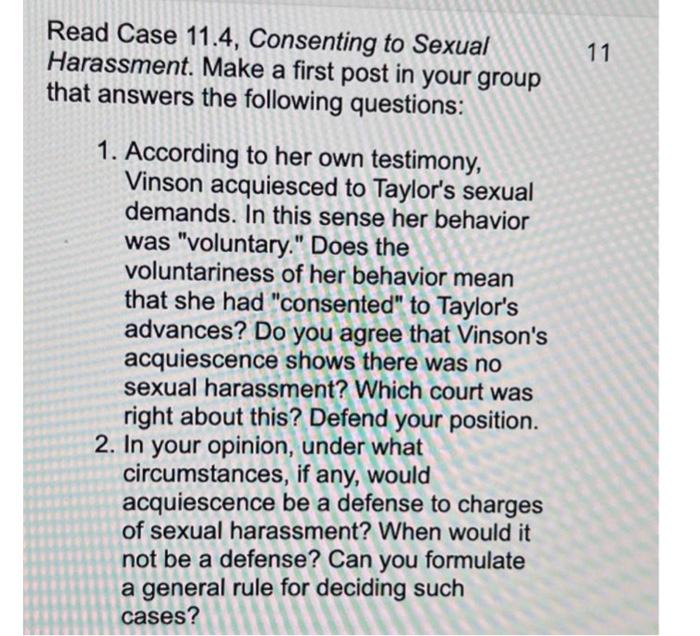
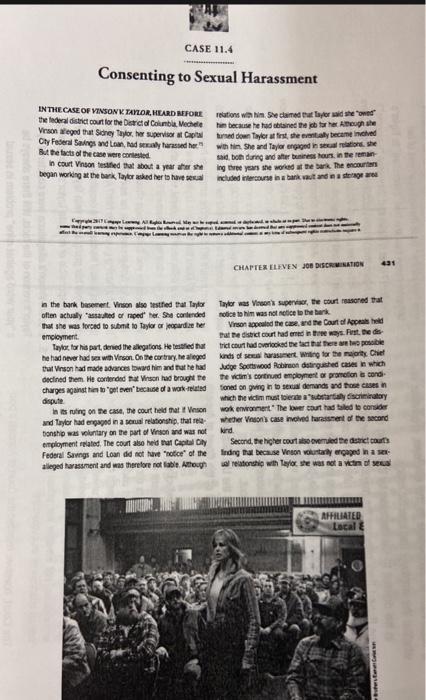
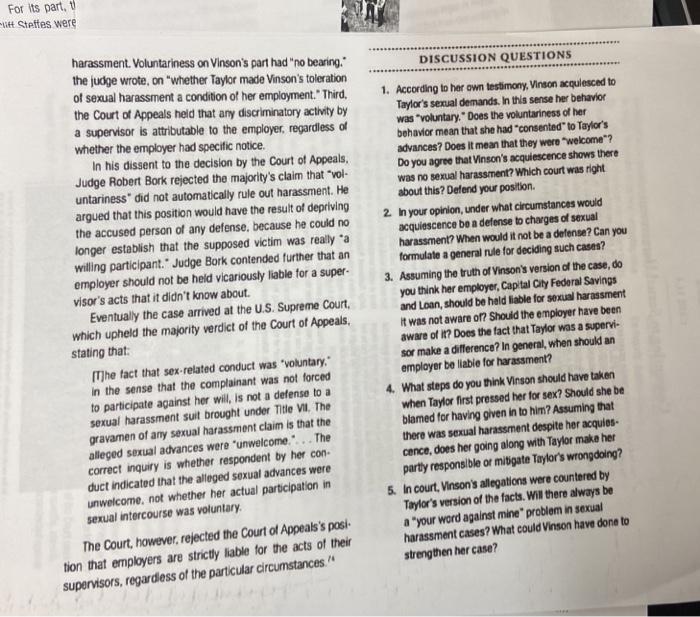
Read Case 11.4, Consenting to Sexual Harassment. Make a first post in your group that answers the following questions: 11 1. According to her own testimony, Vinson acquiesced to Taylor's sexual demands. In this sense her behavior was "voluntary." Does the voluntariness of her behavior mean that she had "consented" to Taylor's advances? Do you agree that Vinson's acquiescence shows there was no sexual harassment? Which court was right about this? Defend your position. 2. In your opinion, under what circumstances, if any, would acquiescence be a defense to charges a of sexual harassment? When would it not be a defense? Can you formulate a general rule for deciding such cases? CASE 11.4 Consenting to Sexual Harassment IN THE CASE OF VINSON TAYLOR, HEARD BEFORE relations with him. She camera ayer dhewed the federal district court for the District of Columbia, Mechele because he had obtained the job for her Ashe Vrson weged that Sdney Taylor her supervisor Captal sed down Tyler at test the eventually became indled Chy Federal Sains and Loan, Mad wyrasted her with him. She und Tayar erged in sector.se But the facts of the case were contested sad both during and after business hours in the reman in court Vinson tested that about a year here in three years she worked at the bank. The encourten began working at the bark Taylor asked her to have included intercourse in bakat anda ser CHAPTEX ELEVEN JOB DISCRIMINATION in the bank basement. Vinson also testfied that Taylor often actually assaulted of raped her. She contended that she was forced to submit to Taylor or orde te employment Taylor for his part denied the allegations Hetfied that he had never had sex with Vinson. On the corrwyte aleged trat Vinson had made advances towed him and that he had declined them. He contended that inson rud brought the charges against then because of a work-related dispute in its ruling on the case, the court held that inson and Taylor had engaged in a relationship, that tionship was voluntary on the part of Vinson and was not employment rated. The court also held that Capital Oy Federal Sawgs and Loan did not have notice of the alleged rasiment and was therefore not able Although Taylor was son's superior, the court and that notice to him was not notice to the bar Virson peated the case, and the Court of Apeld tale district court hadered in the ways. Fest. De dis trict court tad averlooked the there to pooble kinds of larasament Wing for the majority Chief Judge Setswood Robrodotirgashed cases in which the victim's cornued employment of promotion and Toned on ging in to sexual demands and those cases which the victime a substantly chory wokenwonent the lower court had tied to consider whether Vinson's case involved Tangent of the second wird Second, the higher court overed the district courts Inding mal because Veson voluntary engaged in a sa reationship with leforste was not a victim of sus AFFILIATED Local For its part 1 Vit Steffes were DISCUSSION QUESTIONS de for a sus harassment. Voluntariness on Vinson's part had "no bearing." the judge wrote, on whether Taylor made Vinson's toleration of sexual harassment a condition of her employment. Third, the Court of Appeals held that any discriminatory activity by a supervisor is attributable to the employer, regardless of whether the employer had specific notice. In his dissent to the decision by the Court of Appeals, Judge Robert Bork rejected the majority's claim that vol- untariness did not automatically rule out harassment. He argued that this position would have the result of depriving the accused person of any defense, because he could no longer establish that the supposed victim was really a Willing participant." Judge Bork contended further that an employer should not be held vicariously liable for a super- visor's acts that it didn't know about. Eventually the case arrived at the U.S. Supreme Court which upheld the majority verdict of the Court of Appeals, stating that: The fact that sex-related conduct was voluntary, in the sense that the complainant was not forced to participate against her will, is not a defense to a sexual harassment suit brought under Title VII, The gravamen of any sexual harassment claim is that the alleged sexual advances were 'unwelcome... The correct inquiry is whether respondent by her con duct indicated that the alleged sexual advances were unwelcome, not whether her actual participation in sexual intercourse was voluntary The Court, however, rejected the Court of Appeals's posi tion that employers are strictly liable for the acts of their supervisors, regardless of the particular circumstances. 1. According to her own testimony, Vinson aqulesced to Taylor's sexual demands. In this sense her behavior was voluntary. Does the voluntariness of her behavior mean that she had consented to Taylor's advances? Does it mean that they were welcome"? Do you agree that Vinson's acquiescence shows there was no sexual harassment? Which court was right about this? Defend your position. 2 in your opinion, under what circumstances would acquiescence ben defense to charges of sexual harassment? When would it not be a defense? Can you formulate a general rule for deciding such cases? 3. Assuming the truth of Vinson's version of the case, do you think her employer, Capital City Federal Savings and Loan, should be held liable for sexual harassment It was not aware of? Should the employer have been aware of it? Does the fact that Taylor was a supervi- sor make a difference? In general, when should an employer be liable for harassment? 4. What steps do you think Vinson should have taken when Taylor first pressed her for sex? Should she be blamed for having given in to him? Assuming that there was sexual harassment despite her acquies- cence, does her going along with Taylor make her party responsible or mitigate Taylor's wrongdoing? 5. In court. Vinson's allegations were countered by Taylor's version of the facts. Will there always be a "your word against mine problem in sexual harassment cases? What could Vinson have done to strengthen her case
Step by Step Solution
There are 3 Steps involved in it
1 Expert Approved Answer
Step: 1 Unlock

Question Has Been Solved by an Expert!
Get step-by-step solutions from verified subject matter experts
Step: 2 Unlock
Step: 3 Unlock
 Study Help