







Question: First, using the diagram below, decide whether the particle being accelerated parabolically is has positive or negative charge. If it has positive charge, assume
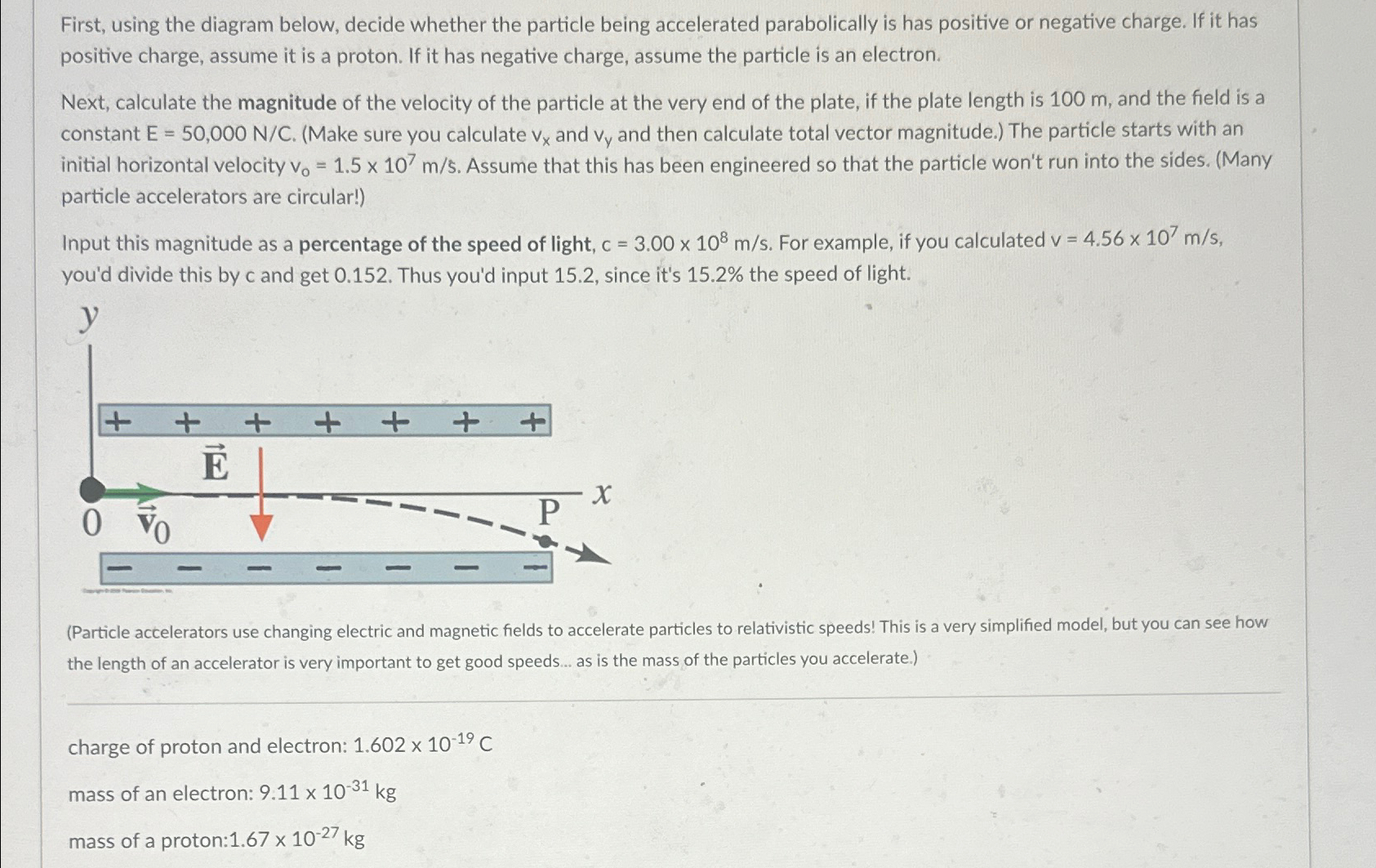
First, using the diagram below, decide whether the particle being accelerated parabolically is has positive or negative charge. If it has positive charge, assume it is a proton. If it has negative charge, assume the particle is an electron. Next, calculate the magnitude of the velocity of the particle at the very end of the plate, if the plate length is 100 m, and the field is a constant E = 50,000 N/C. (Make sure you calculate vx and vy and then calculate total vector magnitude.) The particle starts with an initial horizontal velocity vo = 1.5 x 10⁷ m/s. Assume that this has been engineered so that the particle won't run into the sides. (Many particle accelerators are circular!) =1 Input this magnitude as a percentage of the speed of light, c = 3.00 x 10⁸ m/s. For example, if you calculated v = 4.56 x 10⁷ m/s, you'd divide this by c and get 0.152. Thus you'd input 15.2, since it's 15.2% the speed of light. y + + + + + + + E 0 Vo X P (Particle accelerators use changing electric and magnetic fields to accelerate particles to relativistic speeds! This is a very simplified model, but you can see how the length of an accelerator is very important to get good speeds... as is the mass of the particles you accelerate.) charge of proton and electron: 1.602 x 10⁻¹⁹ C mass of an electron: 9.11 x 10⁻³¹ kg mass of a proton:1.67 x 10⁻²⁷ kg
Step by Step Solution
There are 3 Steps involved in it
To solve this problem follow these steps 1 Determine the Charge of the Particle Since the electric field mathbfE is pointing downward a positive charg... View full answer

Get step-by-step solutions from verified subject matter experts
 Study Help