







Question: Flip Flop Transition indicates what is the input needed for J and K to cause the change from the present state to the next state.
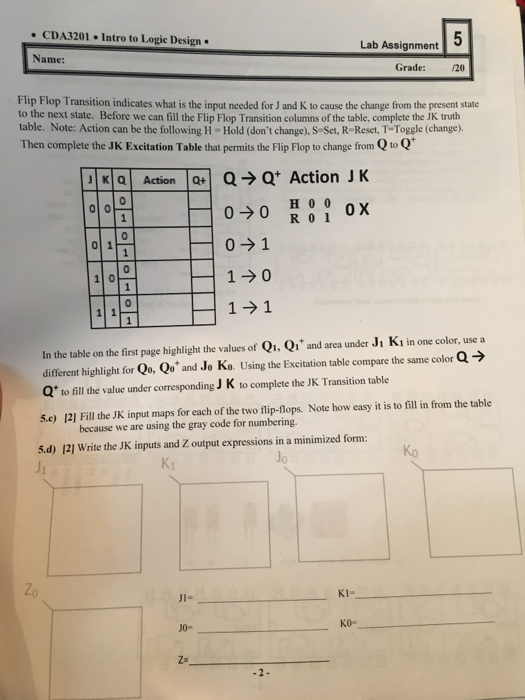
Flip Flop Transition indicates what is the input needed for J and K to cause the change from the present state to the next state. Before we can fill the Flip Flop Transition columns of the table, complete the JK truth table. Then complete the JK Excitation Table that permits the Flip Flop to change from Q to Q^+ In the table on the first page highlight the values of Q_1, Q^+ and area under J_1 K_1 in one color, use a different highlight for Q_0, Q_0^+ and J_0 K_0. Using the Excitation table compare the same color Q_0 Q_0^+ to fill the value under corresponding J K to complete the JK Transition table. c) Fill the JK input maps for each of the two flip-flops. Note how easy it is to fill in from the table because we are using the gray code for numbering. d) Write the JK inputs and Z output expressions in a minimized form: J1 = J0 = z = k1 = k0 = Flip Flop Transition indicates what is the input needed for J and K to cause the change from the present state to the next state. Before we can fill the Flip Flop Transition columns of the table, complete the JK truth table. Then complete the JK Excitation Table that permits the Flip Flop to change from Q to Q^+ In the table on the first page highlight the values of Q_1, Q^+ and area under J_1 K_1 in one color, use a different highlight for Q_0, Q_0^+ and J_0 K_0. Using the Excitation table compare the same color Q_0 Q_0^+ to fill the value under corresponding J K to complete the JK Transition table. c) Fill the JK input maps for each of the two flip-flops. Note how easy it is to fill in from the table because we are using the gray code for numbering. d) Write the JK inputs and Z output expressions in a minimized form: J1 = J0 = z = k1 = k0 =
Step by Step Solution
There are 3 Steps involved in it

Get step-by-step solutions from verified subject matter experts
 Study Help