





Question: Fluid Dynamics a) b) c) d) e) g) . Consider a steady, fully developed, laminar, incompressible flow of water with constant properties (Density = 992

Fluid Dynamics
Fluid Dynamics a) b) c) d) e) g) . Consider a
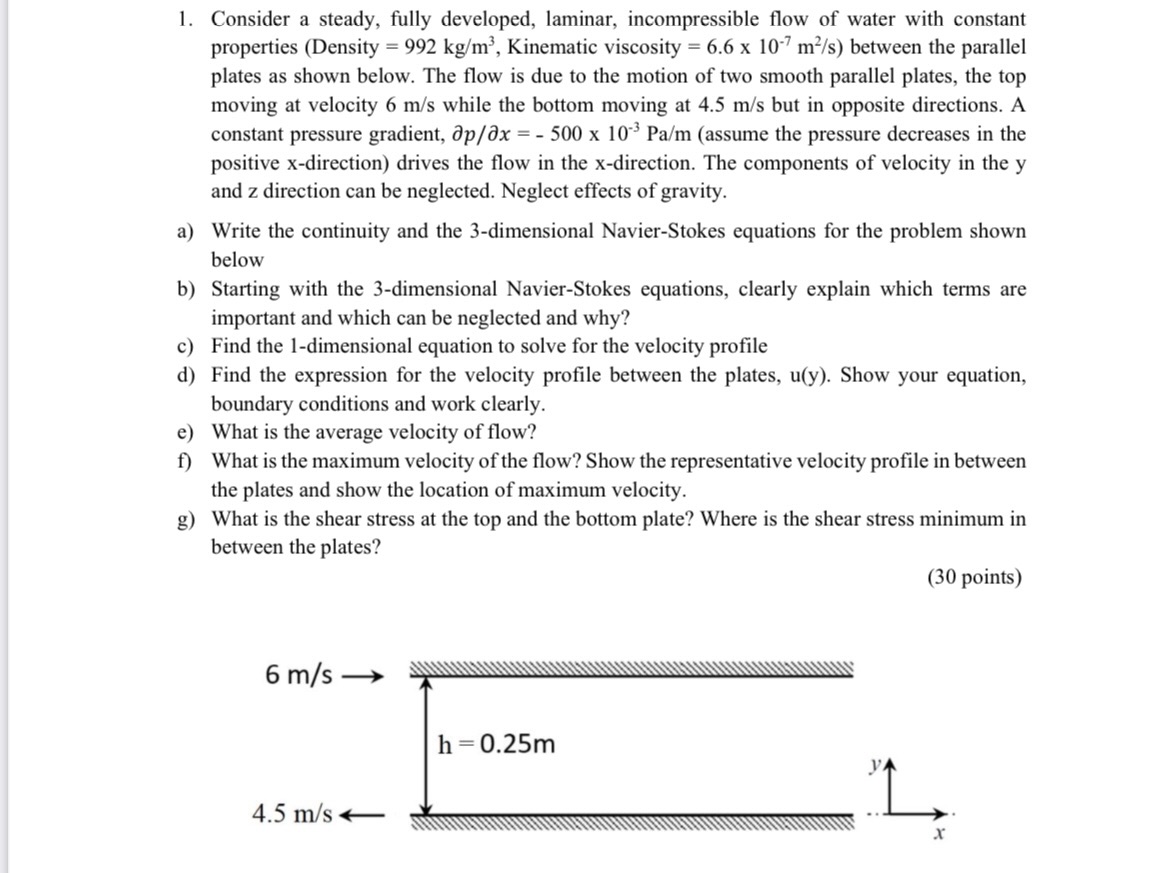
a) b) c) d) e) g) . Consider a steady, fully developed, laminar, incompressible flow of water with constant properties (Density = 992 kg/m?, Kinematic viscosity = 6.6 x 10\"7 m?/s) between the parallel plates as shown below. The flow is due to the motion of two smooth parallel plates, the top moving at velocity 6 m/s while the bottom moving at 4.5 m/s but in opposite directions. A constant pressure gradient, dp/dx = - 500 x 10\" Pa/m (assume the pressure decreases in the positive x-direction) drives the flow in the x-direction. The components of velocity in the y and z direction can be neglected. Neglect effects of gravity. Write the continuity and the 3-dimensional Navier-Stokes equations for the problem shown below Starting with the 3-dimensional Navier-Stokes equations, clearly explain which terms are important and which can be neglected and why? Find the 1-dimensional equation to solve for the velocity profile Find the expression for the velocity profile between the plates, u(y). Show your equation, boundary conditions and work clearly. What is the average velocity of flow? What is the maximum velocity of the flow? Show the representative velocity profile in between the plates and show the location of maximum velocity. What is the shear stress at the top and the bottom plate? Where is the shear stress minimum in between the plates? (30 points) 6m/s h=0.25m -\" 4.5 m/s 9 ..L

Step by Step Solution

There are 3 Steps involved in it

1 Expert Approved Answer
Step: 1 Unlock blur-text-image

Question Has Been Solved by an Expert!

Get step-by-step solutions from verified subject matter experts

Step: 2 Unlock
Step: 3 Unlock

Students Have Also Explored These Related Law Questions!