







Question: For a given feed mixture composition z and temperature T, a flash separation is possible at pressures between the dew-point and bubble-point pressures. Similarly, for
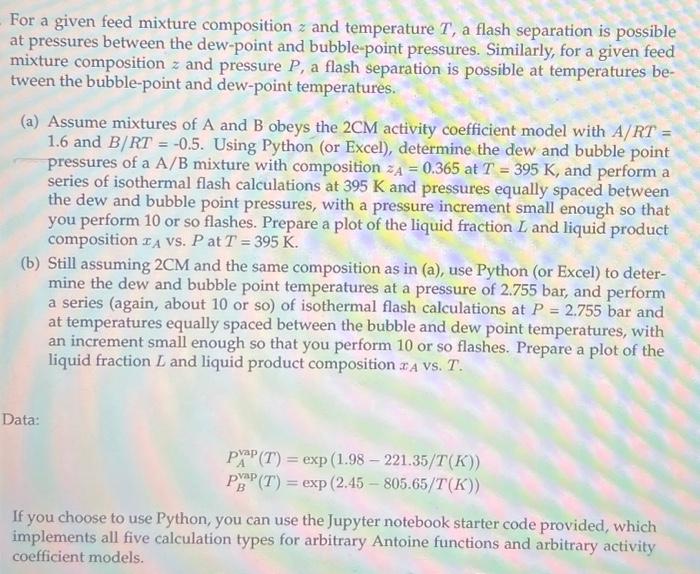
For a given feed mixture composition z and temperature T, a flash separation is possible at pressures between the dew-point and bubble-point pressures. Similarly, for a given feed mixture composition z and pressure P, a flash separation is possible at temperatures between the bubble-point and dew-point temperatures. (a) Assume mixtures of A and B obeys the 2CM activity coefficient model with A/RT= 1.6 and B/RT=0.5. Using Python (or Excel), determine the dew and bubble point pressures of a A / B mixture with composition zA=0.365 at T=395K, and perform a series of isothermal flash calculations at 395K and pressures equally spaced between the dew and bubble point pressures, with a pressure increment small enough so that you perform 10 or so flashes. Prepare a plot of the liquid fraction L and liquid product composition xA vs. P at T=395K. (b) Still assuming 2CM and the same composition as in (a), use Python (or Excel) to determine the dew and bubble point temperatures at a pressure of 2.755bar, and perform a series (again, about 10 or so) of isothermal flash calculations at P=2.755 bar and at temperatures equally spaced between the bubble and dew point temperatures, with an increment small enough so that you perform 10 or so flashes. Prepare a plot of the liquid fraction L and liquid product composition xA vs. T. Data: PAvap(T)=exp(1.98221.35/T(K))PBvap(T)=exp(2.45805.65/T(K)) If you choose to use Python, you can use the Jupyter notebook starter code provided, which implements all five calculation types for arbitrary Antoine functions and arbitrary activity coefficient models
Step by Step Solution
There are 3 Steps involved in it

Get step-by-step solutions from verified subject matter experts
 Study Help