







Question: For a single-stage rocket consuming fuel at a constant rate, the change in velocity resulting from the acceleration of the rocket vehicle has been modeled
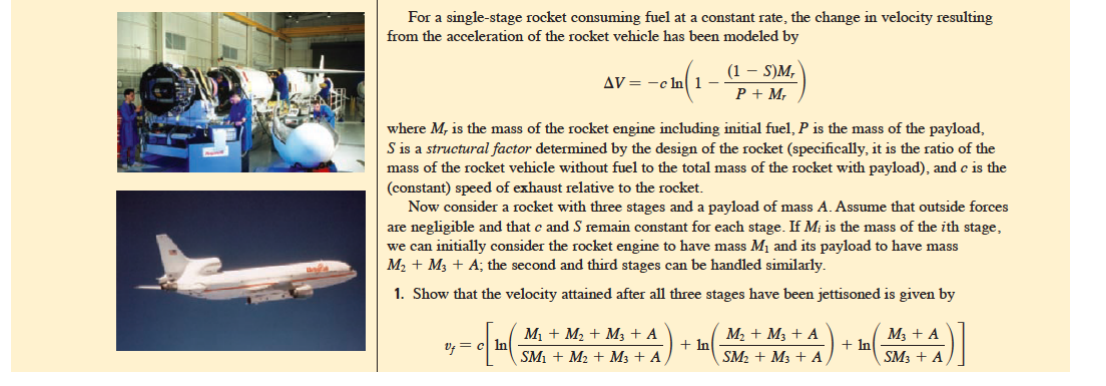
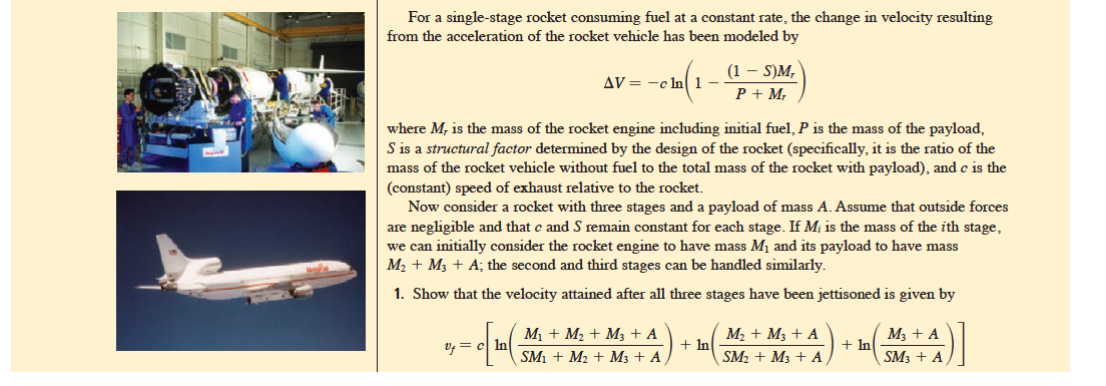
For a single-stage rocket consuming fuel at a constant rate, the change in velocity resulting from the acceleration of the rocket vehicle has been modeled by AV = -cl(1 _ (1-S)M, P + Mr where M, is the mass of the rocket engine including initial fuel, P is the mass of the payload, S is a structural factor determined by the design of the rocket (specifically, it is the ratio of the mass of the rocket vehicle without fuel to the total mass of the rocket with payload), and c is the (constant) speed of exhaust relative to the rocket. Now consider a rocket with three stages and a payload of mass A. Assume that outside forces are negligible and that c and S remain constant for each stage. If M, is the mass of the ith stage, we can initially consider the rocket engine to have mass Mi and its payload to have mass M2 + M3 + A; the second and third stages can be handled similarly. 1. Show that the velocity attained after all three stages have been jettisoned is given by Mit M2 + M3 + A M2 + M3 + A M3 + A of = c In + In + In SMi + M2 + M3 + A SM2 + M3 + A SM3 + A
Step by Step Solution
There are 3 Steps involved in it

Get step-by-step solutions from verified subject matter experts
 Study Help