







Question: for both a and b. 4. (a) Let L e a regular language, accepted by a DFA M. Construct a finite automaton Mc, over the
 for both a and b.
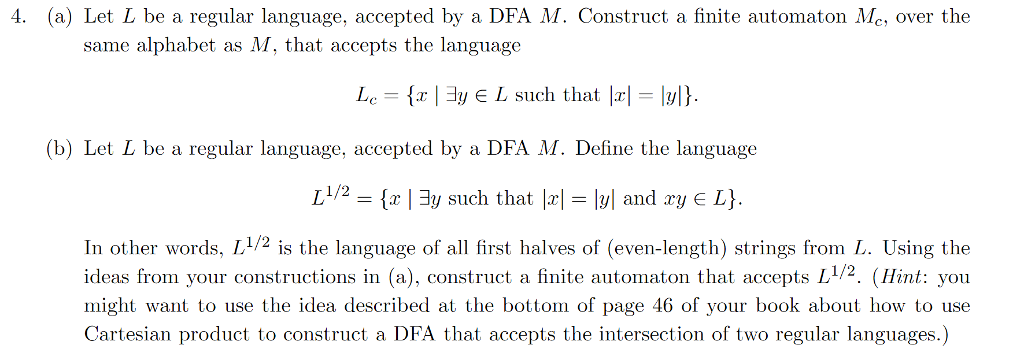
4. (a) Let L e a regular language, accepted by a DFA M. Construct a finite automaton Mc, over the same alphabet as M, that accepts the language Lc I y e L such that lyl (b) Let L be a regular language, accepted by a DFA M. Define the language L1/2 fr l any such that rl- ly and ay E L In other words, L 1/2 s the language of all first halves of (even-length) strings from L. Using the ideas from your constructions in (a), construct a finite automaton that accepts L 2. (Hint: you might want to use the idea described at the bottom of page 46 of your book about how to use Cartesian product to construct a DFA that accepts the intersection of two regular languages
Step by Step Solution
There are 3 Steps involved in it

Get step-by-step solutions from verified subject matter experts
 Study Help