Question: For Computer Organization and Architecture. I think I was able to solve the first one correctly but need help with the rest thanks ! 1.4
For Computer Organization and Architecture. I think I was able to solve the first one correctly but need help with the rest thanks !
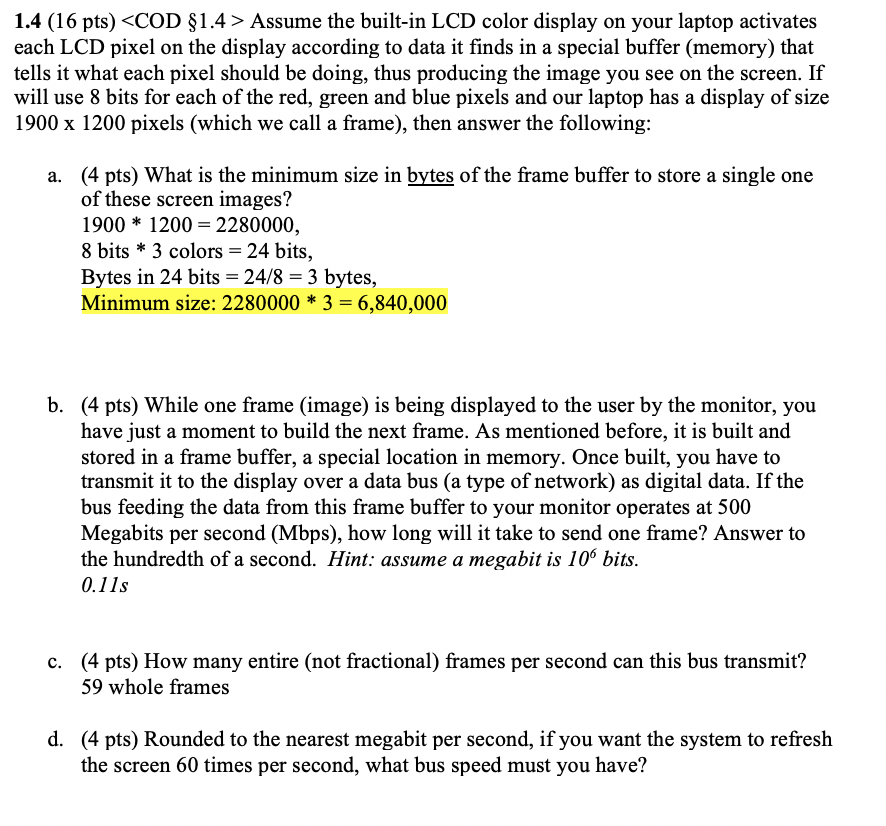
1.4 (16 pts) Assume the built-in LCD color display on your laptop activates each LCD pixel on the display according to data it finds in a special buffer (memory) that tells it what each pixel should be doing, thus producing the image you see on the screen. If will use 8 bits for each of the red, green and blue pixels and our laptop has a display of size 1900 x 1200 pixels (which we call a frame), then answer the following: a. (4 pts) What is the minimum size in bytes of the frame buffer to store a single one of these screen images? 1900 * 1200 = 2280000, 8 bits * 3 colors = 24 bits, Bytes in 24 bits = 24/8 = 3 bytes, Minimum size: 2280000 * 3= 6,840,000 b. (4 pts) While one frame (image) is being displayed to the user by the monitor, you have just a moment to build the next frame. As mentioned before, it is built and stored in a frame buffer, a special location in memory. Once built, you have to transmit it to the display over a data bus (a type of network) as digital data. If the bus feeding the data from this frame buffer to your monitor operates at 500 Megabits per second (Mbps), how long will it take to send one frame? Answer to the hundredth of a second. Hint: assume a megabit is 10% bits. 0.11s c. (4 pts) How many entire (not fractional) frames per second can this bus transmit? 59 whole frames d. (4 pts) Rounded to the nearest megabit per second, if you want the system to refresh the screen 60 times per second, what bus speed must you have? 1.4 (16 pts) Assume the built-in LCD color display on your laptop activates each LCD pixel on the display according to data it finds in a special buffer (memory) that tells it what each pixel should be doing, thus producing the image you see on the screen. If will use 8 bits for each of the red, green and blue pixels and our laptop has a display of size 1900 x 1200 pixels (which we call a frame), then answer the following: a. (4 pts) What is the minimum size in bytes of the frame buffer to store a single one of these screen images? 1900 * 1200 = 2280000, 8 bits * 3 colors = 24 bits, Bytes in 24 bits = 24/8 = 3 bytes, Minimum size: 2280000 * 3= 6,840,000 b. (4 pts) While one frame (image) is being displayed to the user by the monitor, you have just a moment to build the next frame. As mentioned before, it is built and stored in a frame buffer, a special location in memory. Once built, you have to transmit it to the display over a data bus (a type of network) as digital data. If the bus feeding the data from this frame buffer to your monitor operates at 500 Megabits per second (Mbps), how long will it take to send one frame? Answer to the hundredth of a second. Hint: assume a megabit is 10% bits. 0.11s c. (4 pts) How many entire (not fractional) frames per second can this bus transmit? 59 whole frames d. (4 pts) Rounded to the nearest megabit per second, if you want the system to refresh the screen 60 times per second, what bus speed must you have




