







Question: For part A how would someone derive the log likelihood. I just dot understand the question in part A. what is log likelihood? 2. Suppose
For part A how would someone derive the log likelihood. I just dot understand the question in part A. what is log likelihood?
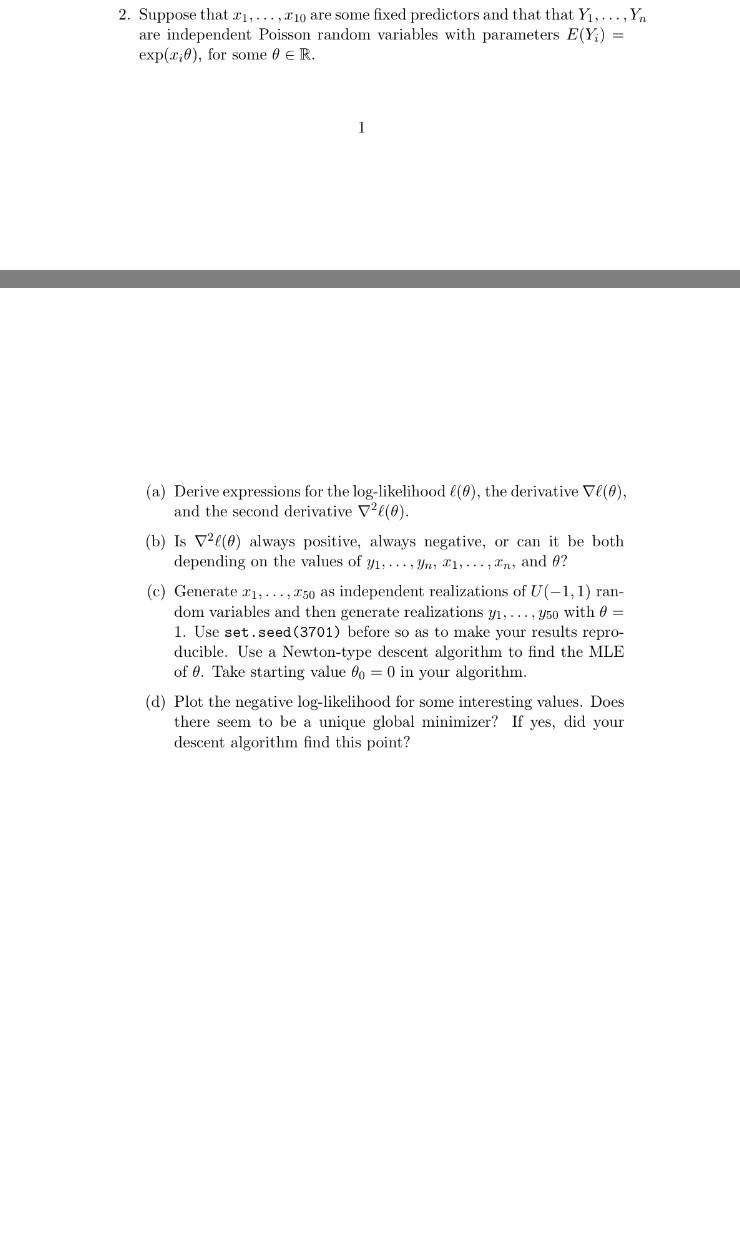
2. Suppose that 1211 . . . ,rm are some xed predictors and that that 3'], . , , . Y1,1 are independent Poisson random variables with parameters ElCK-jl = expat-3}, for some 6 E R. (a) Derive expressions for the log-likelihood 3(6), the derivative V5416), and the second derivative VEEEB}. {b} is Vftti) always positive, always negative, or can it be both depending on the values of m, . . Hy,\" 3:1, . . . ,rrrn, and H? ((1) Generate m1: 1 . . ,sED as independent realizations of EEK1,1) ran dom variables and then generate realizations yl, . . . , 3:53 with 9 = 1. Use set.seed(3701) before so as to make your results repro ducible. Use a Newtontype desoent algorithm to nd the MLE of 6'. Take starting value 30 = D in your algorithm. {d} Plot the negative log-Likelihood for some interesting values. Does there seem to he a unique global rninirnizer? If yes, did your descent algorithm nd this point
Step by Step Solution
There are 3 Steps involved in it

Get step-by-step solutions from verified subject matter experts
 Study Help