







Question: For part a, I said it's true because since both numbers are positive, the result of both the first and second will always be greater

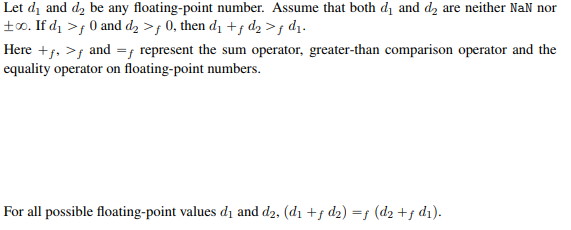
For part a, I said it's true because since both numbers are positive, the result of both the first and second will always be greater than the first term (f1).
For part b I said true because of the commutative property of addition. Could anyone revise and check if they are right? Thank you
Assume we are running code on an Intel x86-64 machine where signed integers are encoded using 32 bit two's complement representation, unsigned integers are 32 bits wide and floating-point numbers are encoded using IEEE 754 double-precision representation. Assume we are running code on an Intel x86-64 machine where signed integers are encoded using 32 bit two's complement representation, unsigned integers are 32 bits wide and floating-point numbers are encoded using IEEE 754 double-precision representation
Step by Step Solution
There are 3 Steps involved in it

Get step-by-step solutions from verified subject matter experts
 Study Help