







Question: For purposes of this problem set, this sample project will be called Project A. The results for Project A, as obtained in Module 9,
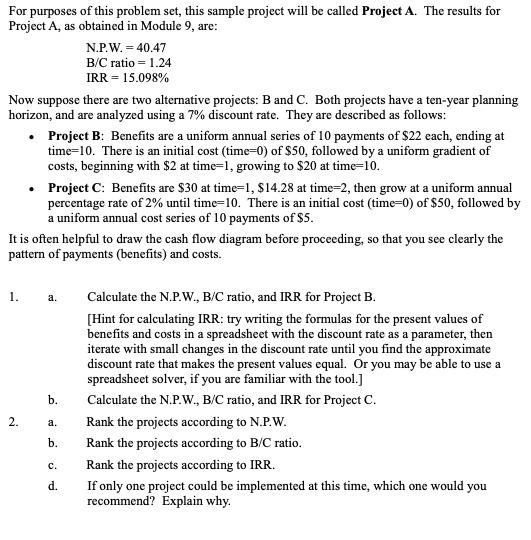
For purposes of this problem set, this sample project will be called Project A. The results for Project A, as obtained in Module 9, are: N.P.W.-40.47 B/C ratio = 1.24 IRR = 15.098% Now suppose there are two alternative projects: B and C. Both projects have a ten-year planning horizon, and are analyzed using a 7% discount rate. They are described as follows: Project B: Benefits are a uniform annual series of 10 payments of $22 each, ending at time-10. There is an initial cost (time=0) of $50, followed by a uniform gradient of costs, beginning with $2 at time-1, growing to $20 at time=10. Project C: Benefits are $30 at time=1, $14.28 at time 2, then grow at a uniform annual percentage rate of 2% until time-10. There is an initial cost (time=0) of $50, followed by a uniform annual cost series of 10 payments of $5. It is often helpful to draw the cash flow diagram before proceeding, so that you see clearly the pattern of payments (benefits) and costs. 1. a. 2. b. a. b. C. PP d. Calculate the N.P.W., B/C ratio, and IRR for Project B. [Hint for calculating IRR: try writing the formulas for the present values of benefits and costs in a spreadsheet with the discount rate as a parameter, then iterate with small changes in the discount rate until you find the approximate discount rate that makes the present values equal. Or you may be able to use a spreadsheet solver, if you are familiar with the tool.] Calculate the N.P.W., B/C ratio, and IRR for Project C. Rank the projects according to N.P.W. Rank the projects according to B/C ratio. Rank the projects according to IRR. If only one project could be implemented at this time, which one would you recommend? Explain why.
Step by Step Solution
There are 3 Steps involved in it

Get step-by-step solutions from verified subject matter experts
 Study Help