







Question: For random variables, if their covariance is equal to zero, then they are uncorrelated. For random variables, their inner product is denoted by <
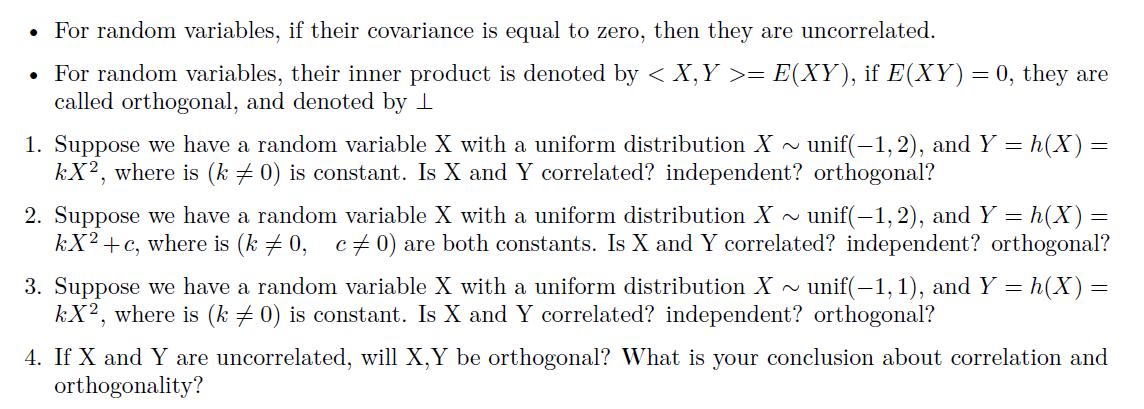
For random variables, if their covariance is equal to zero, then they are uncorrelated. For random variables, their inner product is denoted by < X,Y >= E(XY), if E(XY) = 0, they are called orthogonal, and denoted by 1 1. Suppose we have a random variable X with a uniform distribution X~ unif(-1,2), and Y = h(X) = kX2, where is (k = 0) is constant. Is X and Y correlated? independent? orthogonal? 2. Suppose we have a random variable X with a uniform distribution X~ unif(-1,2), and Y = h(X) = kX2 +c, where is (k = 0, c0) are both constants. Is X and Y correlated? independent? orthogonal? 3. Suppose we have a random variable X with a uniform distribution X~ unif(-1, 1), and Y = h(X) = kX2, where is (k = 0) is constant. Is X and Y correlated? independent? orthogonal? 4. If X and Y are uncorrelated, will X,Y be orthogonal? What is your conclusion about correlation and orthogonality?
Step by Step Solution
3.33 Rating (156 Votes )
There are 3 Steps involved in it
Solutions i assumed orthogonal is denoted by L To determine whether X and Y are correlated independent or orthogonal we need to calculate their covariance and check if it is equal to zero Covariance C... View full answer

Get step-by-step solutions from verified subject matter experts
 Study Help