







Question: For simplicity, we start in 2D. Consider a displacement field, i.e. a mapping where we have used FEM1 notation in naming the position and
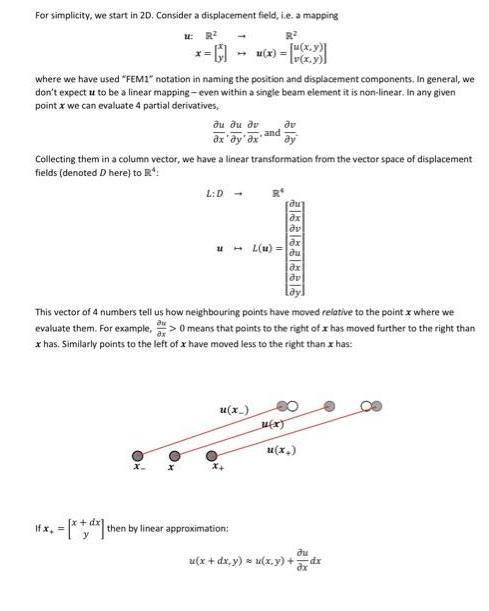
For simplicity, we start in 2D. Consider a displacement field, i.e. a mapping where we have used "FEM1" notation in naming the position and displacement components. In general, we don't expect u to be a linear mapping-even within a single beam element it is non-linear. In any given point x we can evaluate 4 partial derivatives, Collecting them in a column vector, we have a linear transformation from the vector space of displacement fields (denoted D here) to R: Ox dx dy axa Ox L:D - v and ay u(x_) This vector of 4 numbers tell us how neighbouring points have moved relative to the point x where we evaluate them. For example,> 0 means that points to the right of x has moved further to the right than x has. Similarly points to the left of x have moved less to the right than xhas: 1x = [X + dx| then by linear approximation: L(u) = 314615616 u(x) du du dy dr u(x + dx, y) = u(x, y) +
Step by Step Solution
3.41 Rating (148 Votes )
There are 3 Steps involved in it
Yes this is a good understanding of the displacement field and its linearization in the finite element method FEM The displacement field is a vectorva... View full answer

Get step-by-step solutions from verified subject matter experts
 Study Help