







Question: For this assignment you are to use FreeRTOS to study multitasking. Return a zip file containing The code. Please comment your code and include your
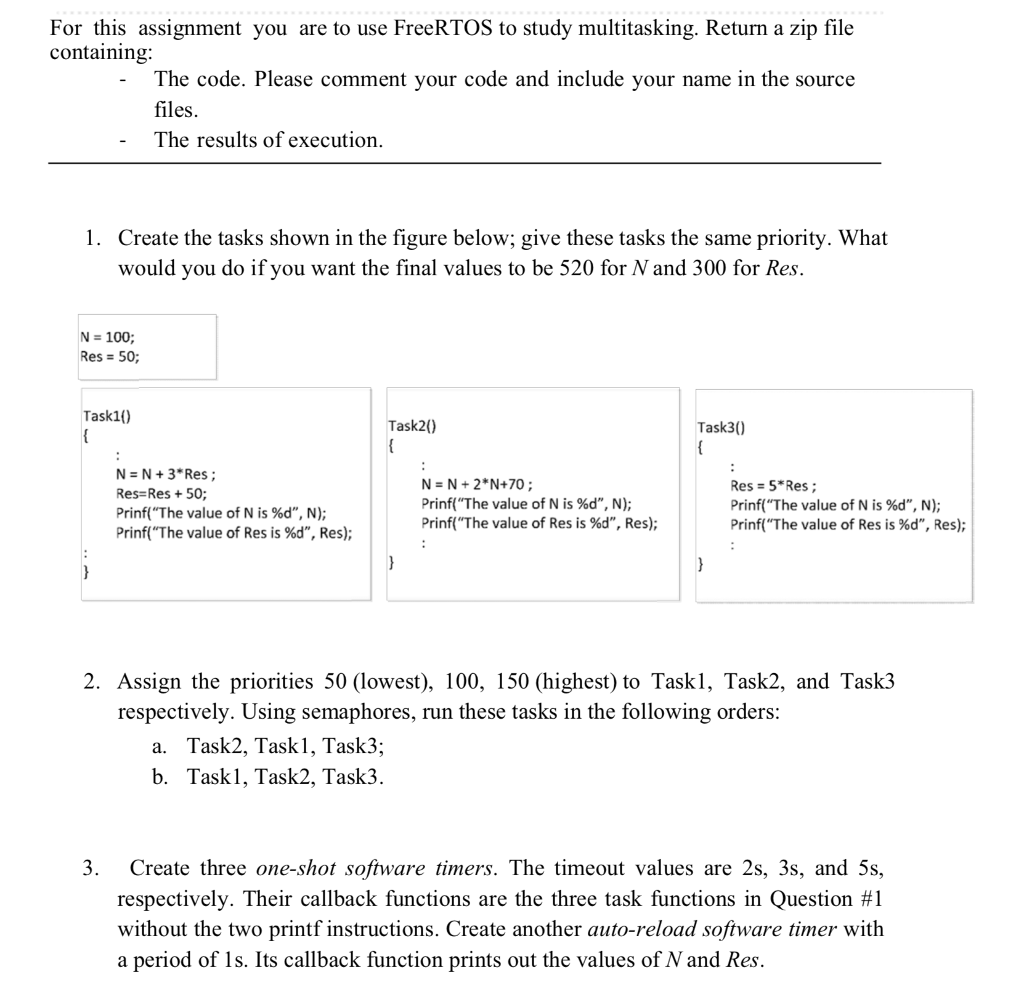
For this assignment you are to use FreeRTOS to study multitasking. Return a zip file containing The code. Please comment your code and include your name in the source files. The results of execution Create the tasks shown in the figure below; give these tasks the same priority. What would you do if you want the final values to be 5 1. 20 for Nand 300 for Res. N 100; Res = 50; Task1) Task2() Task30 N=N+3"Res ; Res-Res +50 Prinf("The value of N is %d", N) Print("The value of Res is %d", Res); N = N + 2*N+70 ; Prinf("The value of N is d", N); Print( "The value of Res is %d", Res); Res-5"Res ; Print("The value of N is %d", N); Print( "The value of Res is %d", Res); 2. Assign the priorities 50 (lowest), 100, 150 (highest) to Taskl, Task2, and Task3 respectively. Using semaphores, run these tasks in the following orders a. Task2, Task1, Task3; b. Taskl, Task2, Task3 3. Create three one-shot software timers. The timeout values are 2s, 3s, and 5s, respectively. Their callback functions are the three task functions in Question #1 without the two printf instructions. Create another auto-reload software timer with a period of 1s. Its callback function prints out the values of N and Res. For this assignment you are to use FreeRTOS to study multitasking. Return a zip file containing The code. Please comment your code and include your name in the source files. The results of execution Create the tasks shown in the figure below; give these tasks the same priority. What would you do if you want the final values to be 5 1. 20 for Nand 300 for Res. N 100; Res = 50; Task1) Task2() Task30 N=N+3"Res ; Res-Res +50 Prinf("The value of N is %d", N) Print("The value of Res is %d", Res); N = N + 2*N+70 ; Prinf("The value of N is d", N); Print( "The value of Res is %d", Res); Res-5"Res ; Print("The value of N is %d", N); Print( "The value of Res is %d", Res); 2. Assign the priorities 50 (lowest), 100, 150 (highest) to Taskl, Task2, and Task3 respectively. Using semaphores, run these tasks in the following orders a. Task2, Task1, Task3; b. Taskl, Task2, Task3 3. Create three one-shot software timers. The timeout values are 2s, 3s, and 5s, respectively. Their callback functions are the three task functions in Question #1 without the two printf instructions. Create another auto-reload software timer with a period of 1s. Its callback function prints out the values of N and Res
Step by Step Solution
There are 3 Steps involved in it

Get step-by-step solutions from verified subject matter experts
 Study Help