







Question: For this assignment, you create your own version of a double-ended queue, known as a deque. Base your implementation using a doubly-linked list, a circular
For this assignment, you create your own version of a double-ended queue, known as a "deque". Base your implementation using a doubly-linked list, a circular linked list, or a combination of the two, a doubly-circular linked list. Up to you.
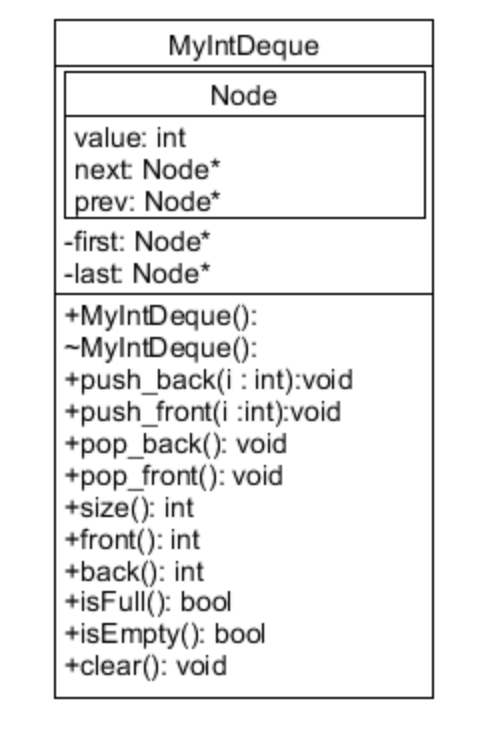 Attributes:
Node: A private, nested struct
value - holds the integer being stored in the deque.
next - holds the memory address of the next node in the deque.
prev - holds the memory address of the previous node in the deque.
front -a pointer that keeps track of the first node in the deque.
back - a pointer that keeps track of the last node in the deque.
Constructor - initializes the the front and back pointers to null.
Destructor - frees all memory used by the deque.
push_back - accepts an integer as it's only argument. Adds the integer to the end of the deque.
push_front - accepts an integer as it's only argument. Inserts the integer at the front of the deque.
pop_back - removes the integer at the end of the deque.
pop_front - removes the integer at the front of the deque.
size - returns the current number of values in the deque.
front - returns the value at the beginning of the deque if it's not empty, -1 otherwise.
back - returns the value at the end of the deque if it's not empty, -1 otherwise.
isFull - returns true if the deque is full, false otherwise.
isEmpty - returns true if the deque is empty, false otherwise.
clear - frees all memory used by the deque, thus emptying the deque. Leaves first and last set to null
MylntDeque Node value: int next Node* Node* -first: Node* -last Node* +MylntDeque: -MylntDeque0 +push_back(i: int):void +push_front(i :int):void +pop back(): void +pop front(): void +size(): int +front(): int +back(): int +isFull): bool +isEmpty(): bool +clear): void
Step by Step Solution
There are 3 Steps involved in it

Get step-by-step solutions from verified subject matter experts
 Study Help