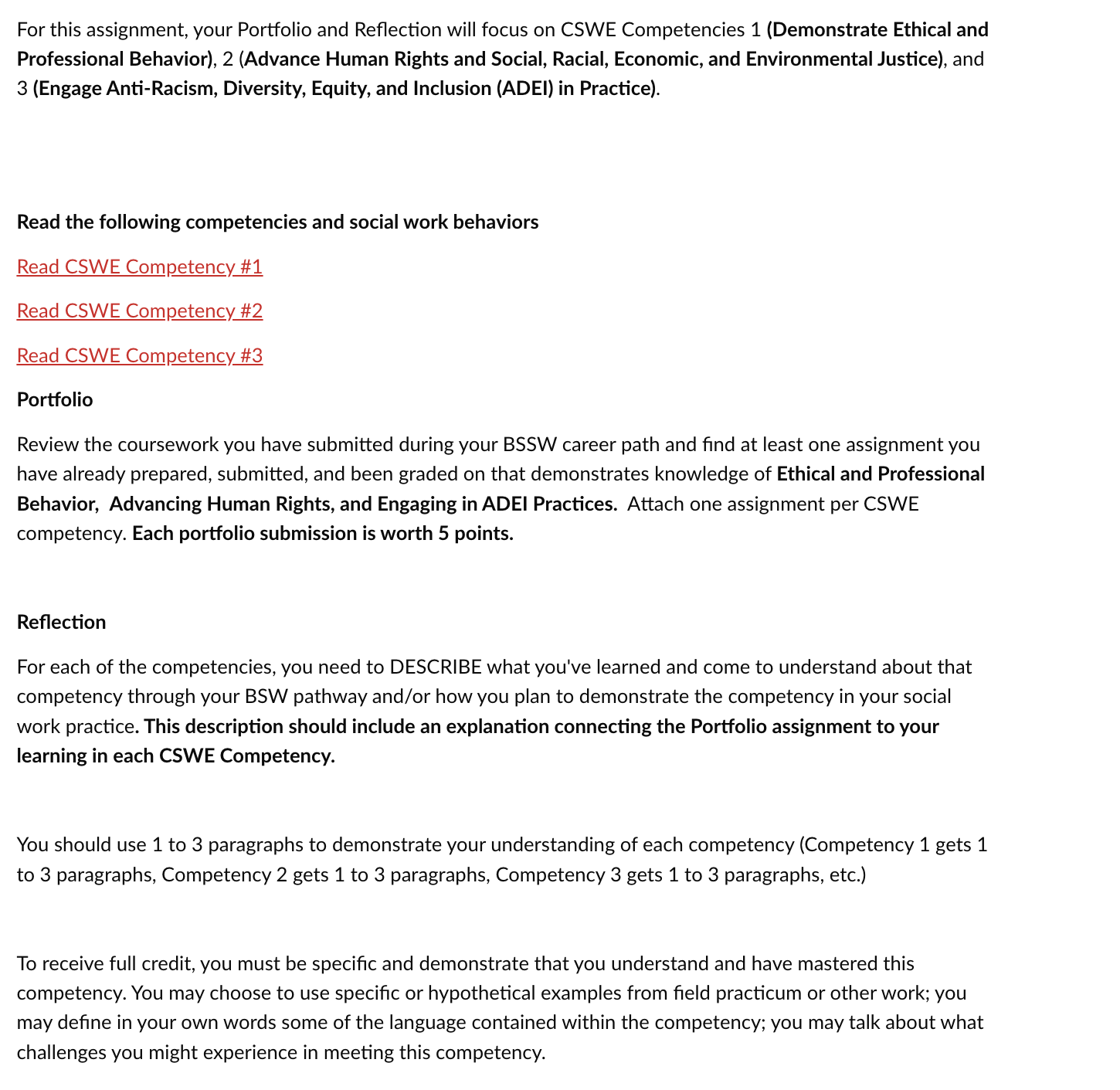
Question: For this assignment, your Portfolio and Reflection will focus on CSWE Competencies 1 (Demonstrate Ethical and Professional Behavior), 2 (Advance Human Rights and Social, Racial,
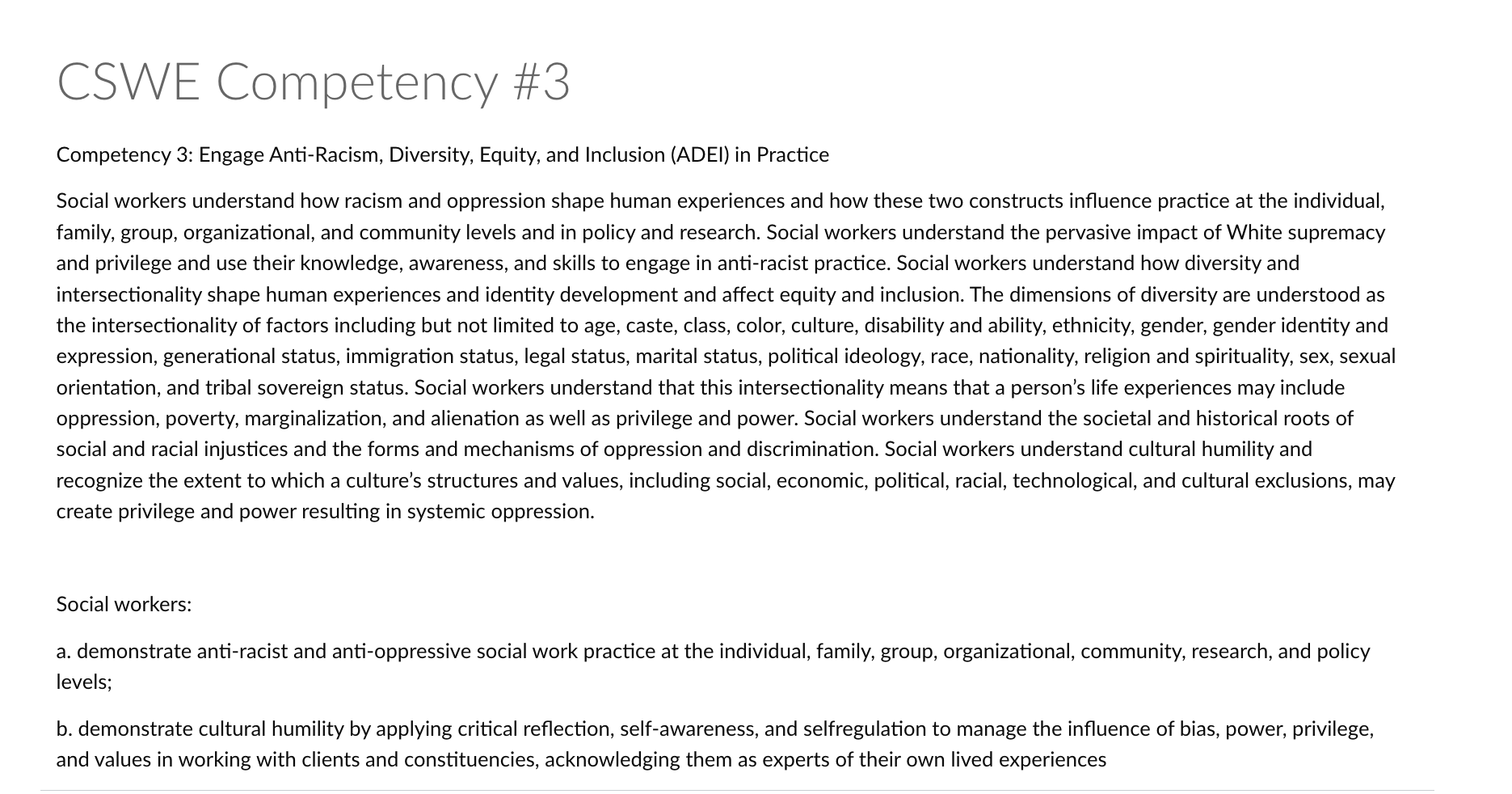
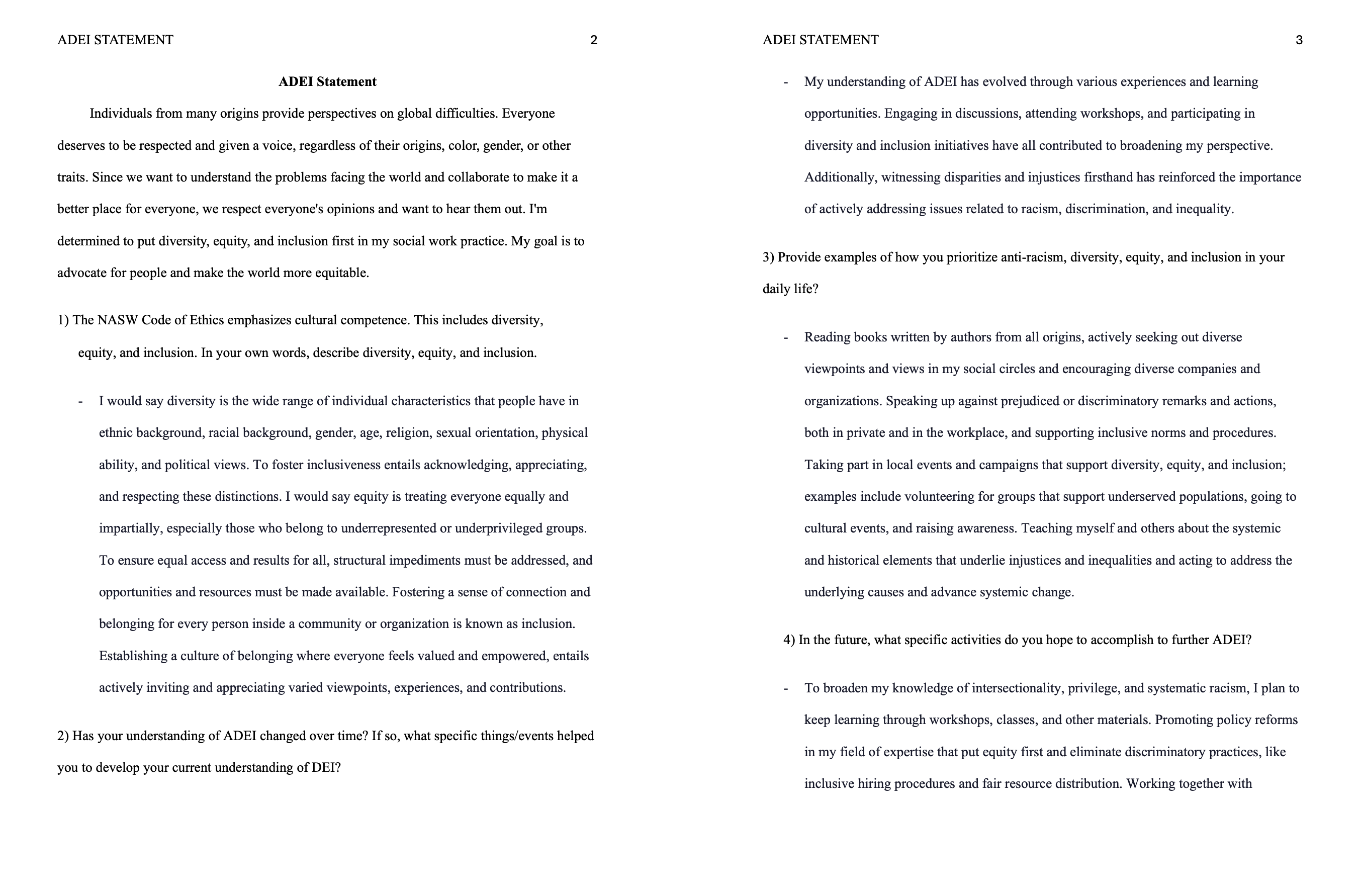
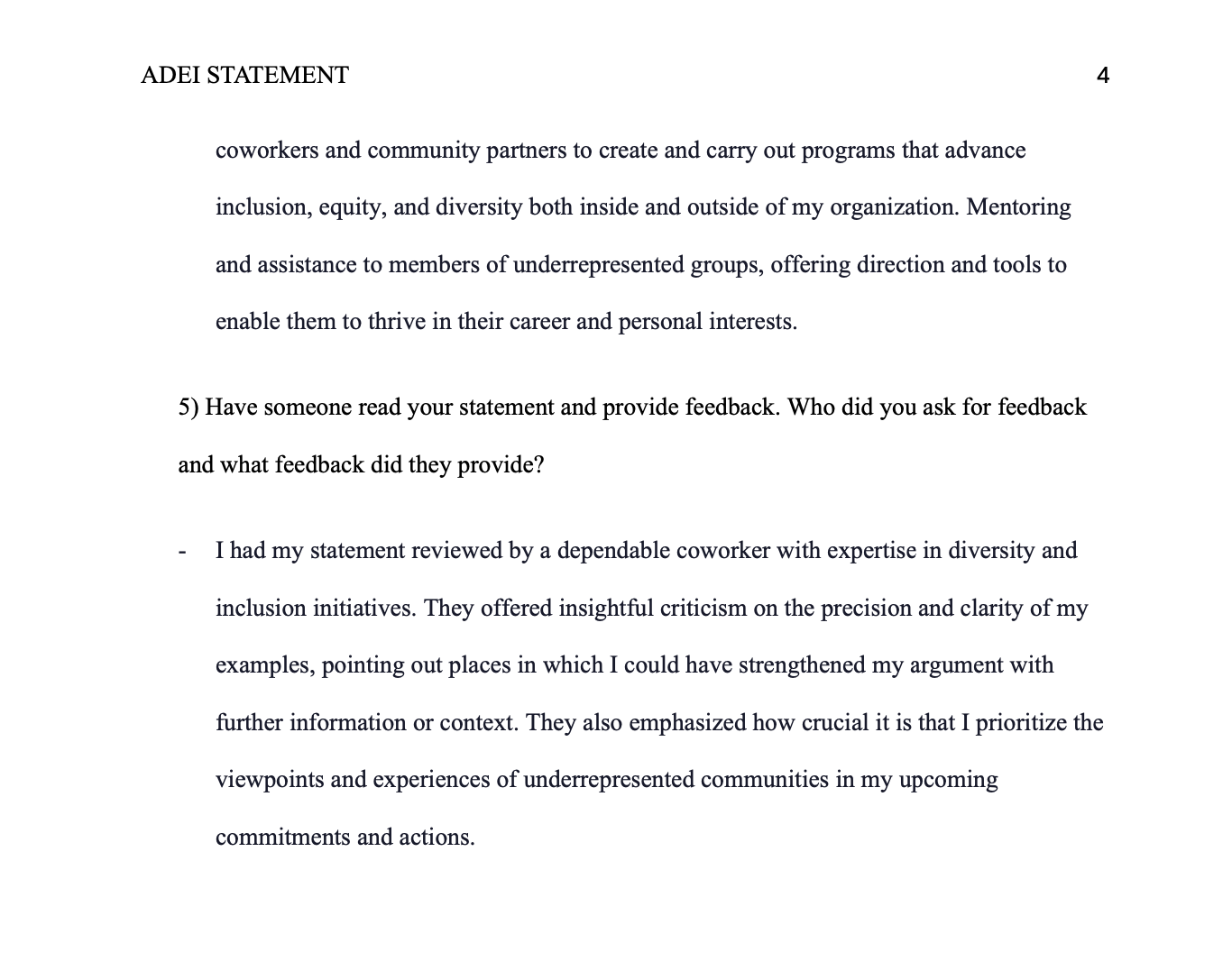
For this assignment, your Portfolio and Reflection will focus on CSWE Competencies 1 (Demonstrate Ethical and Professional Behavior), 2 (Advance Human Rights and Social, Racial, Economic, and Environmental Justice), and 3 (Engage Anti-Racism, Diversity, Equity, and Inclusion (ADEI) in Practice). Read the following competencies and social work behaviors Read CSWE Competency #1 Read CSWE Competency #2 Read CSWE Competency #3 Portfolio Review the coursework you have submitted during your BSSW career path and find at least one assignment you have already prepared, submitted, and been graded on that demonstrates knowledge of Ethical and Professional Behavior, Advancing Human Rights, and Engaging in ADEI Practices. Attach one assignment per CSWE competency. Each portfolio submission is worth 5 points. Reflection For each of the competencies, you need to DESCRIBE what you've learned and come to understand about that competency through your BSW pathway and/or how you plan to demonstrate the competency in your social work practice. This description should include an explanation connecting the Portfolio assignment to your learning in each CSWE Competency. You should use 1 to 3 paragraphs to demonstrate your understanding of each competency (Competency 1 gets 1 to 3 paragraphs, Competency 2 gets 1 to 3 paragraphs, Competency 3 gets 1 to 3 paragraphs, etc.) To receive full credit, you must be specific and demonstrate that you understand and have mastered this competency. You may choose to use specific or hypothetical examples from field practicum or other work; you may define in your own words some of the language contained within the competency; you may talk about what challenges you might experience in meeting this competency. CSWE Competency #3 Competency 3: Engage Anti-Racism, Diversity, Equity, and Inclusion (ADEI) in Practice Social workers understand how racism and oppression shape human experiences and how these two constructs influence practice at the individual, family, group, organizational, and community levels and in policy and research. Social workers understand the pervasive impact of White supremacy and privilege and use their knowledge, awareness, and skills to engage in anti-racist practice. Social workers understand how diversity and intersectionality shape human experiences and identity development and affect equity and inclusion. The dimensions of diversity are understood as the intersectionality of factors including but not limited to age, caste, class, color, culture, disability and ability, ethnicity, gender, gender identity and expression, generational status, immigration status, legal status, marital status, political ideology, race, nationality, religion and spirituality, sex, sexual orientation, and tribal sovereign status. Social workers understand that this intersectionality means that a person's life experiences may include oppression, poverty, marginalization, and alienation as well as privilege and power. Social workers understand the societal and historical roots of social and racial injustices and the forms and mechanisms of oppression and discrimination. Social workers understand cultural humility and recognize the extent to which a culture's structures and values, including social, economic, political, racial, technological, and cultural exclusions, may create privilege and power resulting in systemic oppression. Social workers: a. demonstrate anti-racist and anti-oppressive social work practice at the individual, family, group, organizational, community, research, and policy levels; b. demonstrate cultural humility by applying critical reflection, self-awareness, and selfregulation to manage the influence of bias, power, privilege, and values in working with clients and constituencies, acknowledging them as experts of their own lived experiences ADEI STATEMENT 2 ADEI Statement Individuals from many origins provide perspectives on global difficulties. Everyone deserves to be respected and given a voice, regardless of their origins, color, gender, or other traits. Since we want to understand the problems facing the world and collaborate to make it a better place for everyone, we respect everyone's opinions and want to hear them out. I'm determined to put diversity, equity, and inclusion first in my social work practice. My goal is to advocate for people and make the world more equitable. 1) The NASW Code of Ethics emphasizes cultural competence. This includes diversity, equity, and inclusion. In your own words, describe diversity, equity, and inclusion. - I would say diversity is the wide range of individual characteristics that people have in ethnic background, racial background, gender, age, religion, sexual orientation, physical ability, and political views. To foster inclusiveness entails acknowledging, appreciating, and respecting these distinctions. I would say equity is treating everyone equally and impartially, especially those who belong to underrepresented or underprivileged groups. To ensure equal access and results for all, structural impediments must be addressed, and opportunities and resources must be made available. Fostering a sense of connection and belonging for every person inside a community or organization is known as inclusion. Establishing a culture of belonging where everyone feels valued and empowered, entails actively inviting and appreciating varied viewpoints, experiences, and contributions. 2) Has your understanding of ADEI changed over time? If so, what specific things/events helped you to develop your current understanding of DEI? ADEI STATEMENT My understanding of ADEI has evolved through various experiences and learning opportunities. Engaging in discussions, attending workshops, and participating in diversity and inclusion initiatives have all contributed to broadening my perspective. Additionally, witnessing disparities and injustices firsthand has reinforced the importance of actively addressing issues related to racism, discrimination, and inequality. 3) Provide examples of how you prioritize anti-racism, diversity, equity, and inclusion in your daily life? Reading books written by authors from all origins, actively seeking out diverse viewpoints and views in my social circles and encouraging diverse companies and organizations. Speaking up against prejudiced or discriminatory remarks and actions, both in private and in the workplace, and supporting inclusive norms and procedures. Taking part in local events and campaigns that support diversity, equity, and inclusion; examples include volunteering for groups that support underserved populations, going to cultural events, and raising awareness. Teaching myself and others about the systemic and historical elements that underlie injustices and inequalities and acting to address the underlying causes and advance systemic change. 4) In the future, what specific activities do you hope to accomplish to further ADEI? To broaden my knowledge of intersectionality, privilege, and systematic racism, I plan to keep learning through workshops, classes, and other materials. Promoting policy reforms in my field of expertise that put equity first and eliminate discriminatory practices, like inclusive hiring procedures and fair resource distribution. Working together with ADEI STATEMENT 4 coworkers and community partners to create and carry out programs that advance inclusion, equity, and diversity both inside and outside of my organization. Mentoring and assistance to members of underrepresented groups, offering direction and tools to enable them to thrive in their career and personal interests. 5) Have someone read your statement and provide feedback. Who did you ask for feedback and what feedback did they provide? - [had my statement reviewed by a dependable coworker with expertise in diversity and inclusion initiatives. They offered insightful criticism on the precision and clarity of my examples, pointing out places in which I could have strengthened my argument with further information or context. They also emphasized how crucial it is that I prioritize the viewpoints and experiences of underrepresented communities in my upcoming commitments and actions
Step by Step Solution
There are 3 Steps involved in it
1 Expert Approved Answer
Step: 1 Unlock
Question Has Been Solved by an Expert!
Get step-by-step solutions from verified subject matter experts
Step: 2 Unlock
Step: 3 Unlock
Students Have Also Explored These Related Sociology Questions!









 Study Help