Question: For this question i'm considering ll bean as the subject COMPANY INFORMATION L.L. Bean is a privately held outdoor apprel specialty catalog and retail store
For this question i'm considering ll bean as the subject
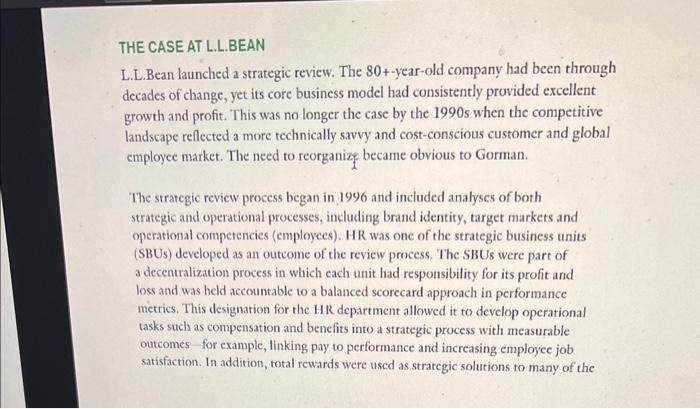
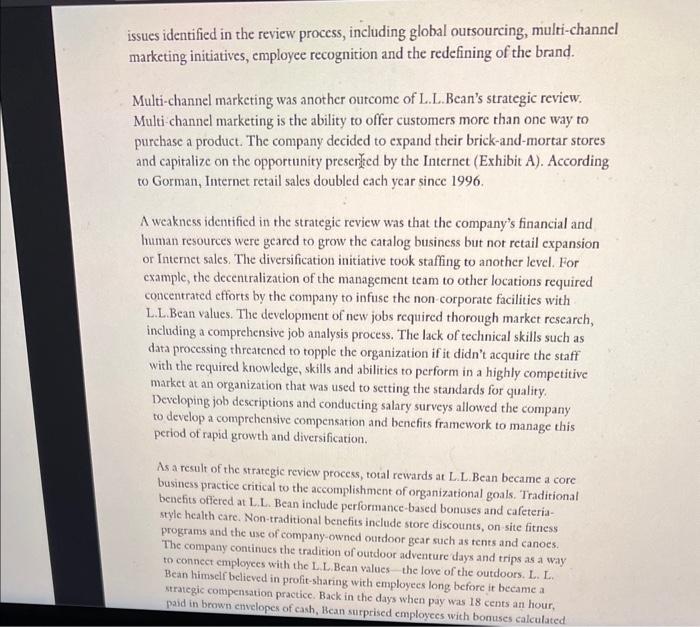
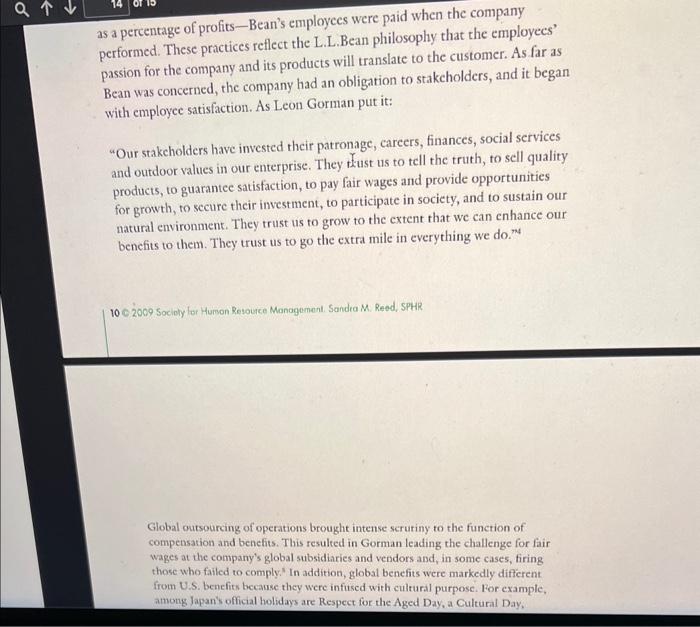
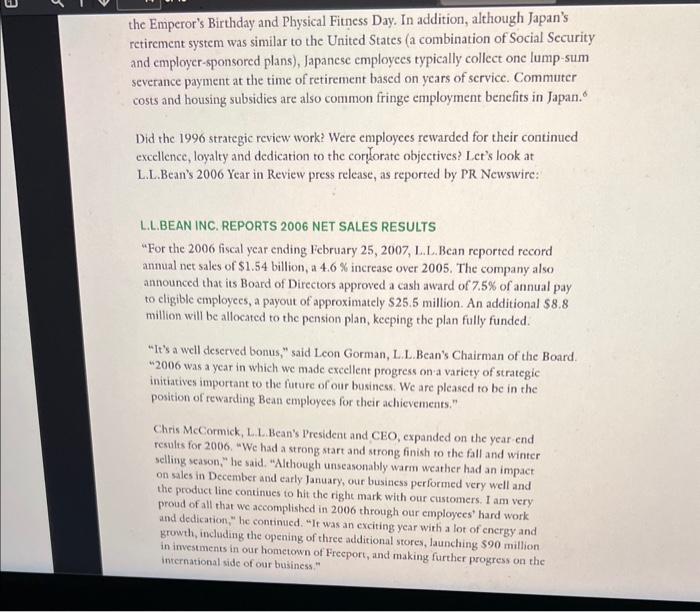
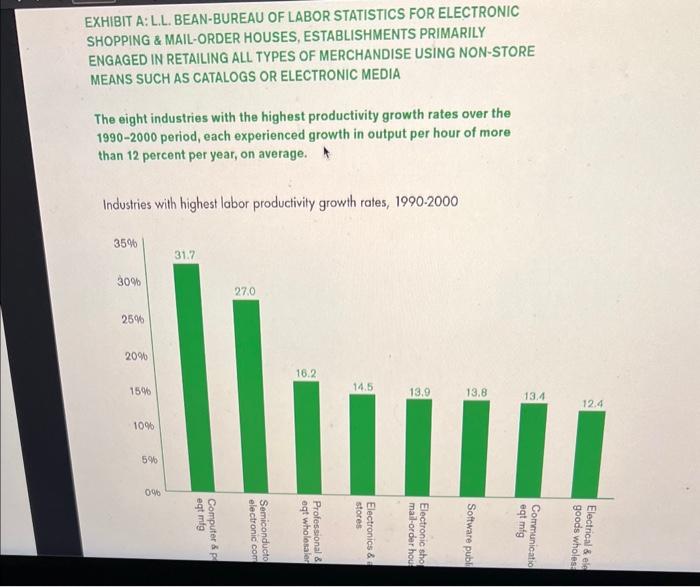
COMPANY INFORMATION L.L. Bean is a privately held outdoor apprel specialty catalog and retail store founded in 1912 by Leon Leonwood Bean, an outdoor enthusiast and entrepreneur. In his autobiography, My Story, Bean wrote that nothing eventful occurred before his 40th year when he created a leather-topped, rubber-bottomed hunting shoe. As the legend goes, he sold his first 100 pairs by mail order with a 100 percent satisfaction guarantee. When 90 pairs were returned defective, he kept his promise and made the refunds. Bean borrowed $400 from his brother to perfect the design and went on to become a clothing consultant for the military during World War II, an author and, of course, the president and founder of a retail giant. As described by Yahoo finance online: "With L.L.Bean, you can tame the great outdoors - or just look as if you could. The outdoor apparel and gear maker mails more than 200 million catalogs per year. L. B. Bean's library includes about 10 specialty catalogs offering products in categories such as children's clothing, fly-fishing, outerwear, sportswear, housewares, footwear, camping and hiking gear, and the Maine hunting shoe upon which the company was built. L.1. Bean also operates about a dozen retail stores and some 15 fictory outlers throughout the Northeast. In addition, it sells online through English- and Japanese-language Web sites." L. L. Bean's annual saler grew from $616.8 million in 1990 to $1.169 billion in 2000 , with an average annual growth rate of 6.8 percent. In 2000 , L.L. Bean paid a 10 percent company wide bonus. More than 11,000 people worked for the company during the 2006 holiday THE BRAND L.L. Bean has always been a marketing professionals' dream of creating a brand into an institution. Strategists, marketing specialists and other business professionals (including the competition) lave tried to duplicate the company's achievements with varying degrees of success. A brand is built on perceptions about quality, scrvice and starus created by using a particular product or working with a specific company. A brand can be built using marketing techniques such as visual imagery, wording that identifies what the organization does, and advertising campaigns targeted to a desired demographic. Strong brand identity can build a relationship with the consumer. In L. T. Fean's case, this is a relationship with Maine and the great outdours. The company operates on the belief that the brand should reflect leean's values, not jus, the products it sells. This case examines how L.L. Bean built the brand by ueing employees as the eritical channel through which to accomplish stratcgic directives. When Leon Gorman, grandson of Lcon Leonwood Bean, assumed, the previdency of the company in 1960 , he teht a message to employec defining their stakeholders L.L. Bcan's stakeholders were its customers, employees, vendors, communities and the natural environment. In addition to a strong customer focus, the company sought to solidify the brand through social responsibility. Social responsibility is a business concept driven by the principles of ethically sound practices, awarencss of the business imprint on the environment, and improvement of the quality of life of the company's employees and the communitics in which it operates. Social responsibility at L.L.Bean is divided into four categories: - 'The environment With company products geared for outdoor use, L.L.Bean focuses its philanthropic efforts on preserving the environment. Examples include green building, charitable giving and employee participation in preservation activities. - Paper procurement L. L. Bean is committed to sustainable, responsible paper procurement, an important consideration because the company mails more than 200 million catalogs cach year. It uses recycled fiber, and suppliers are required to have programs in place to support sustainable management of natural resources. - Labor rights When the company decided to move some operations offshore, it made a commitment to labor rights, including human rights monitoring. In fact, the company terminated at least three offshore vendor relationships that did not meet its human rights standards. Included in Bean's Vendor Code of Conduct are standards for safery, non-discriminatory prictices, and fair compensation and benefits. This code of conduct includes processes for auditing and investigating complaints. Charitable giving Charitable giving at L.L.Bcan is based on Gorman's concept of the stakeholder and the company's heritage in the outdoors. The company has donated more than S5 million toward environmental conservation efforts to groups like The National Park Foundation and Ducks Unlimited. It sponsored the Peace Climb up Mt. Everest, during which more than three tons of trash was collected. In addition, quality of life of the Bean employee and customer is reflected in the company's charitable giving efforts to groups such as United Way and the Portland Symphony Orchestra. THE PROBLEM The company spent the 1970 s and 1980 s developing the brand into an American institution. L.I. Rean operated on the premise that profits are an outcome of strong customer service. Profits, thereforc, were a byproduct rather than a corporate focus. Growth was strong, particularly in mail order. By 1990, however, sales were stagnating, productivity was declining and the mailing list was not growing. The U.S. economy slipped into a recersion, and as a result, 1990 was the worst year for 1. L. Bean in a decade. Sales groweh improved in 1992 when the company expanded into the Japanese market. In 1995, Bean launched their e-commere web site. There was significant upper-management turnover, though, and Gorman belicved that because of the rapidly changing external environment, the company had lost direction. In 1996, sales flattened again, and for the first time under Gorman's leadership, the company reported a decline in sales. It was the first time the board of directors voted to not award annual bonuses to employees. THE CASE AT L.L.BEAN L.L.Bean launched a strategic review. The 80+-year-old company had been through decades of change, yet its core business model had consistently provided excellent growth and profit. This was no longer the case by the 1990 s when the competitive landscape reflected a more technically savvy and cost-conscious customer and global employee market. The need to reorganizg became obvious to Gorman. The strategic revicw process began in 1996 and included analyses of both strategic and operational processes, including brand identity, target markets and operational comperencies (employecs). HR was one of the strategic business units (SBUs) developed as an outcome of the review process. The SBUs were part of a decentralization process in which cach unit had responsibility for its profit and loss and was held accountable to a balanced scorecard approach in performance metrics. This designation for the HR department allowed it to develop operational tasks such as compensation and benefits into a strategic process with measurable outcomes - for example, linking pay to performance and increasing employec job satisfaction. In addition, total rewards were used as strategic solutions to many of the issues identified in the review process, including global outsourcing, multi-channel marketing initiatives, employee recognition and the redefining of the brand. Multi-channel markcting was another outcome of L.L. Bcan's strategic review. Multi-channel marketing is the ability to offer customers more than one way to purchase a product. The company decided to expand their brick-and-mortar stores and capitalize on the opportunity preserryed by the Internet (Exhibit A). According to Gorman, Internet retail sales doubled cach year since 1996. A weakness identified in the strategic revicw was that the company's financial and human resources were geared to grow the catalog business but not retail expansion or Intemet sales. The diversification initiative took staffing to another level. For example, the decentralization of the management team to other locations required concentrated efforts by the company to infuse the non-corporate facilities with L.L. Bean values. The development of new jobs required thorough market research, including a comprehensive job analysis process. The lack of technical skills such as data processing threatened to topple the organization if it didn't acquire the staff with the required knowledge, skills and abilitics to perform in a highly competitive market at an organization that was used to setting the standards for quality. Developing job descriptions and conducting salary surveys allowed the company to develop a comprehensive compensation and bencfits framework to manage this period of rapid growth and diversification. As a result of the strategic review process, total rewards at L. L. Bean became a core business practice critical to the accomplishment of organizational goals. Traditional benefits offered at L.L. Bean include performance-based bonuses and cafeteriastyic health care. Non-traditional benefits include store discounts, on site fitness programs and the use of company-owned outdonr gear such as tents and canoes. The company continues the tradition of outdoor adventure days and trips as a way to connect employees with the L. L. Bean values the love of the outdoors. L. L. Bean himself believed in profit-sharing with employees long before it became a stracgic compensation practice. Back in the days when pay was 18 cents an hour, paid in brown cmvelopes of cash, Bean surprised cmployecs with bomuses calculared as a percentage of profits -Bean's employees were paid when the company performed. These practices reflect the L.L.Bean philosophy that the employecs' passion for the company and its products will translate to the customer. As far as Bean was concerned, the company had an obligation to stakcholders, and it began with employee satisfaction. As Leon Gorman put it: "Our stakcholders have invested their patronage, carcers, finances, social services and outdoor values in our enterprise. They trust us to tell the truth, to sell quality products, to guarantee satisfaction, to pay fair wages and provide opportunities for growth, to secure their investment, to participate in society, and to sustain our natural environment. They trust us to grow to the extent that we can enhance our bencfits to them. They trust us to go the extra mile in everything we do..74. 10 C 2009 Socidy for Hurson Resouice Management. Sandra M. Reod, SPHRR Global outsourcing of operations brought intense scrutiny to the function of compensation and benefits. This resulted in Gorman leading the challenge for fair wages at the company's global subsidiaries and vendors and, in some cases, firing those who failed to comply. 1 In addition, global benefits were markedly different from U.S. benefits because they were infused with cultural purpose. For example, among Japan's official holidays are Respect for the Aged Day, a Cultural Day, the Emperor's Birthday and Physical Fitness Day. In addition, although Japan's retirement system was similar to the United States (a combination of Social Security and employer-sponsored plans), Japancse employecs typically collect one lump-sum severance payment at the time of retirement based on years of service. Commuter costs and housing subsidies are also common fringe employment benefits in Japan. Did the 1996 strategic review work? Were employees rewarded for their continued excellence, loyalty and dedication to the corkorate objectives? Let's look at L.L.Bean's 2006 Year in Review press release, as reported by PR Newswirc: L.L.BEAN INC. REPORTS 2006 NET SALES RESULTS "For the 2006 fiscal year ending February 25, 2007, L.L. Bcan reported record annual net sales of $1.54 billion, a 4.6% increase over 2005. The company also announced that its Board of Directors approved a cash award of 7.5\% of annual pay to cligible employees, a payout of approximately $25.5 million. An additional $8.8 million will be allocated to the pension plan, keeping the plan fully funded. "It's a well deserved bonus," said Lcon Gorman, L.L.Bean's Chairman of the Board. "2006 was a year in which we made cxcellent progress on a variety of strategic initiatives important to the future of our business. We are pleased to be in the position of rewarding Bean employees for their achievements." Chris McCormick, L. L. Bean's President and CEO, expanded on the year end results for 2006. "We had a strong start and strong finish to the fall and winter selling season," he said. "Although unseasonably warm weather had an impact on sales in December and early January, our business performed very well and the product line continues to hit the right mark with our customers. I am very proud of all that we accomplished in 2006 through our employees' hard work and dedication," he continued. "It was an exciting year with a lot of energy and Browth, including the opening of three additional stores, launching 590 million in investments in our hometown of Freeport, and making further progress on the international side of our business " EXHIBIT A: L.L. BEAN-BUREAU OF LABOR STATISTICS FOR ELECTRONIC SHOPPING \& MAIL-ORDER HOUSES, ESTABLISHMENTS PRIMARILY ENGAGED IN RETAILING ALL TYPES OF MERCHANDISE USING NON-STORE MEANS SUCH AS CATALOGS OR ELECTRONIC MEDIA The eight industries with the highest productivity growth rates over the 1990-2000 period, each experienced growth in output per hour of more than 12 percent per year, on average. Industries with highest labor productivity growth rates, 1990-2000 For this section, select one company from the case (Aflac or L.L. Bean). 1. Explain how the company uses its own products or services to enhance the total compensation for its employees. 2. Provide examples of traditional and non-traditional rewards used by the company and discuss how they are used to meet organizational objectives










 Study Help