







Question: Frist, could you please explain what are differences between Ineffective, Slightly Effective, Moderately Effective and Highly Effective and when I can choose the tight right


























 Frist, could you please explain what are differences between Ineffective, Slightly Effective, Moderately Effective and Highly Effective and when I can choose the tight right term for all Scenario from 1 to Scenario 8. After you explain
all term you may answers all Scenario.
Thank you
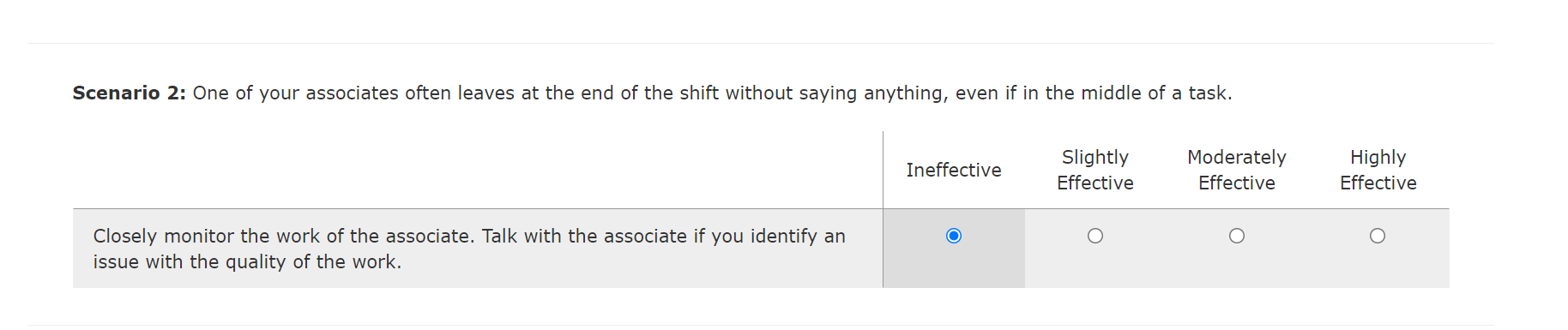
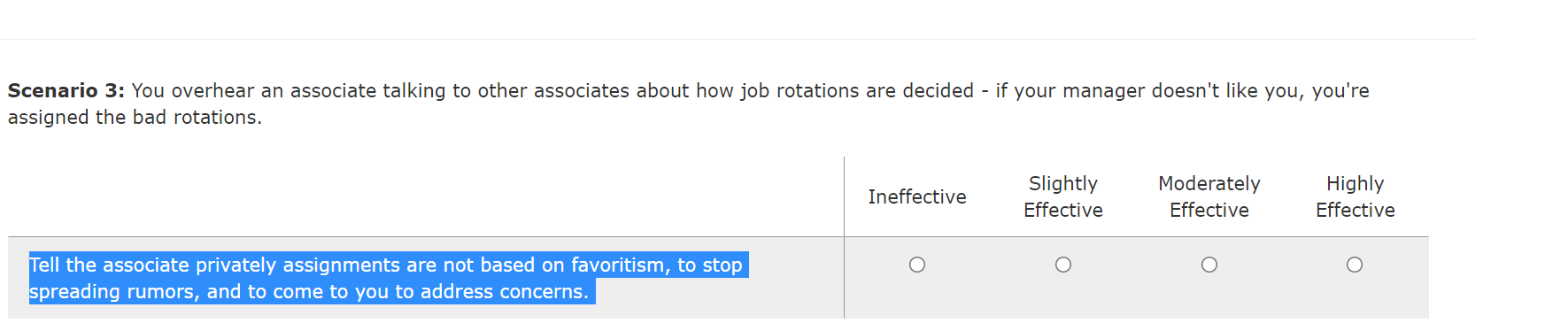
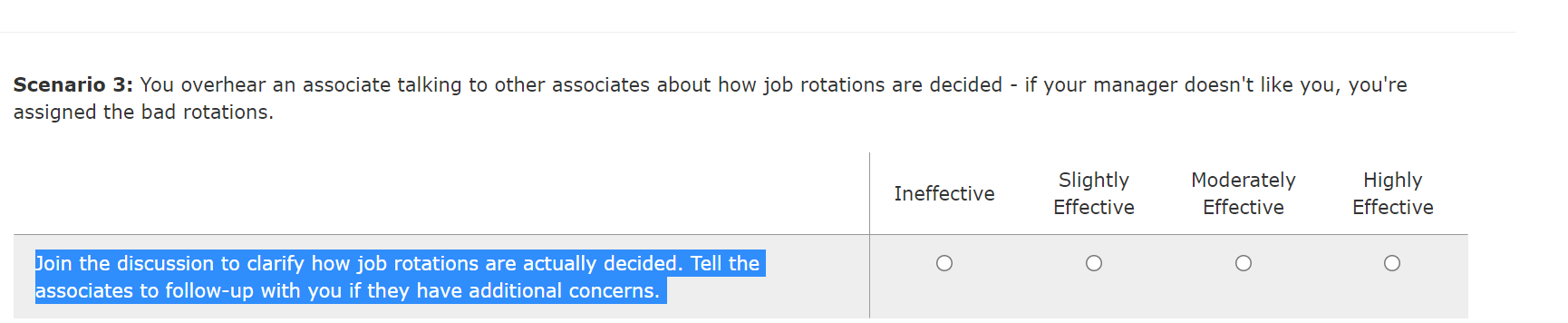
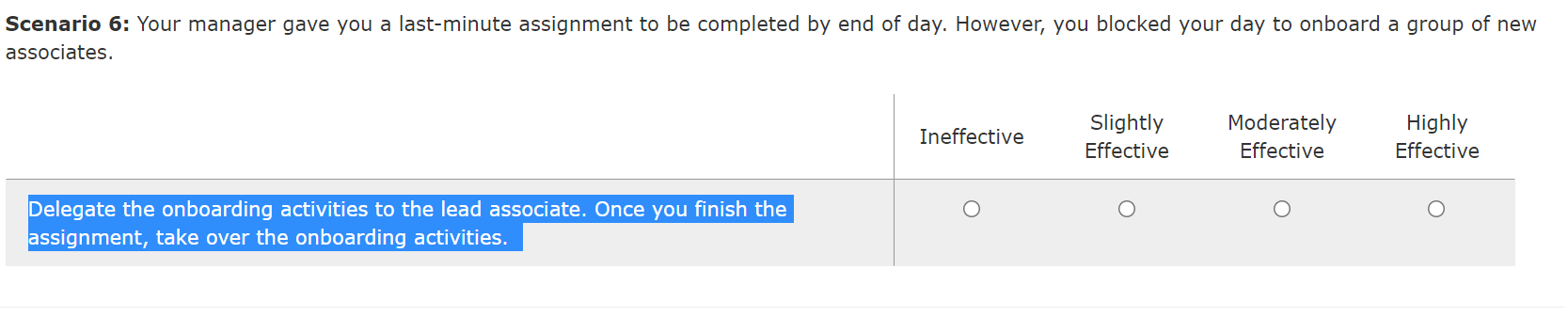
Scenario 1: An associate who started four months ago requested to be a team trainer. Before becoming a team trainer, an associate must have at least six months of experience and demonstrate the necessary skills. Ineffective Slightly Effective Moderately Effective Highly Effective Talk with the associate about the role. Work with the associate to come up with a plan to develop the needed skills. Scenario 1: An associate who started four months ago requested to be a team trainer. Before becoming a team trainer, an associate must have at least six months of experience and demonstrate the necessary skills. Ineffective Slightly Effective Moderately Effective Highly Effective Remind the associate of the eligibility requirements and tell them to talk with you in a couple of months if they are still interested. Scenario 1: An associate who started four months ago requested to be a team trainer. Before becoming a team trainer, an associate must have at least six months of experience and demonstrate the necessary skills. Ineffective Slightly Effective Moderately Effective Highly Effective Talk with your manager to check if the policy can be changed. Afterwards, follow-up with the associate on the decision. Scenario 1: An associate who started four months ago requested to be a team trainer. Before becoming a team trainer, an associate must have at least six months of experience and demonstrate the necessary skills. Ineffective Slightly Effective Moderately Effective Highly Effective Approve the request because the associate is dedicated, will likely do well as a team trainer, and can handle additional responsibilities. Scenario 2: One of your associates often leaves at the end of the shift without saying anything, even if in the middle of a task. Ineffective Slightly Effective Moderately Effective Highly Effective Talk with the associate about the importance of communicating the progress of tasks to ensure all work gets completed. Scenario 2: One of your associates often leaves at the end of the shift without saying anything, even if in the middle of a task. Ineffective Slightly Effective Moderately Effective Highly Effective Closely monitor the work of the associate. Talk with the associate if you identify an issue with the quality of the work. Scenario 2: One of your associates often leaves at the end of the shift without saying anything, even if in the middle of a task. Ineffective Slightly Effective Moderately Effective Highly Effective Notify Human Resources about your concerns so they can follow-up with the associate about the issue you identified. Scenario 2: One of your associates often leaves at the end of the shift without saying anything, even if in the middle of a task. Ineffective Slightly Effective Moderately Effective Highly Effective Schedule time at the end of each shift to review the associate's work and determine what additional tasks still need to be completed. Scenario 3: You overhear an associate talking to other associates about how job rotations are decided - if your manager doesn't like you, you're assigned the bad rotations. Ineffective Slightly Effective Moderately Effective Highly Effective Talk with the associate privately to understand and address the rotation concerns. Discuss job rotations at the next team meeting. Scenario 3: You overhear an associate talking to other associates about how job rotations are decided - if your manager doesn't like you, you're assigned the bad rotations. Ineffective Slightly Effective Moderately Effective Highly Effective Tell the associate privately assignments are not based on favoritism, to stop spreading rumors, and to come to you to address concerns. Scenario 3: You overhear an associate talking to other associates about how job rotations are decided - if your manager doesn't like you, you're assigned the bad rotations. Ineffective Slightly Effective Moderately Effective Highly Effective Join the discussion to clarify how job rotations are actually decided. Tell the associates to follow-up with you if they have additional concerns. Scenario 3: You overhear an associate talking to other associates about how job rotations are decided - if your manager doesn't like you, you're assigned the bad rotations. Ineffective Slightly Effective Moderately Effective Highly Effective During the next team meeting, clarify how job rotation assignments are decided to make it clear favoritism is not part of making decisions. Scenario 4: You were notified that an associate was away from work for a couple of hours last week. After confronting the associate, you remember approving the time-off request. Ineffective Slightly Effective Moderately Effective Highly Effective Apologize for forgetting the schedule change. Make a note in the system so the associate's time away from work is recorded correctly. Scenario 4: You were notified that an associate was away from work for a couple of hours last week. After confronting the associate, you remember approving the time-off request. Ineffective Slightly Effective Moderately Effective Highly Effective Tell the associate to send you a reminder next time so you can make sure it properly documented in the system. Scenario 4: You were notified that an associate was away from work for a couple of hours last week. After confronting the associate, you remember approving the time-off request. Ineffective Slightly Effective Moderately Effective Highly Effective Apologize to the associate about forgetting the schedule change. Review your process for tracking requests to ensure accuracy in the future. Scenario 5: You notice that when it gets busy, some associates start taking shortcuts that could impact the quality of their work. Ineffective Slightly Effective Moderately Effective Highly Effective Follow-up with the associates taking shortcuts so they understand why they cannot do this. Deliver the same message during the next team meeting. Scenario 5: You notice that when it gets busy, some associates start taking shortcuts that could impact the quality of their work. Ineffective Slightly Effective Moderately Effective Highly Effective Talk with the associates to determine if shortcuts are necessary. Work with your team to figure out a way to take shortcuts without impacting quality. Scenario 5: You notice that when it gets busy, some associates start taking shortcuts that could impact the quality of their work. Ineffective Slightly Effective Moderately Effective Highly Effective Closely monitor the output of the work of these associates. If taking shortcuts impacts the quality, tell the associates to stop taking them. Scenario 5: You notice that when it gets busy, some associates start taking shortcuts that could impact the quality of their work. Ineffective Slightly Effective Moderately Effective Highly Effective Request changes be made to the amount of work associates get because they cannot be expected to maintain quality when their workload increases. Scenario 6: Your manager gave you a last-minute assignment to be completed by end of day. However, you blocked your day to onboard a group of new associates. Ineffective Slightly Effective Moderately Effective Highly Effective O Tell your manager you are unavailable today due to the scheduled onboarding activities. Scenario 6: Your manager gave you a last-minute assignment to be completed by end of day. However, you blocked your day to onboard a group of new associates. Ineffective Slightly Effective Moderately Effective Highly Effective Reschedule the onboarding activities so you can focus on the last-minute request. Scenario 6: Your manager gave you a last-minute assignment to be completed by end of day. However, you blocked your day to onboard a group of new associates. Ineffective Slightly Effective Moderately Effective Highly Effective Delegate the onboarding activities to the lead associate. Once you finish the assignment, take over the onboarding activities. Scenario 6: Your manager gave you a last-minute assignment to be completed by end of day. However, you blocked your day to onboard a group of new associates. Ineffective Slightly Effective Moderately Effective Highly Effective Tell your manager about the onboarding activities and ask if you should complete the assignment or the onboarding activities. Scenario 7: It's a busy day and your associates are struggling to keep up with the unexpectedly high workload. Ineffective Slightly Effective Moderately Effective Highly Effective Review the work to figure out if there is a way to make the work more efficient without compromising policies or quality. Scenario 7: It's a busy day and your associates are struggling to keep up with the unexpectedly high workload. Ineffective Slightly Effective Moderately Effective Highly Effective Join the associates to reduce their workload and to make sure all work gets completed. Scenario 7: It's a busy day and your associates are struggling to keep up with the unexpectedly high workload. Ineffective Slightly Effective Moderately Effective Highly Effective Closely monitor progress so that, at the end of shift, you know what else needs to be accomplished and the best next steps. Scenario 7: It's a busy day and your associates are struggling to keep up with the unexpectedly high workload. Ineffective Slightly Effective Moderately Effective Highly Effective Tell the associates you appreciate them and you are confident they will be able to complete everything by working hard. Scenario 8: You implemented a buddy system where tenured associates are partnered with new associates. Your manager thinks the tenured associates are spending too much time coaching and not enough time on their own tasks. Ineffective Slightly Effective Moderately Effective Highly Effective Re-evaluate the system and determine if changes can be implemented so tenured associates are able to balance coaching and their own tasks. Scenario 8: You implemented a buddy system where tenured associates are partnered with new associates. Your manager thinks the tenured associates are spending too much time coaching and not enough time on their own tasks. Ineffective Slightly Effective Moderately Effective Highly Effective Based on your manager's concern, end the buddy system. Closely monitor each new associate and provide additional support as needed. Scenario 8: You implemented a buddy system where tenured associates are partnered with new associates. Your manager thinks the tenured associates are spending too much time coaching and not enough time on their own tasks. Ineffective Slightly Effective Moderately Effective Highly Effective Tell your manager about the benefits of your system so your manager understands why the tenured associates are spending time helping the new associates. Scenario 8: You implemented a buddy system where tenured associates are partnered with new associates. Your manager thinks the tenured associates are spending too much time coaching and not enough time on their own tasks. Ineffective Slightly Effective Moderately Effective Highly Effective Become more creative with the scheduling to ensure new associates get the support they need and all work is completed in a timely mannerStep by Step Solution
There are 3 Steps involved in it
1 Expert Approved Answer
Step: 1 Unlock

Question Has Been Solved by an Expert!
Get step-by-step solutions from verified subject matter experts
Step: 2 Unlock
Step: 3 Unlock
 Study Help