







Question: From Part B: What is the question or problem in the case? Briefly explain to what aspect (or aspects) of the OS strategy model does
From Part B: What is the question or problem in the case? Briefly explain to what aspect (or aspects) of the OS strategy model does this relates?
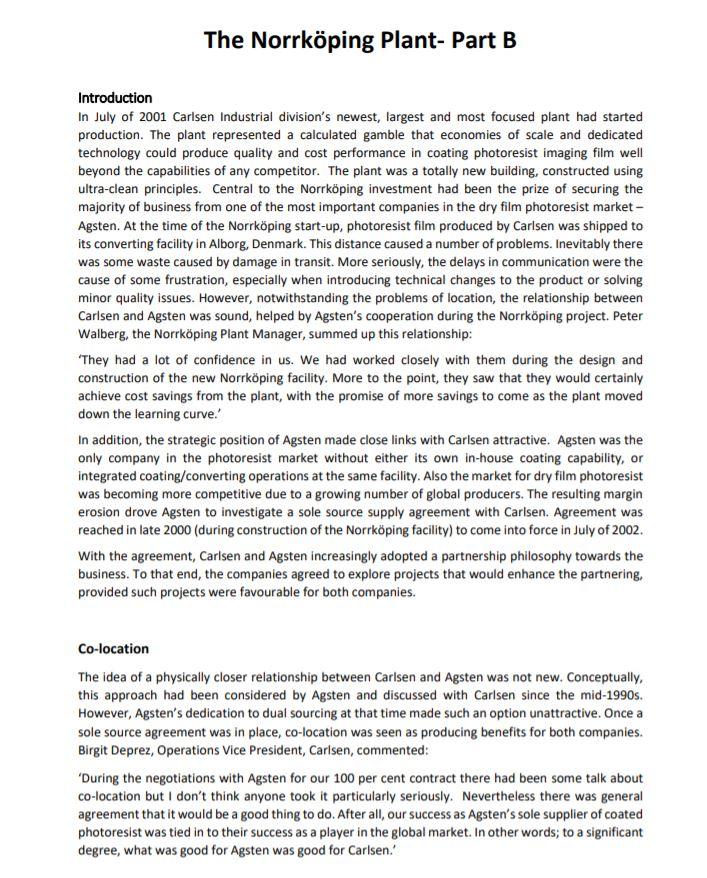
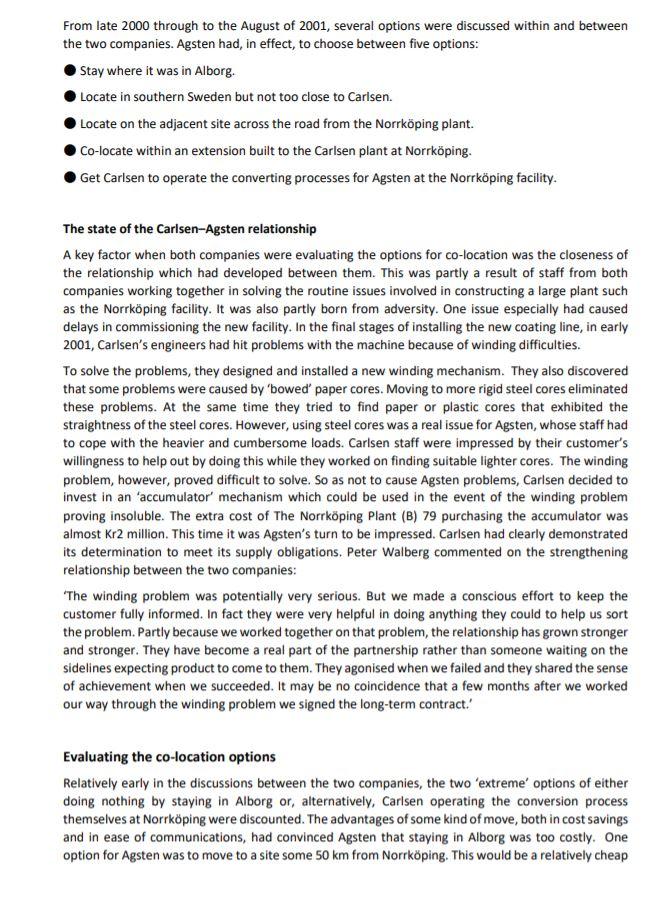
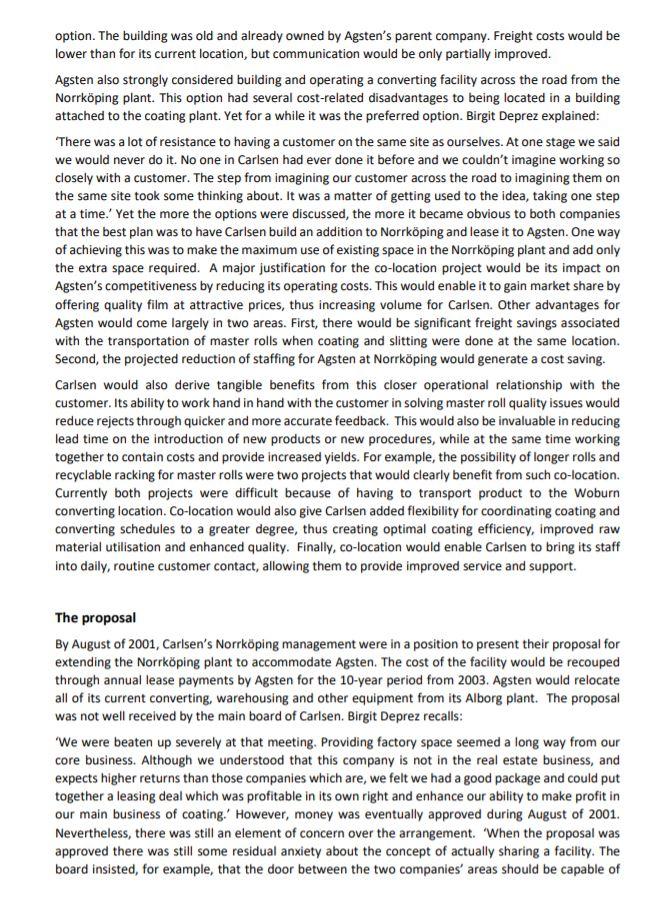
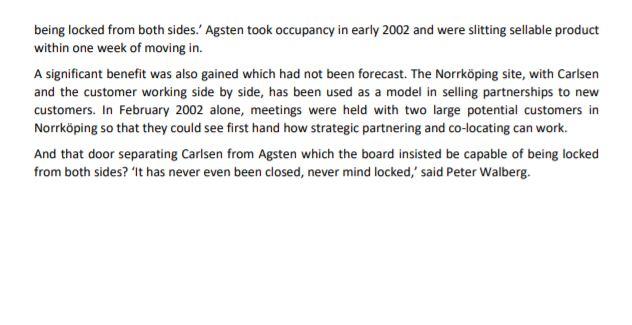
The Norrkping Plant- Part B Introduction In July of 2001 Carlsen Industrial division's newest, largest and most focused plant had started production. The plant represented a calculated gamble that economies of scale and dedicated technology could produce quality and cost performance in coating photoresist imaging film well beyond the capabilities of any competitor. The plant was a totally new building, constructed using ultra-clean principles. Central to the Norrkping investment had been the prize of securing the majority of business from one of the most important companies in the dry film photoresist market - Agsten. At the time of the Norrkping start-up, photoresist film produced by Carlsen was shipped to its converting facility in Alborg, Denmark. This distance caused a number of problems. Inevitably there was some waste caused by damage in transit. More seriously, the delays in communication were the cause of some frustration, especially when introducing technical changes to the product or solving minor quality issues. However, notwithstanding the problems of location, the relationship between Carlsen and Agsten was sound, helped by Agsten's cooperation during the Norrkping project. Peter Walberg, the Norrkping Plant Manager, summed up this relationship: "They had a lot of confidence in us. We had worked closely with them during the design and construction of the new Norrkping facility. More to the point, they saw that they would certainly achieve cost savings from the plant, with the promise of more savings to come as the plant moved down the learning curve. In addition, the strategic position of Agsten made close links with Carlsen attractive. Agsten was the only company in the photoresist market without either its own in-house coating capability, or integrated coating/converting operations at the same facility. Also the market for dry film photoresist was becoming more competitive due to a growing number of global producers. The resulting margin erosion drove Agsten to investigate a sole source supply agreement with Carlsen. Agreement was reached in late 2000 (during construction of the Norrkping facility) to come into force in July of 2002. With the agreement, Carlsen and Agsten increasingly adopted a partnership philosophy towards the business. To that end, the companies agreed to explore projects that would enhance the partnering, provided such projects were favourable for both companies. Co-location The idea of a physically closer relationship between Carlsen and Agsten was not new. Conceptually, this approach had been considered by Agsten and discussed with Carlsen since the mid-1990s. However, Agsten's dedication to dual sourcing at that time made such an option unattractive. Once a sole source agreement was in place, co-location was seen as producing benefits for both companies. Birgit Deprez, Operations Vice President, Carlsen, commented: 'During the negotiations with Agsten for our 100 per cent contract there had been some talk about co-location but I don't think anyone took it particularly seriously. Nevertheless there was general agreement that it would be a good thing to do. After all, our success as Agsten's sole supplier of coated photoresist was tied in to their success as a player in the global market. In other words; to a significant degree, what was good for Agsten was good for Carlsen.' From late 2000 through to the August of 2001, several options were discussed within and between the two companies. Agsten had, in effect, to choose between five options: Stay where it was in Alborg. Locate in southern Sweden but not too close to Carlsen. Locate on the adjacent site across the road from the Norrkping plant. Co-locate within an extension built to the Carlsen plant at Norrkping. Get Carlsen to operate the converting processes for Agsten at the Norrkping facility. The state of the Carlsen-Agsten relationship A key factor when both companies were evaluating the options for co-location was the closeness of the relationship which had developed between them. This was partly a result of staff from both companies working together in solving the routine issues involved in constructing a large plant such as the Norrkping facility. It was also partly born from adversity. One issue especially had caused delays in commissioning the new facility. In the final stages of installing the new coating line, in early 2001, Carlsen's engineers had hit problems with the machine because of winding difficulties. To solve the problems, they designed and installed a new winding mechanism. They also discovered that some problems were caused by bowed' paper cores. Moving to more rigid steel cores eliminated these problems. At the same time they tried to find paper or plastic cores that exhibited the straightness of the steel cores. However, using steel cores was a real issue for Agsten, whose staff had to cope with the heavier and cumbersome loads. Carlsen staff were impressed by their customer's willingness to help out by doing this while they worked on finding suitable lighter cores. The winding problem, however, proved difficult to solve. So as not to cause Agsten problems, Carlsen decided to invest in an 'accumulator' mechanism which could be used in the event of the winding problem proving insoluble. The extra cost of The Norrkping Plant (B) 79 purchasing the accumulator was almost Kr2 million. This time it was Agsten's turn to be impressed. Carlsen had clearly demonstrated its determination to meet its supply obligations. Peter Walberg commented on the strengthening relationship between the two companies: 'The winding problem was potentially very serious. But we made a conscious effort to keep the customer fully informed. In fact they were very helpful in doing anything they could to help us sort the problem. Partly because we worked together on that problem, the relationship has grown stronger and stronger. They have become a real part of the partnership rather than someone waiting on the sidelines expecting product to come to them. They agonised when we failed and they shared the sense of achievement when we succeeded. It may be no coincidence that a few months after we worked our way through the winding problem we signed the long-term contract.' Evaluating the co-location options Relatively early in the discussions between the two companies, the two 'extreme' options of either doing nothing by staying in Alborg or, alternatively, Carlsen operating the conversion process themselves at Norrkping were discounted. The advantages of some kind of move, both in cost savings and in ease of communications, had convinced Agsten that staying in Alborg was too costly. One option for Agsten was to move to a site some 50 km from Norrkping. This would be a relatively cheap option. The building was old and already owned by Agsten's parent company. Freight costs would be lower than for its current location, but communication would be only partially improved. Agsten also strongly considered building and operating a converting facility across the road from the Norrkping plant. This option had several cost-related disadvantages to being located in a building attached to the coating plant. Yet for a while it was the preferred option. Birgit Deprez explained: There was a lot of resistance to having a customer on the same site as ourselves. At one stage we said we would never do it. No one in Carlsen had ever done it before and we couldn't imagine working so closely with a customer. The step from imagining our customer across the road to imagining them on the same site took some thinking about. It was a matter of getting used to the idea, taking one step at a time. Yet the more the options were discussed, the more it became obvious to both companies that the best plan was to have Carlsen build an addition to Norrkping and lease it to Agsten. One way of achieving this was to make the maximum use of existing space in the Norrkping plant and add only the extra space required. A major justification for the co-location project would be its impact on Agsten's competitiveness by reducing its operating costs. This would enable it to gain market share by offering quality film at attractive prices, thus increasing volume for Carlsen. Other advantages for Agsten would come largely in two areas. First, there would be significant freight savings associated with the transportation of master rolls when coating and slitting were done at the same location. Second, the projected reduction of staffing for Agsten at Norrkping would generate a cost saving. Carlsen would also derive tangible benefits from this closer operational relationship with the customer. Its ability to work hand in hand with the customer in solving master roll quality issues would reduce rejects through quicker and more accurate feedback. This would also be invaluable in reducing lead time on the introduction of new products or new procedures, while at the same time working together to contain costs and provide increased yields. For example, the possibility of longer rolls and recyclable racking for master rolls were two projects that would clearly benefit from such co-location. Currently both projects were difficult because of having to transport product to the Woburn converting location. Co-location would also give Carlsen added flexibility for coordinating coating and converting schedules to a greater degree, thus creating optimal coating efficiency, improved raw material utilisation and enhanced quality. Finally, co-location would enable Carlsen to bring its staff into daily, routine customer contact, allowing them to provide improved service and support. The proposal By August of 2001, Carlsen's Norrkping management were in a position to present their proposal for extending the Norrkping plant to accommodate Agsten. The cost of the facility would be recouped through annual lease payments by Agsten for the 10-year period from 2003. Agsten would relocate all of its current converting, warehousing and other equipment from its Alborg plant. The proposal was not well received by the main board of Carlsen. Birgit Deprez recalls: 'We were beaten up severely at that meeting. Providing factory space seemed a long way from our core business. Although we understood that this company is not in the real estate business, and expects higher returns than those companies which are, we felt we had a good package and could put together a leasing deal which was profitable in its own right and enhance our ability to make profit in our main business of coating.' However, money was eventually approved during August of 2001. Nevertheless, there was still an element of concern over the arrangement. 'When the proposal was approved there was still some residual anxiety about the concept of actually sharing a facility. The board insisted, for example, that the door between the two companies' areas should be capable of being locked from both sides.' Agsten took occupancy in early 2002 and were slitting sellable product within one week of moving in. A significant benefit was also gained which had not been forecast. The Norrkping site, with Carlsen and the customer working side by side, has been used as a model in selling partnerships to new customers. In February 2002 alone, meetings were held with two large potential customers in Norrkping so that they could see first hand how strategic partnering and co-locating can work. And that door separating Carlsen from Agsten which the board insisted be capable of being locked from both sides? 'It has never even been closed, never mind locked,' said Peter WalbergStep by Step Solution
There are 3 Steps involved in it
1 Expert Approved Answer
Step: 1 Unlock

Question Has Been Solved by an Expert!
Get step-by-step solutions from verified subject matter experts
Step: 2 Unlock
Step: 3 Unlock
 Study Help