







Question: From these two stats, what conclusions can be made from here and how is it affecting the economy? Thanks Despite the decline in full-time work
From these two stats, what conclusions can be made from here and how is it affecting the economy? Thanks
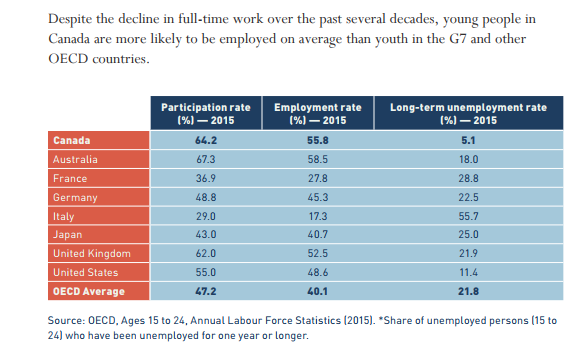
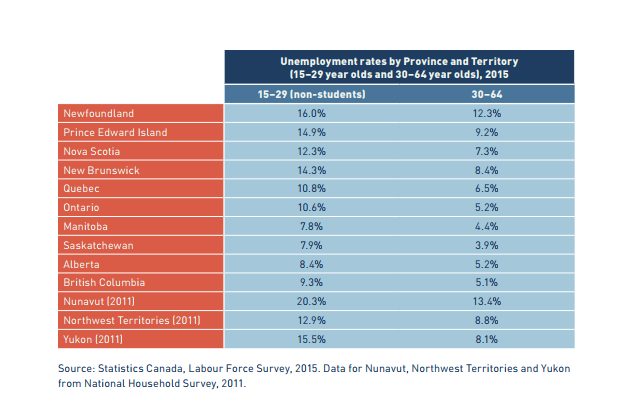
Despite the decline in full-time work over the past several decades, young people in Canada are more likely to be employed on average than youth in the G7 and other OECD countries. Participation rate Employment rate Long-term unemployment rate (%) - 2015 (%] - 2015 (%) - 2015 Canada 64.2 55.8 5.1 Australia 67.3 58.5 18.0 France 36.9 27.8 28.8 Germany 48.8 45.3 22.5 Italy 29.0 17.3 55.7 Japan 43.0 40.7 25.0 United Kingdom 62.0 52.5 21.9 United States 55.0 48.6 11.4 DECD Average 47.2 40.1 21.8 Source: OECD, Ages 15 to 24, Annual Labour Force Statistics (2015). *Share of unemployed persons (15 to 24] who have been unemployed for one year or longer.Unemployment rates by Province and Territory [15-29 year olds and 30-64 year olds), 2015 15-29 (non-students] 30-64 Newfoundland 16.0% 12.3% Prince Edward Island 14.9% 9.2% Nova Scotia 12.3% 7.3% New Brunswick 14.3% B.4% Quebec 10.8% 6.5% Ontario 10.6% 5.2% Manitoba 7.8% 4.4% Saskatchewan 7.9% 3.9% Alberta 8.4% 5.2% British Columbia 9.3% 5.1% Nunavut (2011] 20.3% 13.4% Northwest Territories [2011) 12.9% 8.8% Yukon (2011] 15.5% 8.1% Source: Statistics Canada, Labour Force Survey, 2015. Data for Nunavut, Northwest Territories and Yukon from National Household Survey, 2011
Step by Step Solution
There are 3 Steps involved in it

Get step-by-step solutions from verified subject matter experts
 Study Help