







Question: frontier is (a) Decreasing; convex to the origin. (b) Increasing; convex to the origin. (c) Constant; convex to the origin. (d) Variable; convex to the
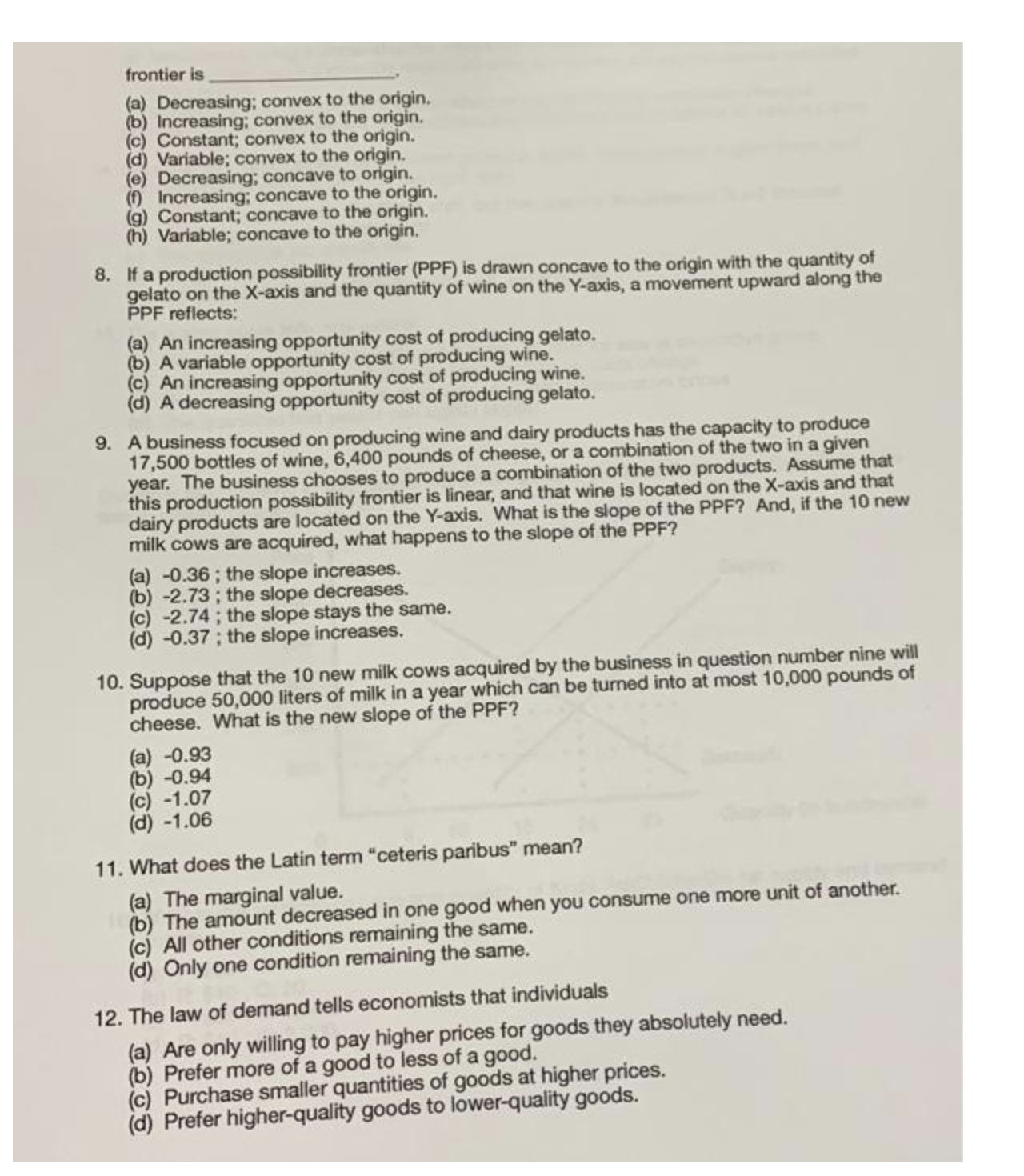
frontier is (a) Decreasing; convex to the origin. (b) Increasing; convex to the origin. (c) Constant; convex to the origin. (d) Variable; convex to the origin. (e) Decreasing; concave to origin. (f) Increasing; concave to the origin. (g) Constant; concave to the origin. (h) Variable; concave to the origin, 8. If a production possibility frontier (PPF) is drawn concave to the origin with the quantity of gelato on the X-axis and the quantity of wine on the Y-axis, a movement upward along the PPF reflects: (a) An increasing opportunity cost of producing gelato. (b) A variable opportunity cost of producing wine. (c) An increasing opportunity cost of producing wine. (d) A decreasing opportunity cost of producing gelato. 9. A business focused on producing wine and dairy products has the capacity to produce 17,500 bottles of wine, 6,400 pounds of cheese, or a combination of the two in a given year. The business chooses to produce a combination of the two products. Assume that this production possibility frontier is linear, and that wine is located on the X-axis and that dairy products are located on the Y-axis. What is the slope of the PPF? And, if the 10 new milk cows are acquired, what happens to the slope of the PPF? (a) -0.36 ; the slope increases. (b) -2.73 ; the slope decreases. (c) -2.74 ; the slope stays the same. (d) -0.37 ; the slope increases. 10. Suppose that the 10 new milk cows acquired by the business in question number nine will produce 50,000 liters of milk in a year which can be turned into at most 10,000 pounds of cheese. What is the new slope of the PPF? (a) -0.93 (b) -0.94 (c) -1.07 (d) -1.06 11. What does the Latin term "ceteris paribus" mean? (a) The marginal value. (b) The amount decreased in one good when you consume one more unit of another. (c) All other conditions remaining the same. (d) Only one condition remaining the same. 12. The law of demand tells economists that individuals (a) Are only willing to pay higher prices for goods they absolutely need. (b) Prefer more of a good to less of a good. (c) Purchase smaller quantities of goods at higher prices. (d) Prefer higher-quality goods to lower-quality goods
Step by Step Solution
There are 3 Steps involved in it

Get step-by-step solutions from verified subject matter experts
 Study Help