







Question: f(x)=0 by the bisection method: SUBROUTINE BISECT(F, N1, R, KERROR, NEND, XEND, FXEND, VITR, VX, VFX) where the following input parameters are supplied: F=N1=R=nameofagenericfunctionf(x)tobesolvedmaximumnumber+1ofiterationstobeperformedaone-dimensionalarrayofrealvariables;R(1)=x=startingvalueofxR(2)=xmin=tolerancelimitforxR(3)=fmin=tolerancelimitforf(x)R(4)=xlower=lowersearchrangeR(5)=xupper=uppersearchrange and
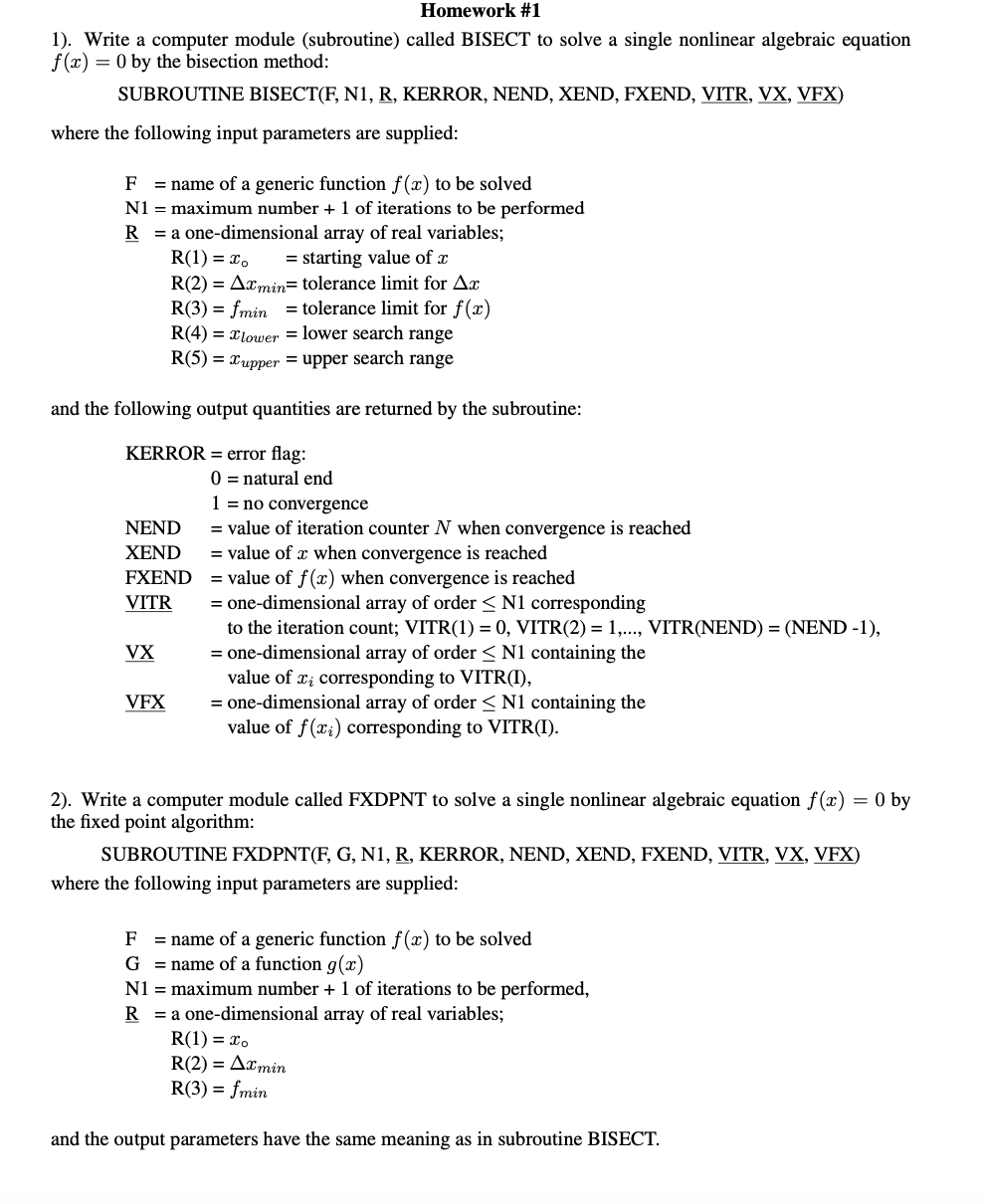
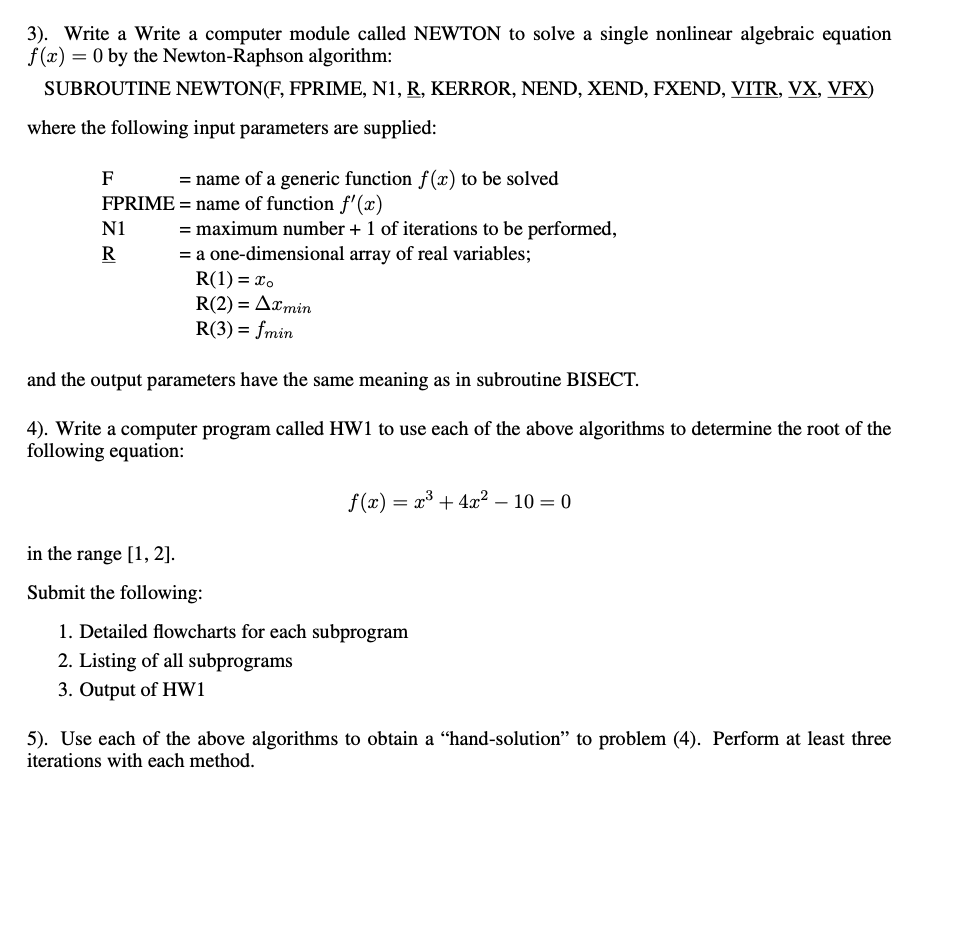
f(x)=0 by the bisection method: SUBROUTINE BISECT(F, N1, R, KERROR, NEND, XEND, FXEND, VITR, VX, VFX) where the following input parameters are supplied: F=N1=R=nameofagenericfunctionf(x)tobesolvedmaximumnumber+1ofiterationstobeperformedaone-dimensionalarrayofrealvariables;R(1)=x=startingvalueofxR(2)=xmin=tolerancelimitforxR(3)=fmin=tolerancelimitforf(x)R(4)=xlower=lowersearchrangeR(5)=xupper=uppersearchrange and the following output quantities are returned by the subroutine: 2). Write a computer module called FXDPNT to solve a single nonlinear algebraic equation f(x)=0 by the fixed point algorithm: SUBROUTINE FXDPNT(F, G, N1, R, KERROR, NEND, XEND, FXEND, VITR, VX, VFX) where the following input parameters are supplied: F=G=N1=R=nameofagenericfunctionf(x)tobesolvednameofafunctiong(x)maximumnumber+1ofiterationstobeperformed,aone-dimensionalarrayofrealvariables;R(1)=xR(2)=xminR(3)=fmin and the output parameters have the same meaning as in subroutine BISECT. f(x)=0 by the Newton-Raphson algorithm: SUBROUTINE NEWTON(F, FPRIME, N1, R, KERROR, NEND, XEND, FXEND, VITR, VX, VFX) where the following input parameters are supplied: FFPRIME=N1R==nameofagenericfunctionf(x)tobesolvednameoffunctionf(x)=maximumnumber+1ofiterationstobeperformed,aone-dimensionalarrayofrealvariables;R(1)=xR(2)=xminR(3)=fmin and the output parameters have the same meaning as in subroutine BISECT. 4). Write a computer program called HW1 to use each of the above algorithms to determine the root of the following equation: f(x)=x3+4x210=0 in the range [1,2]. Submit the following: 1. Detailed flowcharts for each subprogram 2. Listing of all subprograms 3. Output of HW1 5). Use each of the above algorithms to obtain a "hand-solution" to problem (4). Perform at least three iterations with each method
Step by Step Solution
There are 3 Steps involved in it

Get step-by-step solutions from verified subject matter experts
 Study Help