







Question: G.1) Using the convolution integral to go after formulas for some simple unforced and forced oscillators G.1.a) Damped, unforced Here's a plot of the solution
![the solution unforced damped oscillator y" [t] + 0.3 y, [t] +](https://dsd5zvtm8ll6.cloudfront.net/si.experts.images/questions/2024/09/66f451d742276_76666f451d6b407b.jpg)
![4.2 lj: 0 with y[0] = 1 and y'[O] = 1.5 ;](https://dsd5zvtm8ll6.cloudfront.net/si.experts.images/questions/2024/09/66f451d7ef3eb_76766f451d76ffea.jpg)
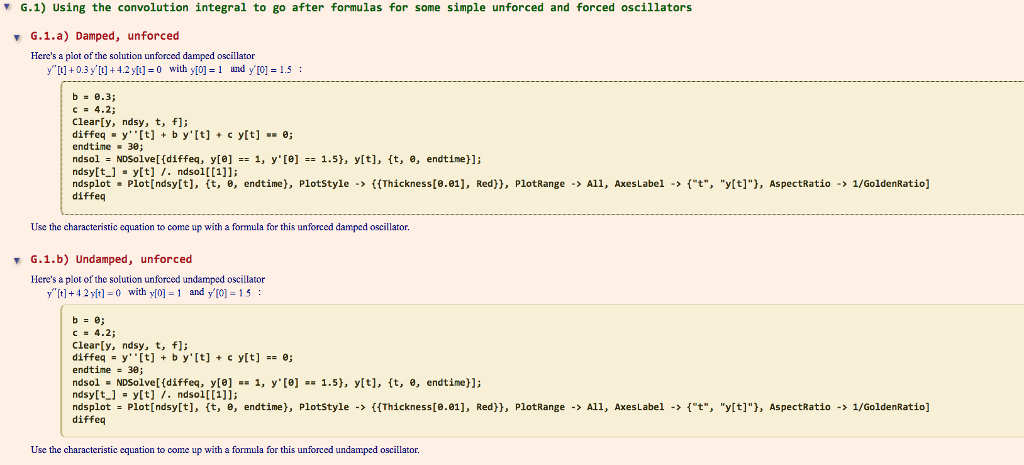
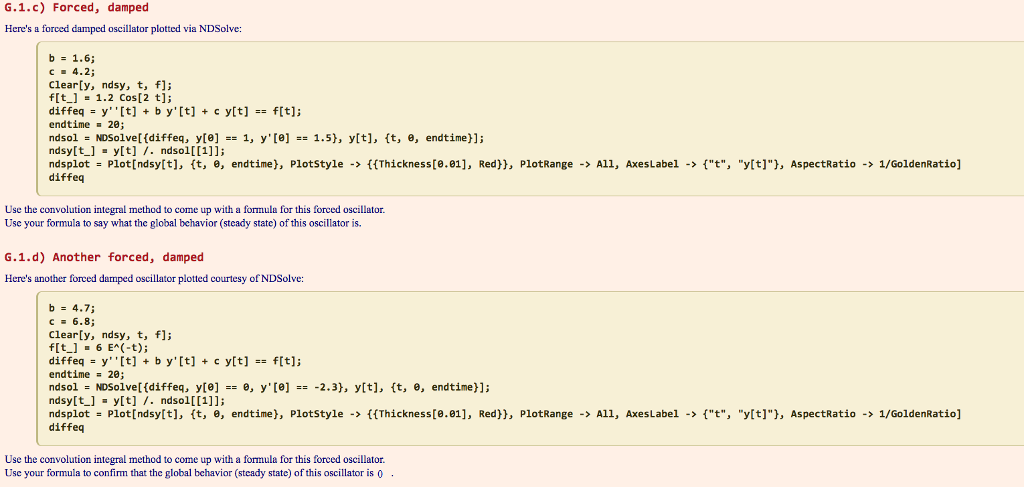
G.1) Using the convolution integral to go after formulas for some simple unforced and forced oscillators G.1.a) Damped, unforced Here's a plot of the solution unforced damped oscillator y" [t] + 0.3 y, [t] + 4.2 lj: 0 with y[0] = 1 and y'[O] = 1.5 ; b = 0.3; c = 4.2; Clear[y, ndsy, t, f]; diffeq-y' '[t]+b y'[t] c y[t]e endtime 30; ndso1 = NDSolve[{diffeq, y[b] == 13 y' [b] 1.5), y[t], {t, e, endtime)); ndsy[t ] y[t] /. ndsol[[111 ndsplot . Plot[ndsy[t], {t, e, endtime), PlotStyle-> {(Thickness(e.e1], Red)), diffeq PlotRange-> All, AxesLabel .> {"t", "y[t]"), AspectRatio-> 1/GoldenRatio Use the characteristic equation to come up with a formula for this unforced damped oscillator. G.1.b) Undamped, unforced Here's a plot of the solution unforced undamped oscillator y" [t] + 4 2 yli-0 with v[0] = 1 and y'[O] = 1 5 : c = 4.2; Clear[y, ndsy, t, f]; endtime 30; ndso1 = NDSolve[{diffeq, y[e] == 1, y' [e]s. 1.5), y[t], {t, e, endtime)); ndsy[t_] = y[t] /. ndso1[[1]]; nds plot Plot[ndsy[t], {t, , endtime), Plotstyle-> {{Thickness[e.e1], Red)), diffeq PlotRange-> All, Axes Label-> {"t", "y[t]"), AspectRatio-> 1/GoldenRatio] Use the characteristic equation to come up with a formula for this unforced undamped oscillator
Step by Step Solution
There are 3 Steps involved in it

Get step-by-step solutions from verified subject matter experts
 Study Help