



Question: Gaining competitive advantage often boils down to getting your product into the hands of consumers more efficiently, which is to say at a cheaper price
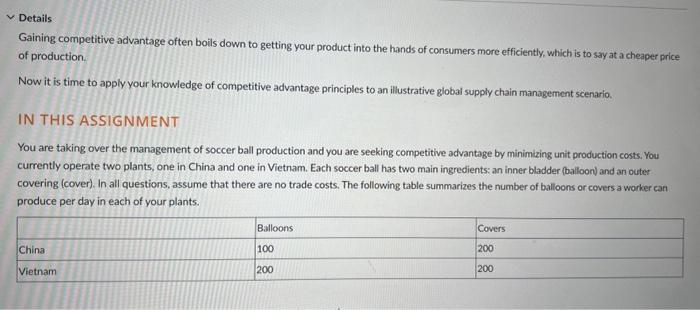

Gaining competitive advantage often boils down to getting your product into the hands of consumers more efficiently, which is to say at a cheaper price of production. Now it is time to apply your knowledge of competitive advantage principles to an illustrative global supply chain management scenario. IN THIS ASSIGNMENT You are taking over the management of soccer ball production and you are seeking competitive advantage by minimizing unit production costs. You currently operate two plants, one in China and one in Vietnam. Each soccer ball has two main ingredients: an inner bladder (balloon) and an outer covering (cover). In all questions, assume that there are no trade costs. The following table summarizes the number of balloons or covers a worker can produce per day in each of your plants. 6. You are following a cost minimizing production strategy. At the moment, it is cost minimizing to produce balloons in Vietnam and covers in China. Your assembly plant is located in Vietnam. In China, a worker can assemble 200 soccer balls per day. In Vietnam, a worker can assemble 300 soccer balls per day. Outputs per worker for balloons and covers are indicated in the table above. Due to labor market programs, however, wages in Vietnam are increasing relative to wages in China. Which part of production do you expect is first to move from Vietnam to China balloons or assembly
Step by Step Solution
There are 3 Steps involved in it

Get step-by-step solutions from verified subject matter experts